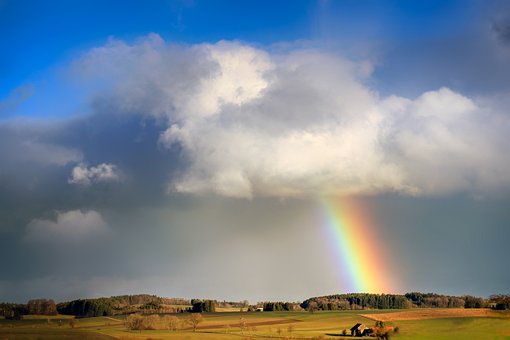
An office with a view. Or maybe it’s time to pack it in and go work from Italy….


What’s that you say…work from Italy? Well according to lonelyplanet.com

If you’re a remote worker looking for a change of scene, consider the possibility that before long you could be working from the sunny terrace of a hilltop town or beachside city in Italy. Italy’s government is planning to launch a new “digital nomad” visa to encourage foreigners to spend a year working there remotely. According to The Local, a government decree was first introduced in January and voted into law on March 28.

The idea of a digital nomad visa is a great one. And there are lots of great companies that are embracing full remote. If you can handle the difficulties of the time zones and you have some Italian in you, then maybe Florence is in your Future. Andiamo!

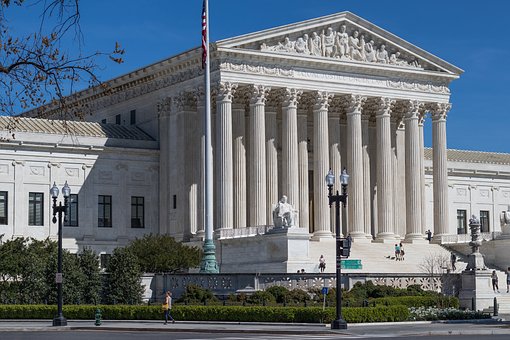
The worst of the Supreme Court of the US?


With all the news concerning the US Supreme Court, I did some digging to see how the current court measures up against its predecessors. Here some pieces I found on the worst decisions ever made:

And here are two articles on the worst members of that court:

Judge for yourself. 🙂


How math can help you flip burgers (or what I find interesting in math and sciences, July 2022)

Last week  was a big one for math, with the Fields Medals being announced. As The New York Times explained:

Four mathematicians whose research covers areas like prime numbers and the packing of eight-dimensional spheres are the latest recipients of the Fields Medals, which are given out once every four years to some of the most accomplished mathematicians under the age of 40.

That piece in the Times goes in depth on each of the winners and is worthwhile.

On a lighter side, here’s a story on how Mathematics can help solve this conundrum:

Should you flip a burger once or lots of times? A mathematician has calculated an answer.

. If you love math and burgers, it’s a must read. 🙂

Other good things I’ve been reading / checking out:

On smarter cities/better cities and the death of certain visions of the city

I am a fan of smarter cities. I was actually part of a group of technologists from IBM who wrote a detailed guide on how to design well performing systems for smarter cities. I was hopeful at the time that we could help governments make lives better for their citizens by using technologies wisely.

I think that is key: the technologies should help governments, not restrict them; the technologies should make the lives of citizens better, not worse. That key idea is what I thought of when I read this piece, Toronto wants to kill the smart city forever in MIT Technology Review. I don’t think Google had that as their key idea: if they did, they didn’t communicate it effectively. As a result, their vision of the future died, at least in Toronto.

Another vision of the cities that is dying is the suburban office park. There are many of them on the outskirts of places everywhere. The story of this one in particular is likely true for any park you encounter as you drive on the edge of a city like Toronto: Lonely Last Days in the Suburban Office Park – The New York Times.

As for other visions of future, WeWork is still hanging on in major cities. Perhaps that vision — of young professionals living and working in the downtown core –will endure for a while. To read publications like BlogTO, you would think so. We shall see.


On rethinking work

Work takes up a significant portion of your life. To me, it is something we should always be examining, if we care about our lives.

This is especially the case during this pandemic. I think we all have been examining work as a result of  how we have had our working lives disrupted. That’s a good thing.

I expect employers are going to want us to resume working as if it were the Before Times. Maybe you are one of those employees who wants to go back to that time. Maybe you aren’t.

All that is to say that I recommend you read these two pieces as you reexamine your work life:

We sometimes need prompts to help us think about things. Those two pieces will help with that.

Thinking about your work life is thinking about your life in general. A worthwhile thing to do.

It’s Sunday. Here are nine pieces to mull over this afternoon.

Sure you can make yourself busy on this warm summer weekend. Or you can chill for a bit and read one of these thoughtful pieces. I know which one I am going to do. 🙂

  1. Here’s a piece on the joy of Latin. Really.
  2. 100% this: The Case for Killing the Trolley Problem
  3. Worthwhile: Piketty on equality.
  4. This is a weak piece that tries to link AI to colonialism but fails to make the case:  AI colonialism.
  5. Do you have siblings? Read this:  How Your Siblings Can Make You Happier.
  6. Worth chewing on:The limits of forgiveness.
  7. On one of our oldest technologies: the importance of wood .
  8. Dive into this list of common misconceptions.
  9. Finally, this piece on  Alexa with the voice of dead people will get you thinking.

The Drone-Jellyfish wars and more (today in robot news)

Man, what I would have given to have these Jellyfish drones monitoring my beach when I was a kid. I hated jellyfish! Still do. Kudos for the folks who came up with this. (I don’t think the drones actually fight the jellyfish, in case you were concerned about this due to my misleading title. :))

Here on land, if you are keen to have a Boston Dynamics dog robot of your own, now you can. Click on that link for more details.

On Liz 2 and Chuck too. (Monarchy Watch)


The Queen of England continues to be well loved by many, both in England and abroad. Even in TV series like The Crown, she comes across well, unlike many others in it. Fine and good.

But we will all have to face a choice once the Queen dies. To make that choice, I thought these pieces are worth bearing in mind:

August 6, 2022: you would have thought after literally being caught red handed holding the bags of cash, that Prince Charles would be embarrassed enough to not do it again. You’d be wrong. Here he is taking money from the bin Laden family. Amazing.

Meanwhile schools are renaming themselves so they are no longer associated with that other disgraced royal, Prince Andrew.

September 8, 2022: the Queen has passed away today. The new monarch is Charles III.

February 28, 2023: Well it hasn’t taken too long for King Charles to start wading into political matters in a big way, this time on Northern Ireland. I expect we will see more of this, alas.


Devs! Could your next online database be a spreadsheet?

If the thought of your next online database being a spreadsheet sounds ridiculous, consider this. Yes, I know, there are times when the only thing that will do the job for you is a highly scalable, highly available relational database. Certainly, there are other times when a NoSQL database with millions of records is the only way to go. That aside, there is likely many times when you need to store one table with hundreds of records or less. In that case, consider using an online spreadsheet from someone like Google.

If you write code to store data in a spreadsheet, one of the key advantages is that you and others can then interact with that data via spreadsheet software. You don’t have to run special ETL programs to get that data there. You have all the power you need. Plus the code to interact with something like Google Sheets is much simpler than the code to interact with something like AWS’s DynamoDB. I know…I have done both.

For more on this, check this out:Google Sheets API using Python : Complete 2021 Guide. It could be just the thing you need.

How to Download Apps on Your Old iPad and iPhone in 2022

If you happen to have an old iPad and you are thinking of using it, you will find this post of interest.

Like you, I have a very old iPad. It still works fine. However, one of the problems with old iPads is that Apple limits them in terms of upgrading the iPads operating system (iOS). My device cannot upgrade past iOS 9.

The problem with having an older version of iOS is this: if you try and download apps for it from the App Store, you will get message after message saying this application needs a later iOS to download. There are a few apps that you can still download directly, but not many, and not the common ones you likely use and want.

There is a work around for this problem. (I found out about it through the video below.) First, you download the apps you want on a iOS device that has a new OS. I did this on my iPhone. Then you go to your old iPad and look for apps you purchased. Voila, the app you just downloaded is there. NOW, when you try to download it, the App Store will say you don’t have the right iOS, BUT it will ask if you want to download a backlevelled version. You say YES and now you have the app running on your iPad.

This will only work for apps that have been around for a long time. So I was able to download apps like Twitter and CNN, but not Disney+. Still you can get quite a few apps downloaded that way, and suddenly mine (and soon your) iPad is much more useful.

For more on this, watch the video.

Thanks, Jishan.


On Obi-Wan Kenobi

I have been a fan of Obi-Wan Kenobi since the first Star Wars, and I’ve been a fan of Ewan McGregor’s acting since his first film. So I was generally pleased with the  Obi-Wan Kenobi series on Disney+. If you’re the same way, I highly recommend you watch it.

Like The Mandalorian, I enjoyed having the chance to see more of the Star Wars universe with characters I’ve come to know and love over time. I thought the acting and directing and visuals all good. My main complaint is that both series played it safe. There is no compelling arch and the tension is low. I compare that to two TV series I’ve recently loved: Slow Horses and The Bear. They had me hanging on the edge of my seat. Not so with these Star Wars series. They are good, but they could be so much better.

The folks who made the video in this post sums up my thoughts better than I can! Also this is a good review.

Would I watch another season of Obi-Wan? For sure! And more from the characters that make up the original trilogy. Let’s hope Disney can put them in the hands of great — as opposed to good — writers.


On July 4th, here’s some links on politics to consider

Like many people, I am riveted to what is happening in the USA lately. It seems to be coming undone as right wingers try and pull the country to a place that will be bad for Americans and in some cases bad for the world. To support that opinion, here’s some links I’ve recently collected. (As well as other links related to politics in general.)

Jan 6th: First up, there is the January 6th committee investigating the insurrection that happened on that day. Mike Pence featured prominently in the beginning, leading to pieces like this, Why Democrats Should Honor Mike Pence, and this and this. Then there were others, like  Rusty Bowers in Arizona.  More on the role of the GOP in the hearings. I respect all those who did their job/duty and pushed back on Trump and those who tried to subvert democracy. I don’t think we need to make them all into heroes, but we should respect their courage and determination. And who knows, but here’s how Merrick Garland might play into this.

Trump: On the other side, here’s a piece on Trump’s legal defence. A key player, Rudy Giuliani used to be looked up to. Hard to believe now. This piece explores his decline. Here’s a piece on the Congresswoman Nancy Mace and limits of Trump’s influence.  Here’s Bob Woodward and Carl Bernstein comparing Nixon and Trump in terms of corruption.

Media: As an aside, this was good:  Bob Woodward explains key scenes in All the President’s Men. This was not so good: The Washington Post’s social media meltdown. Finally, people who are political junkies might like this:  The Rise and Fall of the Star White House Reporter.

The right, SCOTUS, and Roe: To understand what is happening in the US, you need to understand the Religious Right. This helps with that: The Real Origins of the Religious Right. But it helps to know what other players are up to as well, such as Peter Thiel. Or this $%&*, Tucker Carlson.

Which leads to the overturning of Roe vs Wade by the Supreme Court of the US (SCOTUS). Two pieces on that: the Roe opinion and the case against the Supreme Court of the United States and SCOTUS’s argument for overturning Roe v Wade and Casey. Relatedly, this piece was wrong: The leaked draft Roe opinion is a disaster for the Supreme Court. They lived.

Other things worth reading: More on SCOTUS and how they are dishonest in their judgments; this oped, A Requiem for the Supreme Court After Roe’s Demise; and this, Decades Ago Alito Laid Out Methodical Strategy to Eventually Overrule Roe.

To get more of a handle on this, I read these  pieces trying to understand what happens next in the US by these studies of  Oklahoma and Ireland. Here’s a piece on how legislatures play into this. Here’s how right wing extremists will be collecting data potentially to go after women seeking abortion. Finally, this on the doctrine of potential life and what’s wrong with it.

Politics and Tech: here’s four pieces on how tech intersects with politics:  1) On period trackers, 2) Microsoft reportedly censors searches for politically sensitive Chinese data, and 3) Canada and how Russian hackers come after it and 4) The Surreal Case of a C.I.A. Hacker’s Revenge.

Generally: the war is still ongoing in Ukraine. Here’s two pieces on it: here and  here. Elsewhere in Europe: Hungary: where replacement theory reigns supreme. And to wrap up: How Asian Civilizations Will Change The World Order….nope;  The Meaning of Machiavelli.…Yep;  For Tens of Millions of Americans the Good Times Are Right Now….maybe?

If you’ve read this far, thanks. All comments are moderated and any I deem thoughtful I’ll approve. The rest go in the trash.

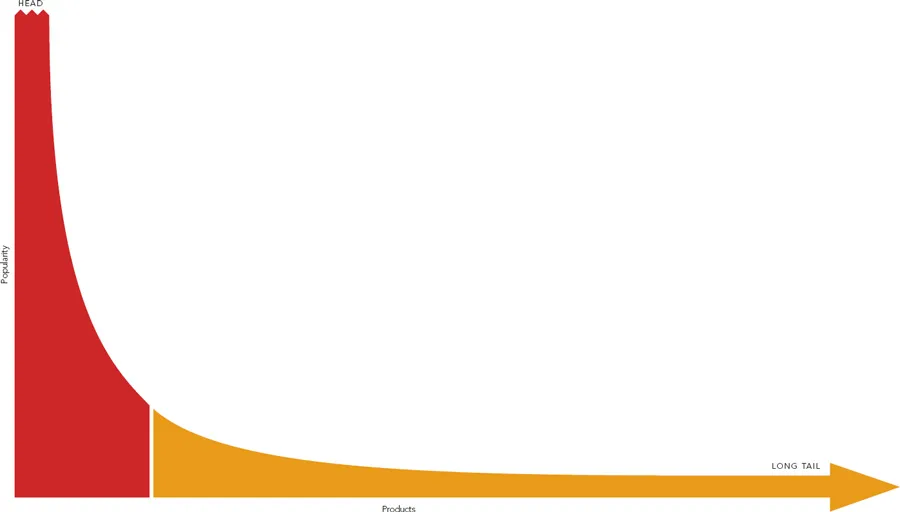
Was the Long Tail a Lie? Ted Gioia’s thoughts and mine

I can’t say if it was a lie. Maybe it was a fairytale. Something too good to be true but something many of us including me wanted to believe in. Whatever your thoughts,  I recommend you read this strong critique on it: Where Did the Long Tail Go? by Ted Gioia. If you are a true believer, Gioia will get you rethinking it.

As for me, I think part of the problem is that online services nudge or even push us to the short tail. There are advantages to them when it comes to selling us more of the short part of the curve in red. We need services and aggregators to get our attention to spiral outwards and look at things we never considered before. Spotify still does that to an extent when it builds me playlists.

Another part of the problem is the willingness of people to get out of their comfort zone and explore the long tail. Again, Spotify will recommend music lists to me, but I often find myself sticking with the tried and true. Services need to better encourage people to try new things or make it easier to try new things.  Give people options, but in a smart way. I know it can be done. I hope it will be done.


For anyone needing medication in the USA, you need to check this out.

For anyone needing medication in the USA, you need to check out this service provided by the billionaire Mark Cuban: Cost Plus Drugs. They cover a wide range of medication and they clearly illustrate how they go about doing it.

Kudos to Cuban for doing this. It’s a highly practical and substantially useful service for people. I hope it saves people a ton of money. More importantly, I hope it saves and extends the lives of many in the USA.

Kubernetes and Clouds and much more (What I find interesting in tech, July 2022)


Since April, here are a ton of links I found useful while doing my work. Lots of good stuff on Kubernetes and Cloud (both IBM’s and AWS’s); some cool hardware links; some worthwhile software links. Plus other things! Check it out.

Kubernetes: plenty of good things here to explore if you are doing things with Kubernetes like I was:

Terraform: Relatedly, I was doing work with Terraform and these were useful:

IBM Cloud: one of the two clouds I have been working with. Alot of the work was Kubernetes on IBM Cloud so you’ll see some overlap:

AWS: I work on alot of cloud providers. Mostly IBM Cloud but others like AWS

Software: some of these were work related, but some are more hobby oriented.

Hardware: the pickings are few here

Finally: here are an odd assortment of things worthwhile:

The end. Here’s my last highlights and ramblings (a newsletter, in blog form, June 2022 edition)

Hey there! Yes, this is my last newsletter in blog form. My first edition of Highlights and Ramblings (a newsletter, as such) was in March of 2020, the beginning of the pandemic. When I started I wanted to provide:

a list of  random items I’ve been stashing away while working from home in this time of social distancing and the pandemic. Initially my goal was to create a newsletter, and perhaps I still will create one. Most of the newsletters I get, though, read like blog posts. That’s fine. But then why do I need to create a newsletter, when I can just post here. Plus, it will save you another thing to deal with in your inbox. Read when you have nothing else to read.

That was my goal. But pretty soon (as early as June 2020) these monthly posts transformed mostly into what was happening pandemic wise. In that month I noted it was…

…a weird time in the pandemic: in parts of the world, the worst is behind them (e.g. parts of Europe)

“The worst is behind them”. How little did I know! In fact, as the months passed, things grinded on with wave after wave of infections. But there was also progress, as I highlighted a year later in June of 2021 :

Canadians continue to ramp up on getting vaccinated. 30% of the population has been fully vaxxed, including yours truly. Well done!

And now it’s been a year later and most Canadians have not only been vaccinated but boosted. Some — like me — double boosted! And many of us — me again! — got COVID anyway. Got COVID and lived and stayed out of hospitals. Not great but good nonetheless.

Societally, we have shifted in our stances. From lockdowns to free travelling and association. Restaurants are full. People are still working from home (although some bullies like Elon Musk are telling staff that ‘remote work is no longer acceptable’). People are still wearing masks. Ottawa even announced the end of troubled COVID Alert app this month. All in all, it feels like the pandemic is over.

But it is not over.  COVID-19 is still out there mutating and people are still getting sick and in some cases dying. It hasn’t gone away, only our extraordinary approach to it has. I don’t know what will happen in the fall. No one knows. Many have beliefs. Some are wondering if and when will COVID-19 be endemic? We will just have to do our best and see.

With that, I think it is time to retire this “newsletter”. Truth is, I don’t have much news to share on a monthly basis that you don’t already know. I’m never go to get rich or gain a big following that way. It’s fine. And not having a monthly deadline is a relief.

Unless  the pandemic was to be medically and socially disruptive, it will stay done. What I do plan to do is just randomly writing my ramblings posts on general topics. We will see. In the meantime, a list of all my newsletters is here. If nothing else, it’s a somewhat interesting plague journal.

Plenty of things have happened in this period. The worst of people (e.g. Putin, Trump) did their worst and left unpunished. The better people (Biden) did their best, only to be unappreciated. Economies recovered, but inflation sprung up. With luck and strong action, in a year from now the war in the Ukraine and worldwide inflation will be positively resolved. One hopes.

Besides newsletters, the other fad of the pandemic  was cryptocurrencies, NFTs, Web3 and all that nonsense. Now with the coming of crypto winter, we may hear less of that. There was also Wordle. Some of you are still playing Wordle, though it seems less so. (if you are, click here to help your score).

We will go on. Thanks to all of you who have read these pandemic ramblings over these many months. If you want to continue to keep up to date on what is happening with Covid, I recommend this newsletter from Eric Topol called Ground Truths. As for me, look here for my (non-pandemic) ramblings and other posts. Take care. Stay well.

 

The King of Jerusalem, and other Ghost Kings haunting Europe and the World

I’ve written about European Royalty, specifically on  the nine kings at Buckingham Palace at the beginning of the 20th century.

Much has changed since then. Most Kings are gone. You might even think that may of their descendants have disappeared from the world. They have not, as this piece by Helen Lewis shows: Among Europe’s Ex-Royals – The Atlantic. It’s an odd but good piece about what the Hapsburgs and their ilk are up to. They’re still around, haunting Europe like ghosts. Some have even come close to regaining their thrones and property. Others have hopes of leading their nations once again as Kings.

I suspect these aristocrats will forever be hanging around, waiting for a chance to reclaim something or other. After all, the current King of Spain also claims the title of  King of Jerusalem, a role that disappeared in the days of the Crusades! I am fascinated by that role in particular. I mean, the idea of anyone from Europe being King of that city is absurd. Yet the claim remains. Just like their other claims will last well into the Third Millenium.

On Fountain, and the power of Duchamp, a century later

I witnessed the power of Duchamp recently when I came across the above piece at Tate Modern in London. There was an show of surrealism with dozens of works, but that work, Fountain, had people stopping and talking as they came across it. The talk was a mix of shock and humour and admiration of the chutzpah of it.

Fountain is coming up on its centenary. Despite a century of art, this readymade still has the power to have people talk about art and aesthetics in a way few other pieces can do. It’s remarkable to me that an object so low in everyday status has such a high place in the history of art. Perhaps that’s part of its power. I think Duchamp would smile at that.

For more in the history of the piece, see this.

The great Starbucks retreat

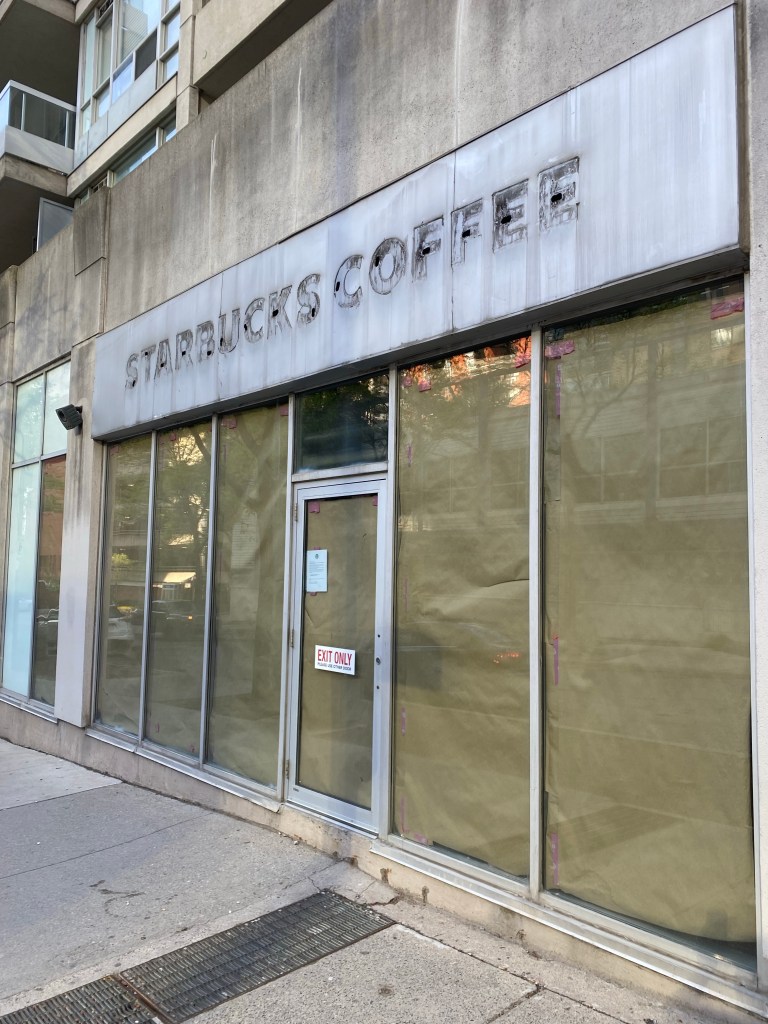
For most of the pandemic, food/bev businesses worked hard to hang on and last through this period. Not Starbucks. They did the opposite. As soon as they could, it seems they shut down their locations. Locations that had barely been open a few years were shuttered. Even this location above, on Eglinton Avenue just east of Yonge in Toronto closed up despite a steady flow of customers even during the pandemic. 

Apparently at the start of the pandemic their goal was to close 400 stores over 18 months.  I would not be surprised if more than that closed. 

I wonder what the fallout for all this will be? One thing for sure, the idea of getting Starbucks as a tenant will likely lose its lustre when they do come back and want to expand. Then again, given that people are reluctant to go back to the office, that expansion could take some time.

The Habsburgs, their history and genetics

Yesterday I featured a painting I took of a Dutch Still Life in the National Gallery in London. Today I want to feature one of the paintings in the Gallery with royalty as a subject. Specifically, Habsburg royalty. If you don’t know anything about the Habsburgs, you might look at this painting and say: his chin is a bit odd. If you did, you would be correct! As this piece shows, centuries of inbreeding among European royals (specifically the Habsburgs) was responsible for famous facial deformities seen in historical paintings. And so you get facial features like those above (or worse). 

This is not a terribly ancient behavior: Queen Elizabeth and her husband were third cousins. So it’s not like the Habsburgs were outliers. (See also: Romanovs.) It is a behavior that can cause terrible genetic deformities, though. Deformities that the Royal Family worried about, if the stories of the Bowen-Lyon sisters locked away are any indication.

In the end such deformities in the Spanish Habsburg led to the War of the Spanish Succession, a major turning point in Europe and the World. All due to inbreeding throughout the ages. Inbreeding you can see in the portrait above.


Still Life is underrated. Let this interactive piece help with that

Still life is underrated. You won’t see crowds of people blocking the view of paintings of food and drink and plates. That’s somewhat understandable, but also too bad. To help promote the greatness of this painting genre, I’d encourage people to take this in:  Dutch Still Life – an interactive guide from the New York Times. It’s a fantastic study of one painting and what it can tell us. What all still life can tell us, really. A feast.

(Above image of Dutch still life taken at the National Gallery in London by me.)

Two pieces on people Doing the Thing despite Difficulty

Some people find it motivating to see people doing the thing (in this case art and running) despite challenges. If that’s you, then you may find these pieces worthwhile:

I admire people struggling and working to do the thing they love, despite their physical challenges. But I don’t romanticize the physical challenge. And I wish them (and all of us) the best of good fortune in overcoming it.

Computer memory isn’t our memory and AI isn’t our intelligence


Since the beginning of the digital age, we have referred to quickly retrievable computer storage as “memory”. It has some resemblance to memory, but it has none of the complexity of our memories and how they work. If you talked to most people about this, I don’t think there would be many who would think they are the same.

Artificial Intelligence isn’t our Intelligence, regardless of how good it gets. AI is going to have some resemblance to our intelligence, but it has none of the complexity of our intelligence and how it works. Yet you can talk to many who think that over time they will become the same.

I was thinking about that last week after the kerfuffle from the Google engineer who exclaimed their software was sentient. Many many think pieces have been written about it; I think this one is the best I read from a lay person’s perspective. If you are concerned about it or simply intrigued, read that. It’s a bit harsh on Turing’s test, but I think overall it’s worth your time.

It is impressive what leaps information technology is making. But however much it resembles us as humans, it is not human. It will not have our memories. It will not have our intelligence. It will not have the qualities that make us human, any more than a scarecrow does.

A sharp critique on stoicism

It seems to me that Stoicism has had a good run recently. I have seen plenty of references to stoicism and famous stoics, and those references have been positive. So it was refreshing to come across this piece, Don’t be stoic: Roman Stoicism’s origins show its perniciousness. The whole piece is worthwhile, but the closing especially so:

The world stands in the middle of a pandemic, a climate crisis, and, in many countries, our own crises of (at least quasi-) democratic self-governance. It may be tempting to embrace a philosophy that counsels us not to be sad, not to mourn the things we’ve lost, to accept all that happens as fate, and to do our duty even as the world crumbles around us. But we should not write speeches for Nero; nor should we glorify the power of the emperor. We should mourn our families when bad things happen to them, our cities when they are threatened, our houses when they burn or flood. It is not easy to feel grief, and it is tempting to seek out exercises to suppress it. But to look around the world and feel the pain of injustice, to understand and wallow in the hurt of the natural world – this is not a sign of weakness. It is a sign of humanity, and the first step towards taking action. Because if you accept your fate joyfully, as a Stoic sage should, you’ll never try to change it.

Well said. There are times when change is impossible and suffering inevitable and in such times stoicism (and other philosophies of detachment) can help. More often than not, change is possible and suffering is optional. In those times, you need a better philosophy to guide you. Keep than in mind while reading Marcus Aurelius or Seneca.

In praise of ritual


I am not sure about this, but these two pieces argue that ritual is the thing you need to live a better life:

I can see value in ritual. But ritual can be as bad as a habit in that they both can lock you into behaviours that limit your life rather than freeing it. But read and judge for yourself.

Not that ritual is essential. Sometimes just a good habit can help. For example, the artist Charles Ray walks to Burger King every day and finds value in that.

Here’s eight good pieces reflecting the state of work these days

I wanted to say the state of work is in flux these days due to the pandemic, but I have to admit that work is always in a state of flux, regardless of what is going on in the world. Here’s eight pieces that reflect that:

  1. According to VOX,  employees don’t want to return to the office . If the pandemic had lasted less than a year, we might not have seen this. But two years later, many people have adjusted and settled.
  2. Still, some are going back to the office. It will be interesting how this looks in a year.
  3. For those working at home, try and find an employer that does not use such surveillance. Such companies do not care about you at all.
  4. If you are going to look for a new job, here’s how to get your resume past the robots .
  5. If you are considering how to balance work and non-work, here may be the best thing ever written about “work-life balance” according to Austin Kleon .
  6. Whatever you do, do not write open letters complaining about your employer, especially AT WORK. Sheesh. I know I am old, but this is a terrible idea and I am not surprised that SpaceX fired the open letter writers.
  7. Here’s a good piece on how the billable hour is a trap into which more and more of us are falling. For some jobs, the billable hour is important. But find other ways to show your value to your clients, your employer and your co-workers.
  8. And finally, whatever you do, remember that you are more than your job title. 

How to grow old, and other things I learned from my Father and his Father

My dad in 2012, around his 72nd birthday, looking over the land he would someday buy

My dad had two dreams late in life. One was to win a (relatively) big lottery, which he did. The other was to buy the property behind his house, which he did some time after winning the lottery. He had played the lottery for years and played the same numbers consistently each week. I thought he would never win but he prevailed.

When I was a child my grandfather planted new fruit trees in his yard. I remember being stunned when he said that they might yield fruit in a decade or so. I could not see the point in spending effort on something you might not get to enjoy soon, if at all.

The lottery tickets and the fruit trees were small acts in support of a belief in a better future. That better future may not come, but the only way it could come would be to take some action and increase — if only in a small way — the chance it would happen.

Fatherhood is like that. You plant roots and you try your luck and work and hope for a better future that may not come, or come after you’re gone. You do it regardless.

Sons and daughters live off the luck and the land of their Fathers and Mothers before they set off to find their own. During their stay some seeds are taken, some luck rubs off, some lessons (intentional and otherwise) are learned along the way. Then they go.

After you go, you think there is nothing left to learn. But then you are old like they were old, and you learn lessons even then. Lessons like the importance of having dreams and goals no matter how old you are. Lessons like living like you will never die and acting accordingly. Or the overriding lesson of believing in a better future no matter what. Though the person passes away, the lessons are passed on, like the fruit that falls from that long ago planted tree.

Happy Father’s Day to us Fathers, living and not. We the living have much to learn, and trees to plant. Wish us luck.

On June being National Indigenous History Month in Canada (and other links)


June is National Indigenous History Month in Canada. Here are some pieces I’ve been collecting over time that I thought worthwhile sharing.

Drinkable water for indigenous people in Canada is a serious problem that is ongoing and needs more focus from everyone. Here’s how the Government of Canada is investing in sustainable water infrastructure for Iqaluit. That’s some progress. And here’s a story on how one indigenous group solved their own drinking water problems. That’s promising. Also promising is this story on how one community at Shoal Lake that was on water advisories for 24 years now has its own award winning treatment plant. All good. We need more of this.

This piece on 5 Anishinabek First Nations in Ontario who have signed an agreement with Ottawa that would allow them to self-govern is also good to see.

The Pope will be coming to meet some of those who suffered as a result of the Residential School system. Here’s more on that from the CBC. Let’s pray for progress.

Finally, here’s a story on a fine initiative showing how one group of indigenous people are using technology to foster and maintain their culture. More on that here.

(Image link of a worker at the Shoal Lake water treatment facility.)

The beauty of the Elysée Shelving System, or not all furniture from the 70s is bad

While many of the furnishings of the 1970s should stay in that decade and never be revived, these shelves are an exception. As Designmilk.com explains, these shelves date

… back to the 70s, when Pierre Paulin was commissioned by President Pompidou to design furniture for the Elysée Palace’s private apartments, (but they were not) …. officially launched to the public until 2009 …

They make me think of the 70s, but they don’t scream it. They would work wonderfully with contemporary furniture today. Also highly expandable. Perfect for book collectors like myself.

For more on them, see: From a Palace to Your Home: The Elysée Shelving System.

On Apple, the Newton, the 90s and me

500

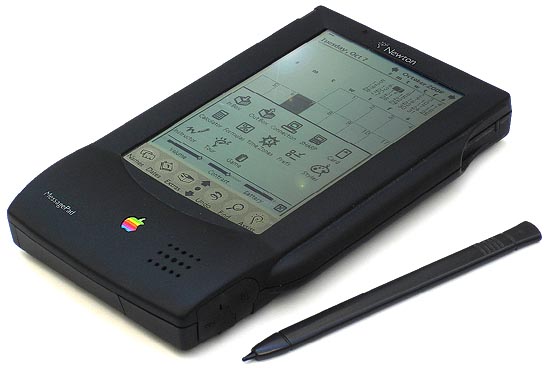
For people in this time, it’s may be hard to imagine Apple as anything other than a tremendously successful company. But in the 90s, it was the opposite. Under John Sculley and others, it was a company in major decline and all but at death’s door before Steve Jobs came back.

In some ways the Newton you see above was emblematic of that time. It was a device that Apple tried to use to regain the magic that it once had. It failed, but in some ways it was a glorious failure. (The Powerbook also came out at that time and it was a fine machine but the problems of Apple were baked into it.)

I’ve always had a fondness for the Newton, and wanted one for a long time, even though I could not justify getting one. And then Jobs returned and tossed it in the bin like so much crumpled paper. It was a smart decision, but a sad one for me.

That’s why I was really interested to read this recently: The Newton at 30. It’s a great rundown on that device. Reading it, I was happy to see that some of the original ideas found in the Newton later made their way into other mobile products from Apple. Good ideas deserve a home, even if they were never going to find that home in the Newton.

In the 90s I had a small role in developing IBM software that ran on Macs and that allowed our customers to access our IBM Global Network via a Mac. I loved building Apple Software, even if it was a nightmare at times. (Writing software for a rapidly declining company is no easy thing.) At the time I got to work on the Powerbook 1400 and 3400 and hang out at Apple and play around with the emate 300. It was a good time despite the difficulty. I never got a Newton then, thought I got close.

Later in the second decade of the 21st century I finally got to buy my own Newton! Mint condition, from Kijiji. 100+ bucks! Funny, a device that was so cutting edge when it first came out seems so limited now! It was a good reminder how fast technology moves. I was still glad to have it. It’s a wonderfully collectable device.

For more on the Newton, click that link.

Happy Anniversary, Newton. You were truly ahead by a century.

On Cabaret, 50 years later

1972 was a very good year for film. Many of the films listed at that link are now seen as classics. One of them, The Godfather, is getting much of the focus this year for its 50th anniversary. While I’m glad people are revisiting and paying attention to that great film, another great film celebrating that milestone that people should also revisit is Cabaret.

Like The Godfather, Cabaret is a period film set in around World War II. Perhaps because of that, neither film feels dated / stuck in the 70s, the way a film like The Candidate might. You can watch them as if they were made in any decade. You can also watch and rewatch both of them because they remain great, half a century later.

To get a sense of what makes Cabaret so special, I recommend this piece: Cabaret at 50: Bob Fosse’s show-stopping musical remains a dark marvel. For fans like me, here are two pieces that allow you to do a deeper dive on the film and its background: 1) Is Bob Fosse’s Cabaret An Unfaithful Adaptation? | by Keith Schnabel | Medium and 2) That Controversial Cabaret Lyric Change – The Official Masterworks Broadway Site.

If you want to stream it but don’t know how, check this out: Cabaret streaming: where to watch movie online?


The Surprise of Rousseau (be surprising too)

Henri Rousseau is the Great Outsider. An outsider to the Establishment of the Art World, from the Salons to Picasso. Despite rejection and mockery, he persevered and painted and exhibited.

Recently the Guardian featured one of his masterpieces, Tiger in a Tropical Storm (also known as Surprised!). It is seen here. (That National Gallery link provides a nice interface you can use to zoom in and out of.) You can read more about the painting here. I highly recommend you check both of those sites out.

In some way Rousseau surprised his fellow artists. Artists like Picasso were fans but mocked him too. You can read about that here (Le Banquet Rousseau: Picasso and Rousseau’s Friendship) and here (When Henri met Pablo, The Guardian).

Keep Rousseau in mind whenever you are doing something you love with little encouragement and even mockery. You may not be making something great, but you never know. Keep going nonetheless. Surprise them.


On Sheryl Sandberg

Sheryl Sandberg is leaving Facebook/Meta. I used to think at best she was weak tea. Like Eric Schmidt, she was brought in to provide a degree of professionalism and organizational skill missing from their respective companies and leadership. And like Schmidt, she left when that missing skill was no longer needed or wanted.

I think Sandberg benefitted from having someone like Zuckerberg as her boss. The worst aspects of Facebook were associated with him, while whatever nefarious actions she was taking were unrecognized. This is not to absolve him or say that she was the one to blame. It’s just to note that many of the terrible things that happened on her time at that company should also fall on her.

Right now I think her legacy will change and darken over time. It will certainly  be less bright than it was in her Lean In days. But who knows: she may pull a Bill Gates and go on to be someone who spends her time and efforts in being philanthropic and charming.

Whatever her future, here’s some things I’ve been reading now in mid 2022 about her leaving:

On my recurring pandemic dreams

During the pandemic I had a recurring dream that was unique to me. It’s not unlike the recurring dream people have about showing up to class and realizing there is a test. In my recurring dream I am travelling somewhere and I know this because I am on a boat or at an airport or in the process of transporting from A to B. But I can’t get to B. Something in the dream starts to come undone: the transportation breaks down, or I don’t have my travel documents, or I have to go back. I keep trying to prevent the breakdown, but it continues until I wake up. Or in some dreams, I say to myself: you are having the Failed Travel dream again, it’s not real.

I wonder if others have had a similar dream or their own dream during the pandemic?

I wanted to record this in case I forget that this occurred.

On the great painter, Christopher Pratt

Last week the great painter and printmaker Christopher Pratt died.

I was going to say Canadian or Newfoundland painter — for he was that — but it is better to leave off the modifiers. His greatness can stand against any painter of any time or place.  I am especially drawn to his hyperrealist paintings of roads and boats and houses. How the light in them changes, how your mood changes as you absorb them. There’s an abstraction to them, despite clearly recognizable imagery.

I’ve been a fan of his ever since I read Jay Scott write so eloquently of him back in the late 80s, early 90s and which was captured in this book, The Prints of Christopher Pratt 1958-1991 by Jay Scott; Christopher Pratt – 1991.

Canada has had many great painters. While many people say Colville is their favorite — especially when it comes to east coast artists —  I have always preferred the work of Pratt.

Though he lived and painted in Newfoundland, for decades he’s been represented by the Mira Godard Gallery in Toronto. If you want to read more about him or see his fine work, go there.

(The image above, Summer on the SouthEast, is a link to the Mira Godard website. I can just feel the heat of the east coast summer as I look at it. I can hear the drone of flies, see the brightness of the sun. It’s perfect.)


On retiring my COVID-19 reporting (for now)


Recently I was reporting COVID-19 data daily. I wrote a program called covid.py that scraped the Ontario.ca Covid web site and and pulled out data for hospitalization and cases. It was a rough but useful gauge to see how COVID was going in Ontario, and I was able to get the information in a snap.

Unfortunately the information is no longer posted on the page I was visiting with my code. The data is out there somewhere in the datasets, but I think I will reconsider things before modifying my code. It is a shame that the data is harder to get though.

All these actions by government organizations to make it harder to get data is a bit frustrating. I read people say: you should track the pandemic and make good decisions. It’s hard to do that though when the information is hard to get.

For more information and data:  Government of Ontario data sets on COVID-19 are here. Government of Canada COVID-19 information is here. More on my code, here.


On Getting Things Done

The book and system Getting Things Done (GTD) has been around for so long that I used to assume that everyone knew of it and used it. Lately I’ve been reminded that is not true.

Well, if you haven’t heard of GTD and forgot about it, this primer on it may be just the things you need to (re)acquaint yourself with it.

I have issues with GTD, but if you are someone who feels like you can never get all the things you have to do organized and get yourself feeling productive, then get using GTD. You will get more productive, for sure.

On Davis Day, and other histories of Cape Breton

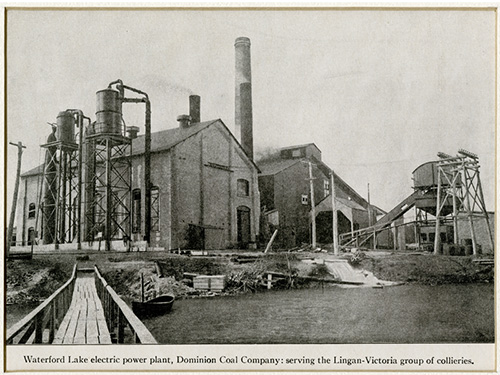
Today is Davis Day in Cape Breton. It’s now known as Miners Memorial Day, but growing up we honoured this day and thought about William Davis and all the sacrifices miners and their families suffered over the years as they struggled to live better lives. It was a solemn day. You can read more about it here: Miners Memorial Day: Davis Day | Museum of Industry. Here’s a good piece on how this day is still relevant in places like my home town of Glace Bay.

Over the last while I have been collecting these links regarding Cape Breton history which I thought worthwhile and you may as well:

(Image from a link and comes from the Beaton Institute)

The water works of Maya Lin


The last few days have been taken up with blogging about artists. Here’s one last one from Colossal: The Precious Nature of Water Ripples Through Maya Lin’s Sprawling Installations.

You may know Lin through her memorial work, but she is a brilliant artist as well. The image above is just a taste of her work featured in Colossal: you really want to go to that site to get the details.

After that, go visit her site for more fine work.