Do your kids love Lego? Then you may want Pley, a Netflix for Lego

Pley is a cool idea and much like Netflix is. You subscribe to the service, you get a new Lego kit. Once you build it and enjoy it for awhile, you send it back and they send you another one. Your kid always has new kits to build, and you avoid having their room fill up with Lego.

For more on this, check out: Cool Tools – Pley.

Some simple but good advice on managing stress

You are stressed. You decide: I need to manage it. That decision alone can help bring down your stress levels.

Your next step it to take action. If you have no idea how to do that, start here: Make stress management as routine as brushing your teeth viaThe Globe and Mail.

Teeth brushing won’t cure cavities and simple stress management techniques like these won’t cure significant problems in your life that are causing you to be stressed. But just like teeth brushing can prevent cavities, simple stress management can help alleviate some stress.

Unless you have a carefree life, these stress management techniques are worth reviewing.

Here comes Yik Yak: a mini primer (plus 2 or 3 — ok, 7– thoughts on it from me)

By now you have heard of Yik Yak (or were curious enough to click through). Here are three links that can tell you more about it:

  1. If you want to get the basics, check out this: You Asked: What Is Yik Yak? | TIME.
  2. If you are a big user of Yik Yak, you most likely are on campus. College students are where it is seems to be taking off. Like any platform, eventually you see people coming out with ways to take advantage of it. Here it was used to have a back channel for a speech Ted Cruz was giving: Ted Cruz Has Skeptics at Liberty, and They Use Yik Yak – Bloomberg Politics.
  3. And here it was used for cheating on exams! Another Use for Yik Yak on Campus? Cheating on Exams – Wired Campus – Blogs – The Chronicle of Higher Education.

My thoughts:

  1. Yik Yak is a platform. Like any platform, people using it will invent new uses for it. I expect to see Yik Yak used in all sorts of innovative ways, and I expect it will grow as a result.
  2. Yik Yak is big on college now. But it likely won’t be limited to that audience. Facebook was also once limited only to colleges. Look how that turned out.
  3. Yik Yak is partially a response to all those Privacy is Dead advocates and those saying young people don’t care about privacy. Yik Yak is anonymous, and I expect there will be more social media going this way. It’s hard to exploit users when your service does not depend so much on identities.
  4. Anonymous social media is also a dangerous thing in the wrong hands, as is illustrated in some of the examples.
  5. Social media needs to mature to a position that is not anonymous but also protects people privacy. Otherwise people will tire of being abused by one or the other and shy away from social media.
  6. I think social media and the people who create it are anywhere near that mature yet.
  7. Privacy lives. Privacy is all about control about information about your life. To say privacy is dead is to say no one has control over information about their life, which just isn’t true. What is true is that new technology will continue to come out and force you and everyone else to think about privacy and what you want to share and what you want to keep to yourself.


Thinking of upgrading your Internet connection? You should test it first

If you think your Internet connection is too slow, or you just want to upgrade it, you owe it to yourself to measure how fast it is. There are a number of ways to measure it, but I like using this: Speedtest.net by Ookla – The Global Broadband Speed Test.

Record both your upload and download speed. Ideally, do it at different times of the day, and do it for both weekdays and weekends. Once you have that information, you can decide on what services would be an upgrade to this.

Also, while speed is important, the other thing to consider when you are upgrading your service is what your monthly bandwidth usage is. Your current ISP should be able to tell you that.


An excellent set of tips to improve your life…

Can be found here: 100 Tips to Improve Your Life – 99U.

I challenge you to go through this list and not find anything here that you could apply to your own life. You will likely find at least five. If you find none, maybe your life is already perfect. 🙂

The 99U is a great source of guidance on any number of topics. I have even written some articles there.

In praise of unfinished projects

Do you beat yourself up for starting projects but not finishing them? Do you not even try to start for fear you won’t finish? If so, I recommend this article: Why Quitting is Perfectly Okay. — So, this is life. — Medium. It’s one thing I hope you finish. Everything else is optional.

Of course, finishing them is also good. Either way, you have something to gain by starting those projects.

And hey, it’s Sunday evening at the start of May: a great time to plan your projects for the week or the month. Give it a go.

How long are you going to live? Now you can find out


According to this, you have two very good rules of thumb or models you can use to determine this:

1) The heuristic bi-linear model. We made this by making the best bi-linear model a bit simpler to apply.

It goes:

If you’re under 85, your life expectancy is 72 minus 80% of your age.

Otherwise it’s 22 minus 20% of your age

2) The 50-15-5 model. This one asks you to remember some key values and then to interpolate between those values. It goes:

The life expectancies of 30, 70, 90 and 110 year olds are about 50, 15, 5, and 0.

For more, check out the link.

Some thoughts on blogging and social media with the news that Dooce is retiring

According to one big name blogger, Jason Kottke, another big name blogger, Dooce, is retiring. How big is big? According to this piece in the NYTimes.com (Heather Armstrong, Queen of the Mommy Bloggers – NYTimes.com), she is hinted at having earned $1M / year. That’s pretty good money. This comes on the heels of Andrew Sullivan, another big name blogger, who recently retired too.  From the sounds of it, Jason Kottke himself is thinking that the days of blogging are numbered. It seems the days of a very limited number of big name bloggers making good money are numbered.

Dooce, Kottke, Sullivan and others rode the wave of the golden age of blogging. Dooce and Kottke kept up the format longer than others. Sullivan, Josh Marshall, and many of the political bloggers I started following years ago, have all but abandoned pure blogging. Marshall’s TPM still retains some elements of his original blog, but his site is more like CNN and less like a traditional blog. Sullivan’s site was chronological, but it was more like a blog on steroids that turned out 30 or more posts a day from a variery of sources. Others, like Nate Silver (538), Matt Yglesias and Ezra Klein (Vox) all went off and start up variations of what Marshall did with TPM. The model of Vox and 538 is more like Buzzfeed and less like a blog.

Kottke and Dooce are good at what they do, but they also were in the right place at the right time. I admired Kottke and modelled my blog off of what he did, but in truth, there was no way my blog would ever catch his. The same goes for Dooce and her mommy blogging. They occupy the left end of the long tail, while most of us occupy the right end. That’s fine: it is great that it is possible for anyone to be able to write and have it published for free. While your writing may not be read widely, it will be read by more people than you expect. That has certainly been the case for me. When I first started, I was thrilled to have anyone read my blog. As of this post, thousands of people have read my posts over 800,000 times. I am still astonished by that.

Like much in IT, blogging hasn’t died so much as it has been displaced. One time blogging was about the only social media out there. Now, all media is social media.  There are so many choices now. Not only that, but as networks get faster, sites like YouTube and Vine and other visual sites attract more attention. Video is the future.

Blogging still exists and likely will continue to exist for some time. The fact you are reading this proves that. As well, blogging platforms like WordPress seem to be doing well. While some platforms like Posterous went away, others like Tumblr continue to attract new writers and new audiences. I expect to see people writing in this format for some time to come.

What I don’t expect to see happen is individuals making the money that Kottke and Dooce and Sullivan made. Those days are done. Perhaps people will make money blogging by doing it in conjunction with sites like Patreon.com. That’s a possibility. Also, people may use blogs as a way to promote other ways they make money.

Blogging, derived from the words “web logging”, was a way to log your thoughts chronologically on the web. It seems  old and trite now. But the need to write and the need to have others read the words that you have written will never get old. We need new and better platforms. Medium.com tried to do that. Other sites, from Google+ to Facebook to Twitter to Ello have all tried to offer some way to do that. Maybe the golden age of online writing via some platform like blogs is over, and people will write less and share less. Or maybe people are waiting for the next great platforms to start creating again.

 

Praise for “Twelve Recipes” from Michael Ruhlman and me


On his blog,  Michael Ruhlman has kind words for the book “Twelve Recipes”, by Cal Peternell. I strongly support this. I bought the book and read through it quickly, enjoying it the entire way.

I call it a book, rather than a cookbook, though it has 12+ recipes and plenty of good advice on cooking. But it is as much a biography and a series of essays as it is collection of recipes. If you want a beautiful book about food and so much more, than I recommend you pick this up.

Here a link to how to order it from Indigo and here is Amazon

If you think it is alarming that Facebook also collects what you decide not to post, then I have some news for you

If you think this is alarming: Facebook also collects what you decide not to post, tech consultant warns – Technology & Science – CBC News, then I have more news for you.

Not only can Facebook do this, but they can do other things. For example, if they wanted to, they could track where you move your mouse, even if you don’t click on something, using technology like the kind mentioned here: web page mouse tracking – Google Search.

In fact, you don’t even have to go to Facebook to have them track you: Facebook Is Tracking Your Every Move on the Web; Here’s How to Stop It.

And if you use Facebook on your mobile phone, there’s potentially even more information they can track about you.

So, lots of reasons to be concerned. I all but avoid Facebook, but it is not an easy thing to do. In addition, I don’t think Facebook is the only one that does this. They seem to be just the most notorious.


My list of 59 thoughts on privilege

I read alot about privilege. Reading about it, I end up considering the privileges I have that arise from being an educated, white, middle-class man in an affluent part of the world with a high standard of living. The flip side to that is that I also consider the priviliges I did not have when I grew up, as well as the privileges I had and no longer have.  I tried to use that to write up a specific view point on privileges, but ended up with this list of thoughts on the topic instead. I have not come to any specific conclusion on the topic. If anything, the list points to the conclusion that I need to think further on the subject. That said, I think sharing the list is worthwhile.

Some people are interesting in certain aspects of privilege: white privilege, or male privilege, or the privileges of the 1%. I am interested in privilege in general, how it comes about, what effects it has, when is it good, when is it bad, and how to manage it in a way that leads to positive social action. That interest lead to this list.

With that all said, rather than sit on it any further, here’s my  list:

1. Privilege assumes a number of things.
2. It assumes that there are at least two distinct groups: the haves and the have nots.
3. It assumes that there is a social good that one group has a surfeit in and one group has a deficit in.
4. It assumes that the social good is recognized as such by both groups.
5. Privilege is about access and the ability to acquire or maintain that social good.
6. There many small social privileges that aren’t noteworthy (e.g. the privilege of belonging to a certain club).
7. Likewise, not all privileges are universally or generally desirable.
8. Some privileges are held by a small number of haves. Other privileges are held by a large number of haves.
9. Some privilege we earn. Some we get randomly. And some we get from belonging to a certain group by default.
10. Rights differ from privileges, for in theory rights are not a social good that one group should have more than another. (In practice, this may be incorrect, but in theory it is)
11. Some privileges are fairer than others.
12. Fairer privileges usually involve things in abundance.
13. Fairer privileges are either random or universally acquirable for most in a society.
14. Unfair privileges are never random: there is a recognizable pattern whereby one group is perceived to have more access than the other.
15. Fair privileges are assumed to be accessible by method agreeable to most of society. For example, to go to university can be considered a privilege, but it can be earned in a way agreeable and accessible to most.
16. Privileges that are most unfair usually involve scarce social goods or rules that are slanted to favor a particular group.
17. Economic wealth is rare privilege. Having a home is a common privilege. Even common privileges are still privileges.
18. Higher education used to be a rare privilege. Now it is a much more common privilege.
19. The right to vote used to be a rare privilege. Now it is a right.
20. Health is not a privilege, until heath care is involved. Then it becomes partially a privilege.
21. Many would like to have the privilege of being wealthy.
22. Many would like the privilege of working for specific companies, belonging to certain occupations. being members of certain organizations.
23. Everyone has privileges.
24. It is worthwhile to consider your own privileges.
25. If you are reading this, you have quite a number of privileges, starting with the technology you are using to access this post.
26. Technology is a tool, and the ability to access tools is a social good.
27. Challenges occur when there are statistical variables associated with privileges. A white man may have a 10% chance of acquiring a particular social good, compared to a 1% chance for everyone who is neither white nor male. From the point of view of the white man, a 1 in 10 chance may not seem much of a privilege. For everyone else, his chance of acquiring the social good is ten times great than theirs and this increased likelihood is a significant privilege.
28. Being aware of your privileges can help you appreciate what you have.
29. Being aware of your privileges can help you understand the grievances of others
30. Thinking you do not have privileges means you have not thought about it enough.
31. Renouncing your privilege doesn’t necessarily result in greater fairness, especially when there are large number of people involved.
32. For some social goods, especially when there are large number of people involved, it is easier to redistribute privileges so as to be fairer.
33. For other social goods, especially when there is only a few people involved, it is less likely to redistribute privileges so as to be fairer.
34. Even social goods that seem meritocratic are to a degree unfair.
35. Social goods that are meritocratic trend towards being less unfair than others, but still have a degree of unfairness to them.
36. Not everyone can have access to every social good.
37. Meritocratic systems are based on rules, and those rules exclude people from certain social goods from the beginning.
38. Social structures reinforce privileges. Friendships and families can reduce the chances of some having access to social goods.
39. Geography reinforces privileges. Being born into neighborhoods and communities with poor or no facilities can reduce access to social goods.
40. Some privileges are more unfair than others. Privileges based on religion, gender, race, sexual orientation, age, body shape are just some of those.
41. Certain privileges we accept. Physical, emotional, and intellectual ability generally are accepted as fair, even though these are not common when the ability is very high or very low.
42. Certain privileges we used to accept we no longer do. It is less acceptable to build publicly accessible environments that cannot be accessed by people who need wheelchairs.
43. As peoples lower needs (as laid out by Maslow) are met, privileges arise in the higher needs.
44. Everyone has access to certain privileges and are barred from having other privileges.
45. Individuals and societies give some privileges higher values than others. This weighting of privileges shifts all the time.
46. Some privileges become undesirable over time. Other privileges become common. Having electric lighting was once a privilege. Now it is so common as to be no longer seen that way.
47. Some technologists believe it is possible to make all social goods abundant so as reduce priviliege.
48. Some privileges may remain privileges because the social benefits outweighs the social cost.
49. Other privileges need to be tackled and dismantled if a society is to consider itself fair and just.
50. One way to dismantle a privilege is to make access more common.
51. Making it more common is possible if a social good is not scarce.
52. If a social good is scarce, then one way to tackle the privilege is to make access to it random.
53. Another way to deal with a scarce social good is to make the criteria for accessing it fairer.
54. The challenge of fairness is judgment.
55. The other challenge of dismantling privilege is the desire of privileged groups to maintain their privilege.
56. The challenge of dealing with privilege is agreeing if fairness consists of access to opportunity or access to outcomes.
57. In achieving certain privileges, I may trade off other privileges.
58. When individuals within a group are encouraged or forced to trade off certain privileges, they may not be able to reacquire them, as others may not want to release their access.
59. Ideally a society can produce such a wealth of social goods that any tradeoffs individuals or groups make, they still feel overall good with their choices and that the society they live in is a good one.

Success doesn’t come easy for anyone, not even Elon Musk

I admire the work that Elon Musk does, be it Tesla, Space X, or other endeavours he takes on.  I also had an opinion that the success he achieves is as close to a Given as success can be. I held that option until I read this article: Elon Musk Had a Deal to Sell Tesla to Google in 2013 – Bloomberg Business. This article shows just how touch and go it was for Musk and Tesla in 2013. Among other thoughts, it reinforced in me the notion that success in challenging areas is difficult for everyone, whether it be Elon Musk or anyone.

If you are trying to accomplish something difficult, and if you think that others have it easier than you, I recommend you read this article. I also recommend it to anyone who needs to be reminded that success is never a given, but with the right effort and focus and dedication, even the most challenging type of work can be accomplished.

The last and only advice you need on how to eat

I think these rules are about the best thing I have seen on how to eat: Simple Rules for Healthy Eating – NYTimes.com.

To make it even simpler, I would boil them down to:

1) Eat less processed food, and more food you make yourself from raw ingredients

2) Eat a variety of ingredients in moderation

3) If you have to drink something, drink water

I recommend you read the NYTimes piece, though. Really good.

One of the reasons McDonald’s doesn’t offer more variety…

…is that it’s expensive for the franchisees, as this article shows: McDonald’s franchisees are furious – Business Insider. I hadn’t thought of it from the perspective, but it makes sense. McDonald’s restaurants are just part of a complex food chain (so to speak). Making changes takes an awful lot, and the cost implications are huge. If this is truly the case for McDonald’s, they may have passed their hey day.

What you should know if you are planning to learn to code

If you are going to learn to code and you are planning to stick with it, then you owe it to yourself to read this: Why Learning to Code is So Damn Hard.

It’s well written, and it has some great graphs, including this one:

I think any area of learning where you get good initial training would look similar to this. I recommend you find some mentors to help get your through the desert of despair.

P.S. Yes, I realized they borrowed heavily from Gartner’s Hype Curve. 🙂

Three takes on twitter (2015): one mine, two others by WiReD and The Atlantic

Here’s two takes on Twitter worth reading for anyone still fascinated by Twitter as a company:

My take on Twitter?

  • Twitter is gunning for revenue growth.  They are sinking any profit they make into research in order to continue to grow revenue wise. It works for Amazon, so maybe it will work for twitter.
  • As they try and ramp up their revenue growth, they are cleaning up their act and acting quicker against trolls. I’d like to think it is because they are more concerned about users, but it is just as likely that they have decided trolls are bad for business
  • New user growth is flat. I am not surprised. I barely get new users following me, and if you think about it, the same is likely true for you.
  • Interaction is dying off. I still get a fair amount of interaction, thankfully. But it is much less than it used to be. Based on some recent analysis, that seems to be the case across the board, even if you are famous. Person A tweets: Person B responds, and at most, Person A favours Person B’s tweet. I believe Twitter is becoming less of a social community and settling into being just a microblogging platform.
  • I think Tweetstorms are terrible, still.

Ten ad hoc thoughts on the Apple Watch from me

  1. It already looks like the Watch is a big success. If anything, what has surprised me is that Apple doesn’t seem to have sufficient quantity in stock to meet the demand. I am not surprised by the success: I am surprised by the breakdown** in the supply chain. (** Further reporting may show that to be not true).
  2. The timing of the Watch is perfect. What do you think will make a great present for young people as they graduate from schools and universities? Yep. Who do you think doesn’t own a watch currently? Yep, same group.
  3. The size of the Watch will likely be a non issue, now and in the future. I’d like it thinner myself, but there have been previous Apple devices that I thought were not ergonomically ideal, and they did just fine. Plus, we have become spoiled: the original iPod and iPhone slimmed down over time, but were still successful in various formats. The same will be said for the watch.
  4. The price is a non-issue too. People pay $179 (in Canada) for a Nano and $249 or more for an iPod Touch. The watch is another price point, but not all that far away from them. What is interesting is that Apple has products from under $100 (the Shuffle), to the Nano, the Touch, to iPad,  the Watch, to the iPhone, to the laptops. If you consider the Apple an aspirational product, that is smart. You can acquire an Apple product at different price points, and once you get them, you are likely to be more inclined to get the new product from them. That happened to me: I went from having no Apple devices to having a shuffle, then a touch, than a phone, then an iPad. I expect to eventually get a laptop from them too. You get used to the quality and the interoperability.
  5. The benefit of the Watch, which I have seen with my Pebble, is that I can keep aware of alerts without looking at my phone. I expect alot of people will love that.
  6. People who think the Apple Watch is just a watch likely think the iPhone is just a telephone. As we all know, the iPhone is a small computer that allows us to make phone calls but really does so much more. The Apple Watch is an even smaller computer that tells us the time but really does much more.
  7. Application developers will drive the Watch to greater success. The new device will drive new applications that couldn’t be written on other devices. The apps will make the watch go from Nice to Have to Must Have.
  8. Copycat hardware makers will also drive success. You can bet that Korean and Chinese hardware manufacturers will be coming out with their own watches soon (and some already have). Soon smart watches will be as common as smart phones.
  9. Expect an explosion of watch bands and other accessories for the watch. Also, you will see that people will own more than one Watch (something they are unlikely to do with other tech, like phones or laptops).
  10. As for the future? If you still believe in Moore’s Law like I do, eventually the Watch will not need the iPhone to work. Also, the future will only see more wearable technology, and I expect the Watch to play a big part in that.

The best restaurant in NYC and how to eat there cheaply and without a reservation

Is Eleven Madison Park the best restaurant in NYC? If you read this, Restaurant Review: Eleven Madison Park in Midtown South – NYTimes.com, you’d be inclined to think so. Regardless, it is excellent and worthy of considering a visit.

But what if you want to experience the place without having to go through the tasting menu? Worse, what if you don’t have a reservation. Well then, you need this: How to Eat at Eleven Madison Park With No Reservation and No Tasting Menu — Grub Street.

I can’t promise that will work, but it is worth considering if you want to casually experience some of the best Manhattan has to offer.


Is ICANN extortionist? On Taylor Swift and the new TLD domains like .porn

Taylor Swift (or her lawyers) have made a smart move and went out and bought some new domain names, according to Taylor Swift buys own porn site domain names ahead of expansion – People – News – The Independent. She was able to buy “TaylorSwift.porn and TaylorSwift.adult before they become available”. Microsoft, who also have good lawyers, bought Office.porn.

Now you might think: big deal…domain names are cheap. But these ones aren’t, going for $2,500 a pop. And if they are like other domains, those fees must be paid annually.

You might also think: well, it was good of them to offer the domain first to individuals before others buy them. I first thought that before I knew how much the domains cost.

Does that add up to a form of extortion? That is very hard to state categorically, and if I was pressed, I would say it isn’t. But using the logic of “if it walks like a duck, and quacks like a duck, then it’s a duck”, you might draw a different conclusion.

Whatever you call it, it makes me think it is time to replace the ICANN and the use of domain names with something much better.


On ripples in time

If you throw a stone into a lake, the ripples move in all direction. They
move back towards you and forward away from you. If the stone is big
enough, the ripples may disturb something far away from you.

Events are like that too. the event can change how you see the past, and
the event can disturb the future too.

We are constantly throwing stones into Time, constantly disturbing the
surface of it, and changing the réflexion that we see when we look into it.

A mental health first aid check list you might find useful

If you know someone is physically injured, you apply First Aid to either repair the injury or limit it until you can get further help.

Likewise, I think of this list as a form of mental health first aid: Eponis | Sinope – Everything Is Awful and I’m Not Okay: questions to ask before giving up. It’s not meant to replace professional help, if you need that, but it may be the thing you need to get you through a rough patch (speaking from personal experience).

Periscope, Meerkat, and the future of virtual tourism

If you haven’t heard, Meerkat and Periscope are two apps that allow one person to stream an event and have others watch it. For example, here is an artist streaming her work on a painting while others watch and  interact: Wendy MacNaughton paints live on Periscope My… – Austin Kleon.

It’s an interesting idea. Once people get creative, there will be all types of events that people stream, from the obvious (porn, music concerts) to things no one thought of before.

I think one of these not so obvious ones will be virtual tourism. Essentially someone will visit a place like Japan and stream the cherry blossom festival or go to Pamplona for the running of the bulls and others will watch in real time. Maybe people will sponsor the person ahead of time, or the person will wear a shirt with ads on it, or find some way to make revenue. In return, lots of people can see something they might not be able to see otherwise.

People will use Periscope and Meerkat in all kinds of ways. Expect this to be one of them.

(Image via techcrunch)

Making pesto without a recipe (and why you should)

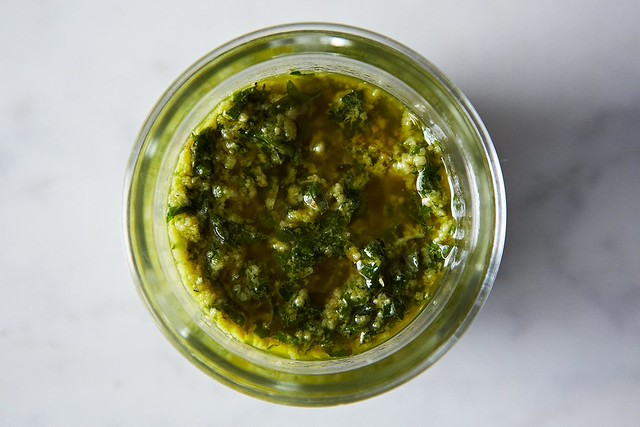
Food52 has a number of good guides to making dishes and sauces without a strict recipe, including this one: How to Make Any Pesto in 5 Steps.

Once you do it once or twice, you will more or less be making it without a recipe.

I’d encourage you to skip basil and pine nuts and go with other greens and nuts, especially greens you may have in your fridge that are about to give up the ghost. I found that the combination of the oil and the greens give the pesto it’s sauce quality, while the nuts and cheese and garlic give it the flavour. So if you don’t like garlic (really?), drop it. Likewise if you have nut allergies.  For additional flavour, add some wine vinegar, balsamic vinegar or lemon juice to taste at the end. And of course, add salt to taste.

Why you should make pesto is easy: once you have it, you can add it to food in all kinds of ways to make your food tastier. It is a very versatile sauce.

Once you have pesto, you can add it to roast meats or vegetables. I opened up a boneless pork roast, spread it on the inside, and closed it up. You could do the same with a boneless chicken breast. (Or add some to just cooked fish.) I tossed my roasted vegetables in a bowl with some pesto until they were lightly and evenly coated.

Another idea is to make a pasta sauce with 2 parts pesto to 1 part cream and warm them in a pot while you cook some pasta until it is al dente. Then drain the pasta and toss it with the sauce until the pasta is covered.

If you have some tomatoes, quarter them and lightly toss them with some pesto for an easy salad.

Or take 1 part mayo and 1 part pesto, combine, and use as a sandwich spread.

Lots of ways to use pesto. Enjoy!

(Image via a link to the Food52 post.)


What happens when Queen Elizabeth II dies?

Alot! As you can see when you read this: What happens when Queen Elizabeth II dies – Business Insider. It’s fascinating, and the number of things that will change will surprise you.

Speaking of surprises, this chart surprised me:

It is amazing to see how many other world leaders have come and gone in the era of Queen Elizabeth II.

Well worth a read.

The pros and cons of FitBits and other wearable fitness devices (plus my own thoughts)

Here’s two recent pieces on the pros and cons of wearable fitness devices.

Pro: Wearables and Self-Awareness (Personal) – NYTimes.com.

Con: Science Says FitBit Is a Joke | Mother Jones

I tend to agree with Krugman’s pro views in the NYTimes.  In a nutshell, Krugman’s view is that having a tracker like a FitBit makes it harder to lie to yourself about your fitness. A FitBit will let you know and help you track when you are active or sedentary, just like a scale will tell you when you are eating too much or too little.

The Mother Jones article has good points, too. FitBits have limits. They aren’t for all kinds or exercise, they may not be precise, and some apps on a smartphone can do just as good a job. That said, their title is a joke and their article is misleading. For example, trackers start at much lower than $100. As well, for people walking or running, carrying a smartphone is not always a good option. FitBits are more accurate than the article let’s on, and the readings that they provide is a reasonably close measure of your activity. The limits to wearable fitness devices are real, but Mother Jones overstate their case.

Do you or I need any of these devices? No. Based on my fitbit, I can walk a mile in about 2000 steps. If I were to sit down with a free service like Google maps, I could easily plot out a 5 mile walking route that, if I walked daily, would mean I would  hit at least 10,000 steps a day. (10,000 steps is my daily goal). Or I could just go for an hour walk and not worry about a route at all. (It takes me around that time to walk 5 miles if I walk it at a good pace.) Either way, a map or a watch can easily replace a wearable device. If you can’t afford or don’t want a wearable device, just use a map, a watch, and a log book, and you will get similar benefits.

Why I like my FitBit is that it does the work for me. I can walk anywhere I want, for as long as I want, and it will keep track of all that for me. Plus it keeps a ongoing record I can look up when I want. Finally, like Krugman noted, it prevents me from lying to myself about how active I am.

A wearable device is an aid, and like any aid, it helps you achieve your desired outcome. If you don’t need such an aid, don’t use it. As for me, the fitbit helps me meet my fitness goals and I am glad I have it.

Janet Yellen, Forecasting Ace

I didn’t expect a positive review of Janet Yellen in the wsj, but this piece, linked to below, is really positive. Here’s a sample:

Steering central bank policy depends more than anything on assessing where the economy is heading. Yet, central bankers, surprisingly, are seldom picked for their forecasting acumen. More often they are former public servants, bankers or academics.

Then there is Janet Yellen.

Her forecasts as a Fed official have been strikingly accurate, as the release of 2009 transcripts to the Fed’s deliberations make clear. If she worked on Wall Street, she’d be a “hot hand.” This does not mean as chairwoman she is necessarily right; but it does suggest her forecasts deserve the benefit of the doubt.

via Janet Yellen, Forecasting Ace – Real Time Economics – WSJ. A really good piece.

Want to start a startup? All you need for that is here

And by here, I mean this site: Startup Stash – Curated resources and tools for startups. It is an amazing collection of tools you likely will need, for one thing. Plus, it has a superb user interface that not only groups the tools well, but gives you a sense of all the things you need to think about if you are going to go forward and create your own startup.

If you aren’t seriously thinking about startups, but would like to know about new tools to make you more productive at work, then I recommend you check out this site too.

Kudos to the creator of the site. Well worth a visit.

How to pair Italian wines with pizza

Over at HisAndHerWine.com they have two great infographics on how to pair wines with pizza. I picked the one above because it focuses on specific Italian wines, but the other infographic and alot more info can be found here: 16 Best Wines to Drink with Pizza.

The best wine to drink with pizza may be the one open nearest to you, but if you want to be precise and have a better pairing, check out that site.

Should you leave your job? Find out in 10 questions (or less)

The 10 questions are from this article: The only employee engagement questionnaire you’ll ever need  and it is the kind of thing a manager would ask employees. But really, they are the kinds of questions you should be asking yourself.

I like the first three:

  1. Why are you still here?
  2. What would make you leave?
  3. Where would you be if you weren’t here? (What company would you really like to work for?)

The other seven are good too.
Anyone working anywhere should ask themselves these questions regularly.

Do you know someone in Toronto who hasn’t much money and needs dental services?

Then I recommend you read this: Dental Services – free dental care – Mobile Dental Clinic – City of Toronto Dental Clinics) and see if that person qualifies for free or lower cost dental services that the city of Toronto provides.  They have a mobile service which could be a great thing for someone who has limited mobility.


” The Apple Watch Is Going To Flop” articles are here, and …

…and I recommend you bookmark one or two to go back and read towards the end of the year to see how poorly they did and why they were wrong. This one, for example, You Guys Realize The Apple Watch Is Going To Flop, Right? | Co.Design | business + design, touches on a lot of things that are likely to be problematic about the new Apple Watch. Yet, the author makes the same two mistakes authors have been making about Apple since Steve Jobs returned: 1) looks at the failures of the competition and 2) looks at the limitations of the current technology. These are mistakes, because 1) Apple has a base of purchasers that has not let the company down in some time and that the competition will never have and 2) Apple has a way of having people focus on the potential, not the limitations.

The Apple Watch will be a success. I have no doubt. Wait and see.

(P.S. image sourced via a link to the article).

New dietary guidelines and the science behind them

The NYtimes has a good piece on new dietary guidelines and why they are changing from what you were used to: Behind New Dietary Guidelines, Better Science – NYTimes.com. You will likely be surprised by some or all of it.

Some people have very serious and specific dietary needs, and if that is the case, consulting your doctor is the best thing to do. For others, the best advice may be the most common sensical, which is to eat a wide variety of food in moderation.