How to be a better conversationalist, starting with 100 questions


When you meet someone at an event or at a party, the inevitable questions come up: What do you do for a living? Where do you live? Whom do you know? These are safe questions, and they lead to tepid conversation most of the time. If such conversations had a colour, it would be beige.

For a list of colourful questions, try some of these (unless beige is your favorite colour)” 100 questions to spark conversation & connection. | Alexandra Franzen

Some of them would still be pretty safe at a work function, such as: What’s your most urgent priority for the rest of the year? Others could lead to some pretty funny stories, such as: What’s something you’ve tried, that you’ll never, ever try again? or What’s the strangest date you’ve ever been on? (These may result in the same story!) Some are fairly personal, such as: What’s one mistake you keep repeating (and repeating)? (You may want to have your own example in case you stump someone). Finally, the last question is one most people should have an answer for, and is likely one that will tell you lots about the person: What are you most grateful for, right now, in this moment?

A great list. Throw some of them in a list on your phone and use them at the next get togther you attend. Better conversations await.

On parenting and the freeing and closing of your mind

There are stages in parenthood when your children occupy all of your mental time, and when they do, you may find your mind is closed. If before parenthood you found yourself open to contemplate and examine ideas, after parenthood you may find that your ability to do that has shutdown. I found that for certain stages of the life of my child, all of my time was spent either focusing on their care or worrying about them. But then there were stages when they settled down and there was less to worry about and my mind freed up again.

If you are a parent and you find yourself wrapped up in the state of your child, you should believe that that will pass, and while you never stop thinking about them, you will find you think / worry about them less. This is a good thing.

YouTube’s fight with its most extreme creators highlights the problem big IT has on it’s hands

Here’s a really good piece highlighting a big problem the Frightful Five / Big IT have right now with user generated content: YouTube’s messy fight with its most extreme creators – Vox.

Some background is in order. For years, content creators on Youtube (part of Google/Alphabet) have been jacking up the extremism in their videos to get more views. Extremism in all senses of the word, including political extremism. Some do it for Fame, but many do it for Fortune. This was going well for them until….

In March this year, 250 advertisers pulled back from YouTube after reports that ads were appearing on extremist content, including white supremacist videos. As a result, YouTube demonetized a wide range of political content, including videos that didn’t include hate speech but might still be considered controversial by advertisers. Creators called it “the adpocalypse” — they saw their incomes from YouTube evaporate without fully understanding what they’d done wrong or how to avoid demonetization in the future.

And this is the problem for Youtube and other platforms…how to maximize both traffic and profit. For a long time the formula was simple: more extreme videos = more traffic = more profit. Now they are hitting a wall, and advertisers and consumers are fed up.

The question big IT will be struggling with is: how to draw the line? In case you think the line is easy to draw, I recommend you watch the video by Carlos Maza of Vox. He makes a case that it is very difficult, even if at first glance it should be obvious what should be removed.

I don’t think there is a simple answer to this. If anything, it is going to be one of the major political debates of the first part of the 21st century, as global IT companies deal with national laws and policies.

Some good philosophy links for amateur thinkers

The word Philosophy
These are all links I’ve come across recently and thought worthwhile:

If you are not used to reading philosophy, the first one is a must read. Otherwise, you may find yourself trying to read philosophy in a way that leaves you frustrated.

I’ve seen references to virtue ethics (as well as stoicism) frequently these days: if you aren’t familiar with it, that link is a good starting point to get to know it.

Finally, the last link is useful if you are new to philosophy and want to know it better but find it hard to get started.

(Image from http://uucch.org/morning-philosophy-group)

On being alone

What does it mean to be lonely? Here are two good pieces exploring the aspect of being lonely. First up, a review of the book, The Lonely City: Adventures in the Art of Being Alone, which is something of a memoir, but a memoir focused on exploring the idea of loneliness. The second piece, The future of loneliness | Olivia Laing | Society | The Guardian, examines the idea of loneliness in the context of our current technology and our current society.

How you think of aloneness and being alone depends on your own personal experiences and context. For some, it can be a terrifying idea, being alone, while others find it liberating and exciting. To some, being alone is a foreign place, to others, the state of aloneness is the place they call home.

One of the best things, and hopeful things, ever made about being alone, is this video:

Enjoy.

On statues and awards and the naming of things

The Edmund Pettus Bridge
Statues and awards and the naming of things (schools, hospitals, museums) are about many things, but first they are about power. Those with political or organizational or financial power decide what names go on things, what statues and monuments go where, and who should get awards. Sometimes it is simple, and an award or a thing gets named after someone or something powerful as a direct result of their power. Other times it is subtle, and the award or the statue or the naming of a thing reflects the values of those with power.

When people want to tear down statues or rename things or revoke awards, there is an outcry. That outcry is because of a group fearing their loss of power. You won’t hear people talk of it in those terms: you will hear people talk about values instead. But the change is the result of a shift in power. History isn’t erased because something is renamed or revoked or torn down: anyone who wants to know the history can know it in other ways. And history isn’t changed by putting up more statues or naming things differently.

Of all the ways of understanding history, objects are the worst. They are a crude reminder that a history exists, and they are put in place by powers that be or powers that were. As a place changes, the statues should change, the awards should be redistributed, and the things should be renamed. And this will indeed happen, and it will happen due to the new people in power.

Some thoughts on HBO’s Confederate, some pro but mostly con

There seems to be many opponents and few supporters of the new series planned on HBO, Confederate. It’s easy to see why. This piece by Bree Newsome is a good example of what many think of the upcoming series:

HBO’s Confederate is just a fantasy — unless you’re black – The Washington Post

In some ways, though, I think this piece can be an argument FOR the series, though it argues the opposite. That’s not just me being Devil’s Advocate. My belief is that science fiction has a way of presenting ideas in a way that gets people to think about them and think about them unlike any other form of fiction. From Star Trek to the Handmaid’s Tale, science fiction (especially on TV)  has gotten people to think about ideas that they might normally avoid. Ideas that people might escape from in real life get in front of them when they escape into science fiction. Newsome cites a number of facts about the current suffering black Americans undergo now, facts that many white Americans would just as soon avoid or ignore. The series Confederate could be a forum to bring those ideas and facts to the foreground in a way news editorials or regular TV news cannot. The series could lead to changes in a way other media cannot.

That’s a potential pro for Confederate. I don’t believe it is enough of one. There are many alternative timelines that the producers of the show could have chosen: they seem to have chosen a terrible one. An alternative history that went in a utopian direction would have had issues of its own, but instead they seem to have gone with a dystopian vision. This is certain to cause more pain for black Americans now and likely encourage racists to interpret the series in a way to support their racism.

As artists, the makers of Confederate might argue that a dystopian view is the best way to emphasize the themes and ideas they want the show to carry. However, the makers of Confederate and HBO are in the entertainment business. Alot of money is going into the show, and no doubt they expect to make alot of money from it.  To make all that money by causing pain and encouraging racists is wrong.

This is a key thing: big TV series, like big movies, are not just a forum for ideas. They are big business, and you can’t separate the two. I think artists should have a lot of freedom to present ideas, including ideas that cause suffering and including ideas that are wrong. But artists that make big films and TV shows are artists-capitalists. And that means they need to expect not just people debating their ideas, but people pushing back on their ability to make money from their ideas, including people organizing strikes and boycotts and promoting competition for your show.

HBO and the makers of Confederate have a choice: they can communicate that the show will have good ideas and that the artistry and intelligence of the show will be of a benefit, even if it is dystopian. Or they can just ignore the obvious problems they are causing and proceed. If they chose that route, they should expect to lose both the battle of ideas and the battle of the marketplace. Let’s hope they choose for the best.


Is everything political? What is wrong about thinking that way?

Albert Camus, gagnant de prix Nobel, portrait en buste, posé au bureau, faisant face à gauche, cigarette de tabagisme.jpg

I was thinking this when reading this quote from Orwell: “The opinion that art should have nothing to do with politics is itself a political attitude.” The idea, implied by this quote, is that everything is political. This idea springs like a trap on people who want to escape from politics and focus on other areas of human concern, like arts or sports or science.

Is this trap avoidable? There is an argument, found here, Only a Game: The Activist’s Argument (Everything is Political), that says that saying “everything is political” renders it meaningless. It’s worthwhile reading the piece, but I don’t think the argument that the statement is meaningless holds true.

Instead, I would first accept it and I would expand the notion of “everything is political” to say that

  • everything is political
  • everything is scientific
  • everything is religious
  • everything is philosophical
  • everything is art

For if you can make the case that everything is political, you can also make the case that everything is scientific, religious, and so on. (In fact, you can extend this list to other areas of human thought and human interest.) But how can everything be all of those things at the same time? To see how that can be the case, that I would refine the statements above and replace “everything is” with “everything can be viewed through the lens of”, as in:

  • everything can be viewed through the lens of politics
  • everything can be viewed through the lens of science
  • everything can be viewed through the lens of religion
  • etc.

More than that, everything can be viewed from each of those lens at the same time. For example, if I go see a film about Alan Turing, I can view it through the lens of science and I can view it through the lens of politics or the lens of art. The film has political and artistic and scientific themes and ideas, and anyone watching it can view it from those differing viewpoints. You may not care to do so, but it is possible to do so.

Now take the list and change it to read this way:

  • everything should be viewed through a political lens
  • everything should be viewed through a scientific lens
  • everything should be viewed through a religious lens
  • everything should be viewed through a philosophical lens
  • everything should be viewed through an artistic lens
  • etc.

For some political activists, the phrases “everything is political” and “everything should be viewed through a political lens” are practically the same. Their worldview is a political worldview and they think everyone should have this worldview too. The same can be said for scientists, artists, philosophers, etc.

I disagree that everything should be viewed through only one lens or mainly one lens. For example, if a crowd is watching a film, they may watch it through any or all of these lens, or none of them. If asked later if the film she made is mainly political, the director may agree that there is a political aspect to it, but the main themes and elements of the film for her could be religious or aesthetic or scientific. The film may have something to do with politics, but if you see it only or mainly as political, you miss out on the other aspects of the film.

What is true of a film is also true of our lives. Our lives, and the things that matter to us in our lives, can be seen through a political lens, and a religious lens, and many other lens we may pick up. Sticking with only one such lens provides us with such a restricted view. It is better to look at our lives and the lives of others with as many lenses as possible. We will see more that way. We will hopefully understand ourselves better. And we will acquire a view and a wisdom that those stuck to peering through only one lens will never achieve.

(Image is not of Orwell but Albert Camus, which I felt to be more appropriate. Photograph by UPI –  image  from the United States Library of Congress‘s Prints and Photographs division under the digital ID cph.3c08028.
http://www.loc.gov/pictures/item/93507512/ and Wikipedia)

On the superior virtue of the oppressed

Unlike other essays in this collection, Unpopular Essays by Bertrand Russell (Google Books), “The Superior Virtue of the Oppressed” continues to be relevant today. It made a big impression on me when I read it, and I recommend it to anyone who has not read it.

You can read pieces by progressive writers still and find examples of this form of thinking. In some cases, oppressed groups do demonstrate exceptionally virtuous behavior in the face of adversity. My belief is they would rather be treated equally, fairly, and justly, and be free to go about their own business without having to take on the difficulty of pushing back on oppression. And rather than assign them a morally superior role, people in a position to break down that oppression should do so without elevating or denigrating them. (In other words, treating them equally).

Read the essay. Then read more of Russell. Regardless of your thoughts on his arguments, he is a good read for many different reasons, not the least being that he is a fine example of what philosophical writing can be: clear, concise, thoughtful, and accessible.

Derek Parfit: Why anything? Why this? 

The great philosopher Derek Parfit died recently. At the time, many things were posted about him, including where you can find his works online. One such work is this:: Derek Parfit · Why anything? Why this? Part 1 · LRB 22 January 1998.

In it, he asks:

Why does the Universe exist? There are two questions here. First, why is there a Universe at all? It might have been true that nothing ever existed: no living beings, no stars, no atoms, not even space or time. When we think about this possibility, it can seem astonishing that anything exists. Second, why does this Universe exist? Things might have been, in countless ways, different. So why is the Universe as it is?

Worth reading, and accessible, even if you aren’t a philosopher (although we are all philosophers, from time to time).

Thoughts on automation, from the WSJ (and me, someone who specialized in automation)

Robots
Christopher Mims has a good piece here that touches on many of the recent arguments concerning automation, here: Automation Can Actually Create More Jobs (WSJ). Well worth reading.

For my own perspective, early in my career my job was automating many of the systems operations tasks in my part of IBM. In one year I automated essentially the work of 10 people. No one lost their job as result, because while it was good to have these activities automated, the activities were not valuable enough to justify hiring people to do the work. Essentially the automation improved the quality of our work. Automation using IT to improve the quality of work is a good use of automation, be that automation be a lowly shell script or very expensive robot with A.I. Quality aside, how the automation affects staff depends on the culture and the makeup of an organization.

There is talk of places like McDonald’s replacing workers with kiosks as a result of a drive by some for a higher minimum wage. First off, McDonald’s are rolling out those kiosks in Canada, too, which makes me think they are going to deploy them regardless of what the minimum wage is. Second, I have used the kiosks a number of times, and they are of a limited benefit to a McDonald’s customer. The kiosks are good if there is a long line for a person to take your order: they kiosks are bad if there is a small line or no line. They are bad because it will take you many more minutes to place your order, due to the kiosk’s user interface. (Try one and you will see.) The kiosks some time will fail to print out your receipt: if you don’t remember your order number, then you have to go in line, tell them what you ordered, and then get your number. Overall the kiosks are not bad: they are especially good if you like to special order. But if the lines aren’t long and your order is standard, skip them and go in line.

Besides that, McDonald’s will still have plenty of staff and likely will for the future. Kiosks can’t cook, can’t pack your order, and can’t clean the restaurant. If you think robots can do that and do it cheaply, you need to learn more about robotics. I can see why McDonald’s and other fast food places need automation: they are constantly trying to retain people while trying to keep costs down. But the notion they are automating to spite people looking for a higher wage is ridiculous. McDonald’s is not going to become a glorified vending machine and they should not try to be. People go to restaurants and coffee shops to socialize and to come in contact with other people, and automation will provide less of that, not more.

As well, smart fast food places will learn that human contact makes for better business (see Starbucks). There are many ways to be successful as a fast food business, and a positive experience in dealing with staff is one of those ways.

Automation changes work. However, how it changes work is complex. It is tempting to assume that it will eliminate all work, but that is too simplistic. In addition, we need to think about work, income, and why we do what we do. Automation can help us do that, and that is one clear benefit of automation.

(Image: link to image.freepik.com)

Zeitgeist links for December, 2016

I often come across links that capture the spirit of the time, links that I save using Pocket or Instapaper.  Here are some of them, with quick comments.

Politics, mostly American:

Culture:

Psychology, mostly links about glumness in America

Work, mainly grim or putting a good face on work.

Palo Alto vs. Tokyo: some modest thoughts on housing 

Image of Palo Alto linked to from Wikipedia

Two pieces on housing got me thinking of housing policy and what if anything can be done to improve it. The two pieces are this:

  1. Letter of Resignation from the Palo Alto Planning and Transportation Commission — Medium
  2. Tokyo may have found the solution to soaring housing costs – Vox

(Note: I don’t have much expertise on housing policy. These are just some notes I jotted down after thinking about these pieces. Take the following with a (huge?) grain of salt.)

The first piece describes how housing in Palo Alto, California is becoming too expensive for all but the rich. Part of what is causing this is the limits placed on adding new housing in the area. The second piece describes how Tokyo gets around this, namely by removing the decisions about housing from city politics and making it at a national level.

It seems pretty straightforward then: all cities should remove decision making about housing from the local level and assign it to a body at a national level. But is this true? And would it work in North American cities?

It depends on what you expect your housing policy to be and how effectively you can impose it. If the policy is to have affordable and available housing for a city, then the Tokyo model makes sense. However, there is an assumption that decisions made at a national level will be in line with the desires of the residence of the city. This is a big assumption.

There are at least two sets of desires that home owners have for their homes and their city. One, that their homes and the neighbourhood they live in remain stable or improve. Two, that their homes appreciate in value. The first desire could be wrecked by the Tokyo model. The second desire would definitely be affected by the Tokyo model. With cities like Palo Alto, you have the two sets of desires met, at least in the short term. In the longer term, the second desire could level off as people and industry move elsewhere.

The ideal is to have a national policy that takes into account the need for neighbourhoods to grow organically, for house values to appreciate over time but still allow for affordability, and for cities to  allow for new housing as well as account for when neighbourhoods become depopulated. Having such a policy would support vibrant cities at a national level. You would treat cities as a network of systems, and you would allocate or remove resources over time to keep all cities vibrant, regardless if they are growing or declining.

This is the ideal. Practically, I just can’t see this happening in North American cities. North Americans are too strongly capitalist to allow what is happening in Japan to happen here. If national organizations tried too hard to manage cities and resulted in cooling off housing markets, people would oppose that. For many people, their house is their chief asset, and any efforts to restrict that from appreciation would be met with defiance.

Sadly, I think there are going to have to be many failures within cities such as Palo Alto and San Francisco before there is enough political will to change the way housing is managed. I think the Tokyo/Japan model is out of reach for my continent for decades, still.

It’s unfortunate: you have cities in the U.S. in the rust belt suffering great decline, while cities on the coasts struggling to come to terms with growth. A national policy on housing would help all cities and have a greater benefits for people than the current approach.

I like Palo Alto. It’s a great city, in a great region. I think it would be greater still if it had more housing.

A great primer on self driving trucks that everyone should read. (Really!)

This piece, 1.8 million American truck drivers could lose their jobs to robots. What then? (Vox) is a great primer on self driving trucks and how they are going to have a major impact sooner than later.

If you are interested in IT, AI or robots, it really shows one of the places where this technology is going to have a significant impact.

If you are interested in economics, politics, or sociology, then the effect of robots replacing all these truck drivers is definitely something you want to be aware of.

If you drive on highways, you definitely want to know about it.

In any case, it’s a good piece by David Roberts. That is his beat and I find he always does a great job of breaking down a topic like this and making it easier to understand and relevant to me. I recommend any of his pieces.

My latest batch of home decor links

Image of a bedroom from Cup of Jo website

As I redo my place, I have found dozens of interesting links, mostly from  the site Apartment Therapy. There’s lots of great ideas, tips, and other news from that site. Buzzfeed Home also has some good stuff, some of which you’ll find below. (The image is a link to the Cup of Jo website. It also has some great home decor ideas, among other things.)

Before & After: Budget Bathroom Upgrade | Apartment Therapy – it doesn’t take much to upgrade your bathroom, and if you want a manageable space to redo, this may inspire you to get going on this.
Furniture Finds: 10 bold and brilliant removable wallpapers – perfect for people who want the boldness of wallpaper, but also the ability to change your mind.
Renters Rejoice: Stylish Solutions to Your Most Common Design Woes | Apartment Therapy – if you are new to decorating, this is worthwhile
The Best Plug-in Sconces (No Electrician Needed!) | Apartment Therapy – like the wallpaper, this is another good idea for people who don’t want to commit.
31 insanely clever cleaning hacks for your messy home – before you decorate, you need to clean. Use this to get your going.
Decorating Mistakes First-Time Homeowners Make – Hither & Thither  – more good advice for those starting off
Affordable Vintage Rugs – Best of Etsy – rugs make such a difference, but they can be very expensive. Use this to help with that.
5 Ways to Update Thrift Store Art | Apartment Therapy – original art is better, in my opinion, but if you have lots of walls and/or lots of thrift art you want to use up, check this out.
A Brief History of Memphis, The Design Group that Defined the Look of the 80s | Apartment Therapy – I don’t know if we will ever see a resurgence of the Memphis Design style, but in the 80s it was influential. Not everyone’s cup of tea, but interesting nonetheless.
The Kitchn’s Guide to Cleaning Your Small Electric Appliances — Cleaning Guides from The Kitchn | The Kitchn – more good cleaning advice.
A Bubbly Life: DIY Wooden Shoe Rack – this is a great, simple project for anyone. I am not sure how good it is to sit on, though. Be advised.
Small Design Details That Make a Big Impact | Apartment Therapy – a handful of good ways to simple ways to improve your living space
A First Apartment in Boerum Hill | A Cup of Jo – a great place. Lots of ideas to take away from here.
31 creative ways to hide eyesores around your home – good advice from Buzzfeed Home
31 insanely clever cleaning hacks for your messy home – good cleaning advice here
How to Make Vinegar Cleaning Spray (That Smells Good!) | The Kitchn – …and here
Grown-Up Versions of Your Favorite Teenage Decorating Trends (You Won’t Believe How Good They Can Look) | Apartment Therapy – ha! If you miss your old room, you can go back again…and reuse those ideas.
DIY Mid Century Modern Coffee Table (Under $50!) – Wonder Forest – another good DIY project. This one is especially good if you want to design a table that fits a particular place. Other than Ikea’s Lack table, you won’t find a cheaper one anywhere, save a garage sale.
25 Clever DIYs for Small Spaces | Apartment Therapy – more good do it yourself ideas.
Get the Warm Industrial Look on a Big Box Store Budget | Apartment Therapy – if you like that look, you can get it without shelling out big bucks at places like Restoration Hardware by reading this.
This is What It’s Really Like to Live in One of Those Tiny Houses | Apartment Therapy – intriguing.
Bright Ways to Beautify a Basic, Boring Bookcase | Apartment Therapy – more good ways to improve your house.
12 Useful & Beautiful Things You Can Do With Butcher Paper | Apartment Therapy – plus you can let your kids draw on the walls and not freak out. 🙂
7 Ways to Fill a Wall that Are as Useful as They Are Beautiful | Apartment Therapy – have a big wall? Here’s some good ideas to make it look great.

What drives A.I. development? Better data

This article, Datasets Over Algorithms — Space Machine, makes a good point, namely

…perhaps many major AI breakthroughs have actually been constrained by the availability of high-quality training datasets, and not by algorithmic advances.

Looking at this chart they provide illustrates the point:

I’d argue that it isn’t solely datasets that drive A.I. breakthroughs. Better CPUs, improved storage technology, and of course new ideas can also propel A.I. forward. But if you ask me now, I think A.I. in the future will need better data to make big advances.

The Real Bias Built in at Facebook <- another bad I.T. story in the New York Times (and my criticism of it)

There is so much wrong in this article, The Real Bias Built In at Facebook – The New York Times, that I decided to take it apart in this blog post. (I’ve read  so many bad  IT stories in the Times that I stopped critiquing them after a while, but this one in particular bugged me enough to write something).

To illustrate what I mean by what is wrong with this piece, here’s some excerpts in italics followed by my thoughts in non-italics.

  • First off, there is the use of the word “algorithm” everywhere. That alone is a problem. For an example of why that is bad, see section 2.4 of Paul Ford’s great piece on software,What is Code? As Ford explains: ““Algorithm” is a word writers invoke to sound smart about technology. Journalists tend to talk about “Facebook’s algorithm” or a “Google algorithm,” which is usually inaccurate. They mean “software.” Now part of the problem is that Google and Facebook talk about their algorithms, but really they are talking about their software, which will incorporate many algorithms. For example, Google does it here: https://webmasters.googleblog.com/2011/05/more-guidance-on-building-high-quality.html At least Google talks about algorithms, not algorithm. Either way, talking about algorithms is bad. It’s software, not algorithms, and if you can’t see the difference, that is a good indication you should not be writing think pieces about I.T.
  • Then there is this quote: “Algorithms in human affairs are generally complex computer programs that crunch data and perform computations to optimize outcomes chosen by programmers. Such an algorithm isn’t some pure sifting mechanism, spitting out objective answers in response to scientific calculations. Nor is it a mere reflection of the desires of the programmers. We use these algorithms to explore questions that have no right answer to begin with, so we don’t even have a straightforward way to calibrate or correct them.” What does that even mean? To me, I think it implies any software that is socially oriented (as opposed to say banking software or airline travel software) is imprecise or unpredictable. But at best, that is only slightly true and mainly false. Facebook and Google both want to give you relevant answers. If you start typing in “restaurants” or some other facilities in Google search box, Google will start suggesting answers to you. These answers will very likely to be relevant to you. It is important for Google that this happens, because this is how they make money from advertisers. They have a way of calibrating and correcting this. In fact I am certain they spend a lot of resources making sure you have the correct answer or close to the correct answer. Facebook is the same way. The results you get back are not random. They are designed, built and tested to be relevant to you. The more relevant they are, the more successful these companies are. The responses are generally right ones.
  • If Google shows you these 11 results instead of those 11, or if a hiring algorithm puts this person’s résumé at the top of a file and not that one, who is to definitively say what is correct, and what is wrong?” Actually, Google can say, they just don’t. It’s not in their business interest to explain in detail how their software works. They do explain generally, in order to help people insure their sites stay relevant. (See the link I provided above). But if they provide too much detail, bad sites game their sites and make Google search results worse for everyone. As well, if they provide too much detail, they can make it easier for other search engine sites – yes, they still exist – to compete with them.
  • Without laws of nature to anchor them, algorithms used in such subjective decision making can never be truly neutral, objective or scientific.” This is simply nonsense.
  • Programmers do not, and often cannot, predict what their complex programs will do. “ Also untrue. If this was true, then IBM could not improve Watson to be more accurate. Google could not have their sales reps convince ad buyers that it is worth their money to pay Google to show their ads. Same for Facebook, Twitter, and any web site that is dependent on advertising as a revenue stream.
  • Google’s Internet services are billions of lines of code.” So what? And how is this a measure of complexity?  I’ve seen small amounts of code that was poorly maintained be very hard to understand, and large amounts of code that was well maintained be very simple to understand.
  • Once these algorithms with an enormous number of moving parts are set loose, they then interact with the world, and learn and react. The consequences aren’t easily predictable. Our computational methods are also getting more enigmatic. Machine learning is a rapidly spreading technique that allows computers to independently learn to learn — almost as we do as humans — by churning through the copious disorganized data, including data we generate in digital environments. However, while we now know how to make machines learn, we don’t really know what exact knowledge they have gained. If we did, we wouldn’t need them to learn things themselves: We’d just program the method directly.” This is just a cluster of ideas slammed together, a word sandwich with layers of phrases without saying anything. It makes it sound like AI has been unleashed upon the world and we are helpless to do anything about it. That’s ridiculous. As well, it’s vague enough that it is hard to dispute without talking in detail about how A.I. and machine learning works, but it seems knowledgeable enough that many people think it has greater meaning.
  • With algorithms, we don’t have an engineering breakthrough that’s making life more precise, but billions of semi-savant mini-Frankensteins, often with narrow but deep expertise that we no longer understand, spitting out answers here and there to questions we can’t judge just by numbers, all under the cloak of objectivity and science.” This is just scaremongering.
  • If these algorithms are not scientifically computing answers to questions with objective right answers, what are they doing? Mostly, they “optimize” output to parameters the company chooses, crucially, under conditions also shaped by the company. On Facebook the goal is to maximize the amount of engagement you have with the site and keep the site ad-friendly.You can easily click on “like,” for example, but there is not yet a “this was a challenging but important story” button. This setup, rather than the hidden personal beliefs of programmers, is where the thorny biases creep into algorithms, and that’s why it’s perfectly plausible for Facebook’s work force to be liberal, and yet for the site to be a powerful conduit for conservative ideas as well as conspiracy theories and hoaxes — along with upbeat stories and weighty debates. Indeed, on Facebook, Donald J. Trump fares better than any other candidate, and anti-vaccination theories like those peddled by Mr. Beck easily go viral. The newsfeed algorithm also values comments and sharing. All this suits content designed to generate either a sense of oversize delight or righteous outrage and go viral, hoaxes and conspiracies as well as baby pictures, happy announcements (that can be liked) and important news and discussions.” This is the one thing in the piece that I agreed with, and it points to the real challenge with Facebook’s software. I think the software IS neutral, in that it is not interested in the content per se as it is how the user is responding or not responding to it. What is NOT neutral is the data it is working off of. Facebook’s software is as susceptible to GIGO (garbage in, garbage out) as any other software. So if you have a lot of people on Facebook sending around cat pictures and stupid things some politicians are saying, people are going to respond to it and Facebook’s software is going to respond to that response.
  • Facebook’s own research shows that the choices its algorithm makes can influence people’s mood and even affect elections by shaping turnout. For example, in August 2014, my analysis found that Facebook’s newsfeed algorithm largely buried news of protests over the killing of Michael Brown by a police officer in Ferguson, Mo., probably because the story was certainly not “like”-able and even hard to comment on. Without likes or comments, the algorithm showed Ferguson posts to fewer people, generating even fewer likes in a spiral of algorithmic silence. The story seemed to break through only after many people expressed outrage on the algorithmically unfiltered Twitter platform, finally forcing the news to national prominence.” Also true. Additionally, Facebook got into trouble for the research they did showing their software can manipulate people by….manipulating people in experiments on them! It was dumb, unethical, and possibly illegal.
  • Software giants would like us to believe their algorithms are objective and neutral, so they can avoid responsibility for their enormous power as gatekeepers while maintaining as large an audience as possible.” Well, not exactly. It’s true that Facebook and Twitter are flirting with the notion of becoming more news organizations, but I don’t think they have decided whether or not they should make the leap or not. Mostly what they are focused on are channels that allow them to gain greater audiences for their ads with few if any restrictions.

In short, like many of the IT think pieces I have seen the Times, it is filled with wrong headed generalities and overstatements, in addition to some concrete examples buried somewhere in the piece that likely was thing that generated the idea to write the piece in the first place. Terrible.

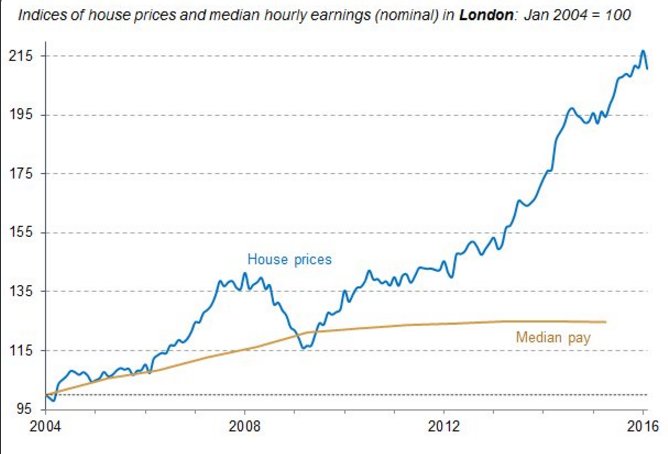
Houses aren’t homes: they’re capital

And in the richest cities, like London, they are greatly appreciating capital, as this shows:
Media preview

With some reflection, this makes sense, if you take as a given that:

  •   Stocks and bonds and even wages are fairly stagnant in terms of return on investment
  • Urbanization means homes in cities that are desirable to live in are becoming more scarce

The result is homes becoming one of the forms of capital that can has the means to greatly appreciate in value.

To reverse this will require a greater supply of homes on the market, either through greater density in desirable cities or through more cities becoming desirable to live in. I can see both of these occurring. What I don’t see occurring is other forms of capital becoming more capable of great growth.

It will be interesting to see what happens in 10 years. But right now, bet on homes in key cities to continue to do this.


This article about body cameras is asking the wrong questions, which is not surprising, since everyone is.

This article,  Will Body Cameras Work? – The Atlantic, is asking the wrong questions. The wrong questions are occurring because the initial answer to the question of “how do we deal with bad policing?” was often, “body cameras”. The better question to repeatedly ask: “how can we make police more accountable?” because if “body cameras” is the first answer to that question, the next question should be concerning the information captured by those body camera. How are police accountable for that? Which should then lead to another question: how are police accountable for information they capture generally? Because with new technology, police will soon be able to capture alot more information about you than just images. It will soon be possible for police to look at you or your vehicle and have that information feed back to centralized computer systems, essentially collecting information about you without you even knowing it. How will police be accountable for that?

Police accountability will come, likely through the courts. In the meantime, we will likely struggle with the fallout of police forces capturing more information.

This may just be the stupidest defense of Amazon’s workplace practices

This piece may be the stupidest defence of Amazon’s workplace practices: Replace Just 2 Words in the New York Times Amazon Article and Something Amazing Happens | Inc.com.

Amazon employees are not entrepreneurs. There is nothing in the NYTimes.com article that gives any inkling that they are. If anything, they have all the downside of being an entrepreneurs with little if any of the upside.  If someone can point out an article showing how Amazon consistently rewards employees as if they are true entrepreneurs, I’d love to read it.

There’s nothing wrong with being an entrepreneur. In fact, for some people, being an entrepreneur is the best type of work there is. Everything about it appeals to them, and working for a large corporation would kill them.

The Amazon employees are not entrepreneurs.  If you want to be an entrepreneur, be one. Don’t try to be one working at a large corporation. That is antithetical to what being an entrepreneur is.

Forget self driving cars – the first big thing will be self driving trucks

While there is lots of discussion about self driving cars, it’s much more likely that self driving trucks will become standard and accepted first. Here are two stories that support that. First this: How Canada’s oilsands are paving the way for driverless trucks — and the threat of big layoffs. Second, over at Vox, is:  This is the first licensed self-driving truck. There will be many more. Key quote from Vox:

Last night at the Hoover Dam, the Freightliner company unveiled its Inspiration Truck: the first semi-autonomous truck to get a license to operate on public roads.

The Inspiration is now licensed to drive autonomously on highways in Nevada. It works a bit like a plane’s autopilot system: a driver will get the rig on the highway, and can take control at any time once it’s there. But the truck will be able to drive itself at high speeds, using cameras to make sure it stays within its lane and doesn’t get too close to the vehicle in front of it.

Self driving trucks are already up and operational. Additionally, the business case and the hurdles to overcome with self driving trucks will be easier to achieve than that of self driving cars in urban areas. Sooner than you think, you will commonly see self driving trucks on highways, especially during the hours when most highways are 80-90% trucks.

Transportation is changing. Self driving trucks are going to be leading that change. Self driving cars will be a distant second.


ICYMI: What is code, by Paul Ford

Happy Monday! Are you affected by code at work? Of course you are! Do you code at work yourself? Very likely, even if it is to use formulae in a spreadsheet program like Excel (which, years ago, would have required been considered coding). However code affects you, I highly recommend you read this:
Code. It’s a very rich piece on code (i.e. software) and what it means to you (and everyone else).

Among other things, it is brilliantly designed. Lots of hard work went into this piece. If you can’t get started yet this week at work, read this as a research project.

Veganish: for bacon loving vegan wannabes, a possible option

You may want to become a vegetarian or vegan but you may also be reluctant to give up eating things like bacon or fish. If you are experiencing this dilemma, then this question might appeal to you:

“The most effective question we can ask is not how can we increase the amount of vegetarians and vegans,” he says, “but rather, how can we reduce the amount of meat consumed?”

If this appeals to you, then I recommend this article: Love Bacon AND Animals? ‘Reducetarianism’ May Be For You. Still interested? Then I also recommend this book by Mark Bittman: VB6: Eat Vegan Before 6:00 to Lose Weight and Restore Your Health . . . for Good.

My list of 59 thoughts on privilege

I read alot about privilege. Reading about it, I end up considering the privileges I have that arise from being an educated, white, middle-class man in an affluent part of the world with a high standard of living. The flip side to that is that I also consider the priviliges I did not have when I grew up, as well as the privileges I had and no longer have.  I tried to use that to write up a specific view point on privileges, but ended up with this list of thoughts on the topic instead. I have not come to any specific conclusion on the topic. If anything, the list points to the conclusion that I need to think further on the subject. That said, I think sharing the list is worthwhile.

Some people are interesting in certain aspects of privilege: white privilege, or male privilege, or the privileges of the 1%. I am interested in privilege in general, how it comes about, what effects it has, when is it good, when is it bad, and how to manage it in a way that leads to positive social action. That interest lead to this list.

With that all said, rather than sit on it any further, here’s my  list:

1. Privilege assumes a number of things.
2. It assumes that there are at least two distinct groups: the haves and the have nots.
3. It assumes that there is a social good that one group has a surfeit in and one group has a deficit in.
4. It assumes that the social good is recognized as such by both groups.
5. Privilege is about access and the ability to acquire or maintain that social good.
6. There many small social privileges that aren’t noteworthy (e.g. the privilege of belonging to a certain club).
7. Likewise, not all privileges are universally or generally desirable.
8. Some privileges are held by a small number of haves. Other privileges are held by a large number of haves.
9. Some privilege we earn. Some we get randomly. And some we get from belonging to a certain group by default.
10. Rights differ from privileges, for in theory rights are not a social good that one group should have more than another. (In practice, this may be incorrect, but in theory it is)
11. Some privileges are fairer than others.
12. Fairer privileges usually involve things in abundance.
13. Fairer privileges are either random or universally acquirable for most in a society.
14. Unfair privileges are never random: there is a recognizable pattern whereby one group is perceived to have more access than the other.
15. Fair privileges are assumed to be accessible by method agreeable to most of society. For example, to go to university can be considered a privilege, but it can be earned in a way agreeable and accessible to most.
16. Privileges that are most unfair usually involve scarce social goods or rules that are slanted to favor a particular group.
17. Economic wealth is rare privilege. Having a home is a common privilege. Even common privileges are still privileges.
18. Higher education used to be a rare privilege. Now it is a much more common privilege.
19. The right to vote used to be a rare privilege. Now it is a right.
20. Health is not a privilege, until heath care is involved. Then it becomes partially a privilege.
21. Many would like to have the privilege of being wealthy.
22. Many would like the privilege of working for specific companies, belonging to certain occupations. being members of certain organizations.
23. Everyone has privileges.
24. It is worthwhile to consider your own privileges.
25. If you are reading this, you have quite a number of privileges, starting with the technology you are using to access this post.
26. Technology is a tool, and the ability to access tools is a social good.
27. Challenges occur when there are statistical variables associated with privileges. A white man may have a 10% chance of acquiring a particular social good, compared to a 1% chance for everyone who is neither white nor male. From the point of view of the white man, a 1 in 10 chance may not seem much of a privilege. For everyone else, his chance of acquiring the social good is ten times great than theirs and this increased likelihood is a significant privilege.
28. Being aware of your privileges can help you appreciate what you have.
29. Being aware of your privileges can help you understand the grievances of others
30. Thinking you do not have privileges means you have not thought about it enough.
31. Renouncing your privilege doesn’t necessarily result in greater fairness, especially when there are large number of people involved.
32. For some social goods, especially when there are large number of people involved, it is easier to redistribute privileges so as to be fairer.
33. For other social goods, especially when there is only a few people involved, it is less likely to redistribute privileges so as to be fairer.
34. Even social goods that seem meritocratic are to a degree unfair.
35. Social goods that are meritocratic trend towards being less unfair than others, but still have a degree of unfairness to them.
36. Not everyone can have access to every social good.
37. Meritocratic systems are based on rules, and those rules exclude people from certain social goods from the beginning.
38. Social structures reinforce privileges. Friendships and families can reduce the chances of some having access to social goods.
39. Geography reinforces privileges. Being born into neighborhoods and communities with poor or no facilities can reduce access to social goods.
40. Some privileges are more unfair than others. Privileges based on religion, gender, race, sexual orientation, age, body shape are just some of those.
41. Certain privileges we accept. Physical, emotional, and intellectual ability generally are accepted as fair, even though these are not common when the ability is very high or very low.
42. Certain privileges we used to accept we no longer do. It is less acceptable to build publicly accessible environments that cannot be accessed by people who need wheelchairs.
43. As peoples lower needs (as laid out by Maslow) are met, privileges arise in the higher needs.
44. Everyone has access to certain privileges and are barred from having other privileges.
45. Individuals and societies give some privileges higher values than others. This weighting of privileges shifts all the time.
46. Some privileges become undesirable over time. Other privileges become common. Having electric lighting was once a privilege. Now it is so common as to be no longer seen that way.
47. Some technologists believe it is possible to make all social goods abundant so as reduce priviliege.
48. Some privileges may remain privileges because the social benefits outweighs the social cost.
49. Other privileges need to be tackled and dismantled if a society is to consider itself fair and just.
50. One way to dismantle a privilege is to make access more common.
51. Making it more common is possible if a social good is not scarce.
52. If a social good is scarce, then one way to tackle the privilege is to make access to it random.
53. Another way to deal with a scarce social good is to make the criteria for accessing it fairer.
54. The challenge of fairness is judgment.
55. The other challenge of dismantling privilege is the desire of privileged groups to maintain their privilege.
56. The challenge of dealing with privilege is agreeing if fairness consists of access to opportunity or access to outcomes.
57. In achieving certain privileges, I may trade off other privileges.
58. When individuals within a group are encouraged or forced to trade off certain privileges, they may not be able to reacquire them, as others may not want to release their access.
59. Ideally a society can produce such a wealth of social goods that any tradeoffs individuals or groups make, they still feel overall good with their choices and that the society they live in is a good one.

Periscope, Meerkat, and the future of virtual tourism

If you haven’t heard, Meerkat and Periscope are two apps that allow one person to stream an event and have others watch it. For example, here is an artist streaming her work on a painting while others watch and  interact: Wendy MacNaughton paints live on Periscope My… – Austin Kleon.

It’s an interesting idea. Once people get creative, there will be all types of events that people stream, from the obvious (porn, music concerts) to things no one thought of before.

I think one of these not so obvious ones will be virtual tourism. Essentially someone will visit a place like Japan and stream the cherry blossom festival or go to Pamplona for the running of the bulls and others will watch in real time. Maybe people will sponsor the person ahead of time, or the person will wear a shirt with ads on it, or find some way to make revenue. In return, lots of people can see something they might not be able to see otherwise.

People will use Periscope and Meerkat in all kinds of ways. Expect this to be one of them.

(Image via techcrunch)

On adults around you doing science experiments on large populations of children

Right now there are many adults around you doing science experiments on large populations of children. Here are three examples.

#1) The city of Calgary is currently doing a science experiment by removing fluoride from Calgary’s water supply (Dental decay rampant in Calgary children, pediatric dentist says | CBCNews.ca Mobile). The results from that experiment:

Dentists and dental hygienists are seeing an increase in child tooth decay and Dr. Sarah Hulland says the decision to remove fluoride from Calgary’s water supply three years ago is playing a big role.

“I’m seeing a lot more children having a lot more cavities,” she said. “I’m seeing a lot of decay on 19- to 20-month babies, and this is even before they’ve got all the teeth in.”

#2) We have a rise in measles and other infected diseases because of parents decided to experiment and not vaccinate their children. That experiment is not going well either. According to the CDC, measles cases in the United States reach 20-year high:

Two hundred and eighty-eight cases of measles were reported to the Centers for Disease Control and Prevention (CDC) in the United States between Jan. 1 and May 23, 2014. This is the largest number of measles cases in the United States reported in the first five months of a year since 1994. Nearly all of the measles cases this year have been associated with international travel by unvaccinated people.

“The current increase in measles cases is being driven by unvaccinated people, primarily U.S. residents, who got measles in other countries, brought the virus back to the United States and spread to others in communities where many people are not vaccinated

#3) Climate change. This is potentially the biggest science experiment of all, affecting the largest population of children. See Climate Change: Vital Signs of the Planet: Evidence, if you haven’t seen enough evidence of this.

I think, and likely you agree, that performing these experiments is wrong and unnecessary. Somehow too many people do not.  Too many think there is a need to disagree with the science behind fluoride in water, vaccines, and climate change.  It is true that science is not dogma, and it needs to be challenged.  But the way to do that is scientifically and in a way that minimizes or eliminates harm to the subject of the experiment. I would think that would be especially true when it comes to children.

I understand people having concerns and worries about technology. The way to deal with those thoughts about technology is to become better educated and to developer numeracy so that you can have a better understanding of the science involved. If you can’t do that, at least develop better sources of information, so that if you have to depend on authorities, make them the best ones you can find. I would think that is especially the case when it comes to science that has to do with children.

On the Jonathan Chait p.c. discussion

I joked that when this article by Jonathan Chait came out, I would wait three days, and then comment. My joke being that in three days the whole story would have blown over and there would be nothing left to comment on.

I was clearly wrong here, and instead it has gone on for some time. If you click on this: chait political correct – Google Search, you’ll see what I mean. Given this, I feel I should say something. 🙂

I don’t have much to add to the content of the argument going back and forth, and there are much smarter people than I who have commented on the topic: if you go through some of the results of the search, you can find them.

However reading the various pieces, instead of the content, I had some thought on the format and structure of the pieces. Specifically, I had four impressions:

  1. The first impression was that many writers do not like Jonathan Chait. Even a number of writers defending what he had to say would start off by saying disparaging things about him. I found it odd they had to say that, as if supporting the argument wasn’t enough. They needed to show somehow they were on the side solely of the argument and not of Chait.
  2. The second impression is how much of the evidence one way or another was anecdotal and not data or statistical driven. I don’t doubt the anecdotes and examples given: I just didn’t seen any hard data in the pieces that I read. Maybe it is some and I just missed it. Examples are relevant, but data is better to me.
  3. The third impression I had was how in arguments the people arguing often did not agree on the terms of argument. I realize the writers are not philosophers, but I felt sometimes that the definitions used were twisted to suit the argument of the writer.
  4. The fourth impression I had was how much invective was pulled into the pieces for or against Chait. It wasn’t enough that the authors had to disagree with Chait: they had to disparage him.

It’s important to stress these are impressions. I read roughly 6-10 pieces, including the original one by Chait. I’d be happy to be corrected on these.

The things about the impressions is that while I didn’t find the argument that Chait made had merit, but it wasn’t because of the pieces critical of him. If anything, it was just the opposite. Maybe I should dislike him, but even if I did, if he had a good argument I should listen to it, and if he doesn’t have a good argument, then it should be enough to dismantle it to discredit him or his supporters. This may be naive, but it is what I look for when someone is making an argument for or against something. If anything,  name calling and invective towards someone tends to persuade me to go in support of that person. In this case, perhaps I am not the audience, and the writers do not care if I am persuaded or not.

This had me thinking about a bigger thing that I have been thinking about for some time. And that is the topics of influence and attention. I think influence and attention are the key attributes writers want to have associated with their work on the Internet.

This idea of the importance of influence and attention  requires more thought though. For now, I wanted to jot this down, to get it off my mind, if anything.

Thanks for your attention. I hope this influenced you in a positive way.

Feeling stressed? You need some crayons! Really

It’s Wednesday. You are feeling stressed. Maybe you should go out on your lunch break and get some crayons and do some art work. According to this,
Coloring ….Can Actually Help Adults Combat Stress.

And if you think, “who does that?”, you should know that in France, the UK and Spain, coloring books for adults are very popular.

There are worse ways to deal with stress than adding some color to a blank book. Might be worth a try.


Why not a three day week? Something to consider on day two of your work week

This piece on the three day work week, Why Not a Three-Day Week? in The New Yorker explores the notion of working three and not five days a week and is well worth a read. But….

But….before you protest that you don’t work a five day week now, the better and more important question is: why do we have to work so much and so hard and why can we not have a lot more for a lot less? My own belief is that we are still shackled to a culture underlined by a Protestant work ethic and devoted to to a lower form of capitalism. We would lead better lives if our energies and our lives were devoted to more meaningful activities that addressed our higher needs, instead of tolling away to survive. The good/bad news is that even if we want to stay chained to this culture, we will not be able with the way mechanization and automation is proceeding. We need to start thinking about the way we work now, whether we want to or not.

My marginalia from my copy of Piketty’s capital

My previous post was a guide to reading Piketty’s Capital. As I was going through it, I also jotted down some rough notes on the book and things I thought as I was going along. My marginalia, so to speak. Here it is, for what it’s worth to you:

  • Piketty’s book irked people for a number of reasons, including me initially. One reason, I think has to do with the grandness of his book. First, there’s the title. It implies this is a follow on to the great text by Marx. Second he does things like state fundamental laws of capitalism, as if economics were physics and Piketty is the 21st century Einstein. While Piketty can seem grand at time, he’s also humble in other parts. Throughout the book he often confesses to the limits of his approach based on the data (or lack of data) he has. He still has a lot of data and he has done a lot of analysis, but he is aware of the limits of it. This humility helped me get over the parts that irked me.
  • For non-economists like me, I think the book is most enjoyable when Piketty relates economic theory with example in literature and history. His references to Austen and Balzac make his ideas less abstract and make them richer. Fortunately, he does this often.
  • Some American critics would have you believe that Piketty is anti-capitalist / pro-socialist. I didn’t see that. I’d say Piketty is for open markets, strong on education, and democratic.  From an American point of view, he may seem left wing, but to most of the developed world I would place him closer to the center, slightly left.
  • One thing Piketty’s analysis can’t or doesn’t take into account is the exponential change in everything starting at the end of the 19th century. He touches on it a bit (pop growth rates on page 80), but this is factor. I believe that there is a correlation between growth rates and birth rates, with growth rates lagging birth rates. But this is a belief I have: I don’t have the ability to show this.
  • I was surprised by how limited economic growth is. (Chart on page 94). As Piketty mentions, people think it should be in the 3-4% range, but is much more likely to hover around the 1% range. Yet even such growth rates have a huge impact over decades and centuries.
  • Indirectly, Piketty makes the case for Naomi Klein’s thesis on disaster capitalism.  The biggest opportunities for growth in the 20th century occur as a result of the World Wars. Take a look at the charts on page 97 to see what I mean. Wars are terrible for people and cities but good for economic growth.
  • As I was reading the book in the summer, there were a slew of critics writing Think Pieces (or tweets!) against him and his book. The most ridiculous arguments against Piketty are the shallow ones, of course: the ones based on the book title, or that he is French, or that the book is all about new taxes. These arguments, mainly from American writers, reflect a lack of thought and the biases of Americans more than anything else. Critics of Piketty who write small articles on his book, criticizing this point or that, are missing the much bigger picture. Piketty, in presenting all of this data and analysis, is providing a broad stage to discuss capitalism. I think anyone wanting to take him on really has to do the same level of work. That’s the thing. Cherry picking is useless. Yes, it would be good to have more data. But this is the data available. If you want to criticize Piketty, you need more data, or you need to critique his data. If you want to show how technology is making inequality less not more, bring that data. Saying “Piketty is a red” or “this is not 19th century range” and thinking you are done just makes you look foolish and your arguments weak. (Of course you can believe what you like, but belief is not argument.)
  • Another thing he doesn’t touch on is the destructive nature of IT on capital. Being an IT professional, I was wondering if he would examine capital in the 21st century from that perspective, since IT is having a greater and greater effect on our economies, and as more things become digital, the depreciation of capital related to those things accelerates. If you’d like to read more on that topic, you won’t find it here.
  • It is interesting to note the stability of capitalism in the 19th century, at least in Europe. It was a conservative time politically, with limited warfare. Currency and other things economic were also stable then. No point here, just something that struck me as interesting.
  • I believe that an accumulation of capital leads to anti-democratic measures by capitalists that result in revolutions or wars, which lead to the destruction of private capital. Piketty doesn’t go into this, but it would be interesting to read an analysis that shows a relationship between the accumulation of capital and the advent of wars and revolutions.
  • I found this fact fascinating: after the Napoleonic wars and World War 2, Britain’s public debt was 200% of the GDP. 200%! I found this fascinating, first because there is a lot of worry now about the wealthiest nations having their public debt going over 100% of their GDP. Yet Britain’s was much much higher in those two cases. How did they reduced that debt and bring the percentage down from 200% to a much smaller number (as seen in the book)? Inflation. It was done over a very long period of time, but it is proof that high debt can be brought down and that it isn’t irreversible.
  • Reading the section on slaves and capital made me think many things, including the idea that capital based on anti-democratic or inhumane means is precarious — think of capital that pollutes or depends on the deprivation of otherwise rights….it is unstable capital — and that capitalists and not just socialists should argue for an economic society based on democracy and human rights.
  • One thing Piketty does well is whenever possible he links data from the US and Sweden because they are both relative outliers to the UK, France and Germany. It also highlighted to me how much the US lags (or leads, depending on your viewpoint) much of the developed world.
  • Piketty is big on education. If anything, I think he gives it too much weight. People from better schools stay wealthy not just because of what they learn but who they connect with in such schools. (Maybe it is different in France, but I doubt it.) Establishment schools are smart enough to let new blood in but they are far from meritocracies. To me, Piketty seems to have a blind spot when it comes to academia that he doesn’t show elsewhere when talking about inheritance or super-managers.
  • Piketty makes the case that taxes are better than debt. I made this note: “The concern for progressives is that capitalists will drive down both taxes and debt by abusing social programs.” But I don’t know why! 🙂 Ah well…it was likely a good thought at the time of reading it.
  • Piketty talks at the end about the contradiction of capitalism is r > g. My belief is that this formula should be more complicated and that when you add a time factor in there and some other dependencies, you see have a better model and formula (or formulae) on how capitalism corrects itself, either through war, or revolution, or other drastic social change. But this is just another belief I have.

As you are reading it, you will likely have your own notes and marginalia. Let me know what you think.

My modest guide to Piketty’s Capitalism and how to read it (all the way to the end)


You are looking at buying Piketty’s Capitalism, or maybe you already bought it, but you are daunted by it. Having read it, I can say it is daunting in parts, but it is also great. I highly recommend you get it and read it from front to back. Some of you will have no problem with that. For the rest, I put together this modest guide on how best to read it and finish it and not get bogged down and put it aside.

Here goes.

The introduction is an easy read. If anything, it is highly approachable. Piketty is a good writer, and he does a number of things to make it easy to read. (For example, he brings in a lot of literary references. He also does not assume you are an economist.) For the first 100 pages I thought: why is everyone having difficulty with this book….it’s fun! (Mind you, I am interested in economics, but still….) What I’d say is that this introduction is a good introduction not only to the book but the field of economics in general. Don’t be fooled though: the rest of the book is not as easy to read.

Of the book’s four sections, the first and last are the most approachable for non-economists. Emergency tip: if you are getting bogged down in the middle of the book, feel free to skip to the last section. Reading the first and last section is still rewarding, and you can read the last section without reading the middle. (Not ideal, of course, but better than skipping the last section all together).

That said, there are great passages in the middle, and there are some slow sections in the front and back. (Don’t entirely skip the middle, and likewise, don’t be thrown off by some harder parts in the front or back.) Here’s some examples of what I mean:

While non-economists might want to skip over it, I found his history of data collection — around page 55 — interesting. He is following in the footsteps of some of these other figures in the field of economics while also showing the limits of what analysis can be done, given the lack of data. I think this is an important thing to read if you read his critics. Piketty is aware of the limits of his analysis: something you would not think by reading his critics like I have. It’s good to know this. Also, this supports the case that Piketty makes later in section 4 on why a global capital tax would not just be good for states and a check on capitalism, but also as a way of improving the field of economics. Try to read this part.

Generally, the sections of the book on growth, income and capital are interesting infor the long term perspective they give. I found those worthwhile.

The second section is a good take on how capital has changed over the centuries. If you are going to think about capital and capitalism, it’s worth reading the second section on this history. There were radical changes in capital from the 18th century to the 20th, as capital went from being largely agricultural land or largely housing. In the United States another big capital shift occurred as human capital in the form of slaves rightly disappeared after the American civil war. So, I liked this section: it got me thinking about capital in ways I hadn’t before.

I highly recommend you don’t skim the part on the relationship between slavery and capitalism in around page 158. The value of slaves as part of the overall wealth of the US south is incredible, and the effect the Civil War would have on rightly destroying such capital was significant. You can rightly argue that slaves are human beings and not capital, but from the point of view of the slave owner, they were as much capital as machinery or barns or land. A thought provoking section, I found.

Of the middle section, make sure you read page 166 where Piketty introduces his law of capitalism. Piketty’s laws are a key part of the book. Also at the beginning of page 237 the book moves away from the data to talk about inequality and there is more approachable analysis. For example, around this point of the book, Piketty provides a good analysis of labor vs capital, class, and an insightful review of inequality. In particular his analysis around super managers and super salaries is really good and highly relevant in our times. (I think it also got up the nose of some Silicon Valley types, which I found fascinating.)

Make sure you read the section of the book on inequality: I found it to be one of the better parts of the book.

Overall, beware of section two. In this section, Piketty looks at capital in various parts of the world. If you are an economist, then  you really want to focus on this section, because he is making a case for his central idea. However, for a general reader, you might become fatigued in the middle of this part as it tends to feel repetitive. By the way, I think this repetitiveness is really supportive of Piketty’s point. He can argue: hey! look there is a consistency here we can make some conclusions about. If you already support his point, skim away.

If you are skimming madly in the middle, slow down as you get to page 400.
I took a lot more notes towards the end of the book (in the 400s) and I thought this section readable and interesting. For example, in the 400s, Piketty deals with merit. I believe a lot of critics don’t like the book because of how Piketty places limits on virtues of merit and hard work. Piketty argues you can work hard to get rich but someone with a lot of capital can get as rich or much richer with little if any effort. He goes on to show that capitalism is structured such that the rich will…well, get richer. Which means that proportionally the poor get poor. You may believe the rich get richer: here’s the argument as why in a capitalism society that happens.

The other thing I like about the 400s is that Piketty bring in literary examples again. He does that in the first section, and he does it again here, and I found whenever he does this, the book becomes livelier and more interesting.

Still reading? At the last section? Good! In the last section, Piketty focuses on the importance of regulating capital. Now, I am skeptical of what he recommends, even though it is hardly revolutionary (literally or figuratively). Maybe it will happen in the 22nd century. I am willing to believe it will happen, thought. After all, progressive income tax is a fairly new thing, and taxes themselves will continue to evolve, just like they have for centuries. Likewise, freer trade has increased dramatically in the 20th century, and other taxes like VAT taxes have made a big impact. Perhaps a global tax would not be impossible. That said, you should read the last section, because to not do so would be to miss out on a key point of the book.

Ok, that’s my modest guide to reading Piketty’s Capital. Did I convince you to give it a try? Great! Give it a go! If you can avoid the pitfalls in the middle, you’ll find yourself cruising towards the end and find you are done sooner than you think. Book completion aside, when you finish Piketty’s Capital you’ll have a much better understanding of capital in the 21st and capitalism in general. I think this important, because even if you don’t want to think about capitalism, capitalism affects us all. Knowing more about it, knowing how to think about it, and having ideas on how to change it are valuable.

Good luck!

The subversive genius that is Cracked.com

The team at cracked.com have a tested formula: take some good advice  and practically bury it in humour to get a piece that has you laughing at first but thinking later. It is a very subversive way to get people thinking on a site you wouldn’t expect to be doing so.

I first started reading cracked.com for the laughs, but afterwards thought: hey, they have a really great piece of guidance there. Here are two pieces from many good ones on the site:

There are lots of sites on the Web giving advice (including this one). Cracked does it in a way that is better than most. Worth checking out.

On the benefits of wearing a uniform

There are benefits to wearing a uniform: you look good, people can read you, and you simplify your life. I think that is what this article is getting at too, but to me, it oversells it: The Genius of Wearing the Same Outfit Every Day. Still worth a quick read, though.

I add that there are drawbacks to wearing a uniform: you can get stereotyped and you can get sick of it. I have tried it, and I think the trick for me was to have more of a template of clothing to wear and stick to that. By that I mean you have a number of different things to wear, but all the clothing fits a certain pattern or template. That approach  allows for some variation, but you gain all the benefits of a uniform.

Having read this, do you think the uniform idea is good or bad?

More ideas for late afternoon: are midlife crises biological?

Yesterday we considered math and infinity. Today, apes and biology.

If you read this, Even apes have ‘midlife crises,’ study finds – Yahoo News, you might conclude “possibly”. What do you think?

My thoughts: I’d push back and say the notion of a midlife crisis is a complex representation of a lot of different things, and being able to tie that back to biology direct doesn’t make sense. It may be possible to find linkages there, though, and through the discovery of these linkages gain a better understanding of how we relate to life as we mature.

Your thoughts?


Is your day boring? You need to think bigger thoughts. Here’s a short post on Infinity

This is a great introduction to the topic of Infinity. I think even people who struggle with math will get this and enjoy it.

Unless you studied mathematics, you likely didn’t know that about infinity. It is fascinating stuff, I find.

Found here: Infinity is bigger than you think – Numberphile – YouTube via @anitaleirfall on twitter.