
Or at least a high resolution image of Vermeer by going here:
Open Culture has lots of great links, including at the bottom of the Vermeer one, mentioned above. Open Source is good; so is Open Culture.
(Image linked to on the Open Culture page)

Or at least a high resolution image of Vermeer by going here:
Open Culture has lots of great links, including at the bottom of the Vermeer one, mentioned above. Open Source is good; so is Open Culture.
(Image linked to on the Open Culture page)

This piece, Why Freud Survives, is a great review of not just Freud’s legacy, but some of the people involved with Freud’s legacy since his death. I’ve read about it before: believe it or not, this is the short version of it. While long, the piece is well worth reading.
This section in particular gives some good context with regards to psychoanalysis in the context of psychiatry.
Since the third edition of the DSM, the emphasis has been on biological explanations for mental disorders, and this makes psychoanalysis look like a detour, or, as the historian of psychiatry Edward Shorter called it, a “hiatus.” But it wasn’t as though psychiatry was on solid medical ground when Freud came along. Nineteenth-century science of the mind was a Wild West show. Treatments included hypnosis, electrotherapy, hydrotherapy, full-body massage, painkillers like morphine, rest cures, “fat” cures (excessive feeding), seclusion, “female castration,” and, of course, institutionalization. There was also serious interest in the paranormal. The most prevalent nineteenth-century psychiatric diagnoses, hysteria and neurasthenia, are not even recognized today. That wasn’t “bad” science. It was science. Some of it works; a lot of it does not. Psychoanalysis was not the first talk therapy, but it was the bridge from hypnosis to the kind of talk therapy we have today. It did not abuse the patient’s body, and if it was a quack treatment it was not much worse, and was arguably more humane, than a lot of what was being practiced. Nor did psychoanalysis put a halt to somatic psychiatry. During the first half of the twentieth century, all kinds of medical interventions for mental disorders were devised and put into practice. These included the administration of sedatives, notably chloral, which is addictive, and which was prescribed for Virginia Woolf, who suffered from major depression; insulin-induced comas; electroshock treatments; and lobotomies. Despite its frightful reputation, electroconvulsive therapy is an effective treatment for severe depression, but most of the other treatments in use before the age of psychopharmaceuticals were dead ends. Even today, in many cases, we are basically throwing chemicals at the brain and hoping for the best. Hit or miss is how a lot of progress is made. You can call it science or not.
Psychiatry has a long way to go. It will need better tools and better ways of understanding the brain and the mind. I think over time Freud will be seen the way Galen is: not so much relevant as influential and important in moving medicine forward.
(Image from link to Wikipedia)

Mostly good recipes, but some pieces lower down on food
And now for some non-recipe related food links:
I have been fascinated by the idea of povera cucina. Here’s too links on it.
(Image linked to is of chicken bulgogi from David Lebovitz.)

If you are looking for a variety of low cost meals online that are straightforward to make — I am looking at you, college students — then I recommend the site BudgetBytes.com. Each of the recipes has a breakdown of the expected cost, how long it takes to make, as well as the typical information you will find in a recipe. Here’s a few I highlighted recently, in no particular order.
They have a wide range of recipes, and categories (e.g. chicken, vegetarian). The recipes are simple, the ingredients easy to find, and generally they look good. Give it a try.
Save money, eat better.
(Image from here.)

Getting fit can seem like a big production, and for people who haven’t been exercising, that can be all it takes to prevent them from getting fitter. Speaking from experience, I know this to be the case.
What I think you need is something that will a) get you in the habit b) be so low key you have no real excuse to get started.
If you agree then I think these two pieces are just what you need to get started on your way to being fitter.
As for the yoga, if you don’t want to do all 10, then pick a few just to get started. Even doing 2-3 at first should get you started.
Good luck!
P.S. For more on simplifying exercise, check out this piece in Vox.
Of course you can go out and order one. But if you feel like staying home and making one, then the good folks at Bon Appetit have two version on the classic martini you might be interested in trying:
Don’t have martini glasses? Consider Crate and Barrel: they have a selection here.
(Image from Crate and Barrel)

Most people understand depression does exist and it is different and more severe than routine sadness or tiredness. Recent studies in depression indicate that there may be different categories of this mental illness. As this piece highlights, Brain Scans Show 4 Different Types of Depression | Mental Floss, there may not be just one medical profile for people with depression, but…
different medical profiles. Patients in subtypes 1 and 2 described feeling more fatigue, while people in subtypes 3 and 4 had trouble feeling pleasure.
One significant thing about this separation is that there are different treatments for different subtypes.
If you suffer from depression or know someone that does, or want to have a better understanding of the disease, I recommend that piece. That said, if you think you may be suffering from depression, always seek out professional help.
(Image is a link to the web site http://namila.org/)

John Lanchester manages in a review of a number of books to extensively pin down where Facebook is, here:
Here’s some reasons why you should care, even if don’t use Facebook
Facebook has an ability to influence politics in ways that no one understands, except possibly Facebook. I don’t imagine they are going to share that information readily. Politicians need to push back on Facebook and discover the extent of their influence.
My belief is that the strength and influence of social media like Facebook is going to decline in the next few years. That’s not anywhere certain at this point, though, and the power they have needs to be limited now.

And the NYTimes has an update on where he is in his life and his career, here: David Hockney, Contrarian, Shifts Perspectives – NYTimes.com.
I have always admired Hockney both for the wonderful lushness of his paintings and for the way he speaks about art. Both of those admirable qualities are on display in the piece in the Times. He’s in his 80s now: I hope he continues to work and speak for some time to come.
(Image linked to in the NYTimes and taken by Nathanael Turner)

These are all links I’ve come across recently and thought worthwhile:
If you are not used to reading philosophy, the first one is a must read. Otherwise, you may find yourself trying to read philosophy in a way that leaves you frustrated.
I’ve seen references to virtue ethics (as well as stoicism) frequently these days: if you aren’t familiar with it, that link is a good starting point to get to know it.
Finally, the last link is useful if you are new to philosophy and want to know it better but find it hard to get started.
Fascinating: How 5 Different Creatures Flap Their Wings

Highly recommended: Emil Zátopek: The greatest Olympian vanished from public life after he defied Russian tanks in 1968 | The Independent.
As a kid I saw a documentary on Zatopek and was in awe of how dominant a runner he was. Anyone looking for inspiration in athletics can find that in many places: I found mine watching Zatopek and Abibi Bikila (running barefoot in Rome) excel at the Olympics.

Then you need to read this: The Thrill of Losing Money by Investing in a Manhattan Restaurant | The New Yorker
It is a wonderful read of a terrible experience.
Besides that, though, it is an entertaining but damning analysis of the restaurant business in cities like New York. (I imagine it is the same for most cities.) I think at some point there will be fewer and fewer fine dining experiences in cities, and the best food will come from places that are small and have very low overhead. And all those large spaces that were once filled with large restaurants will close.
If you still want to own a restaurant after all that, don’t say you weren’t warned! 🙂
(Image is of Prune, one of my favourite NYC restaurants. If fine dining is to have a model in the future, it is likely to come more from places like this, imho.)

The juicero is toast. Not surprising to me: it was a terrible idea.
While the juicero was terrible, this analysis of the engineering behind the juicero is fantastic: Here’s Why Juicero’s Press is So Expensive – Bolt Blog.
Even if you aren’t interested in this device, read this analysis. You will come away with a much better appreciation of all the devices currently in your own life and some of the thinking that goes into making them.

If you have the itch to be an author, then here are some links you may find helpful:
Image from here: http://www.wikihow.com/Write-a-Cookbook.

If you are applying for a job and haven’t done so in a while, chances are you will have a difficult time with some of the questions asked of you, if only because you are expected to provide answers on topics you likely haven’t thought of in some time.
Two ways to deal with that. First, find friends who have recently gone to job interviews and get them to give you some of the questions they were asked. Second, try out some of the questions found here: swissmiss | My Favorite Interview Questions.
I should add, any place that asks you the kind of questions found at swissmiss.com is likely the kind of place you want to work.
Good luck. Ace that interview.
(Image linked to http://sscrecruitmentresults.in/hr-interview-questions-answers-freshers/)

Perhaps the hype around the standing desk is finally going to die. Here’s hoping. Based on this source, Standing All Day Is Twice as Bad as Sitting for Your Heart | Runner’s World, standing all day is no good either. It mentions an interesting study….
… just published in the American Journal of Epidemiology that finds jobs that require a lot of standing to be much worse for your health than jobs that require mostly sitting. The new study is a surprising counterweight to the ubiquitous “sitting is the new smoking” message
Like anything, standing or sitting at your job should be done in moderation. Ideally you would have a work station that allowed you to easily switch from sitting to standing (like the one in the image above from http://www.smallbiztechnology.com/). If you don’t have a set up like that, at least try and find opportunities to stand and sit throughout the day. Better still, get a walk or two in as well.
Be good to yourself and your body.

If you take any of these meds then you really should read this: Should you take Tylenol, Advil, or aspirin for pain? Here’s what the evidence says. – Vox
I was surprised by what they said about Tylenol. You might be surprised by what’s in here as well.
As for me, I have found when I have had a sore back, ASA was the best thing to relieve the pain.
Like any medicine, consult with your doctor or pharmacist before taking. You should especially consult with them if you are taking such medicine on a regular basis.

When I first saw this: 20 misused English words that make smart people look silly in Quartz, I was confident that I would not be someone who misused any of them. Turns out there were a few that I did. Not many! But a few. 🙂
See if the same applies to you. If none, congrats!
Easy, with this beautiful map:

A link to a full sized version of the map is here.
More information on the map, here: New map charts parks near TTC stations
What does it mean to be lonely? Here are two good pieces exploring the aspect of being lonely. First up, a review of the book, The Lonely City: Adventures in the Art of Being Alone, which is something of a memoir, but a memoir focused on exploring the idea of loneliness. The second piece, The future of loneliness | Olivia Laing | Society | The Guardian, examines the idea of loneliness in the context of our current technology and our current society.
How you think of aloneness and being alone depends on your own personal experiences and context. For some, it can be a terrifying idea, being alone, while others find it liberating and exciting. To some, being alone is a foreign place, to others, the state of aloneness is the place they call home.
One of the best things, and hopeful things, ever made about being alone, is this video:
Enjoy.
Yesterday I mentioned Robert Caro and his writing routine. Today, here’s a good piece by George Saunders and what writers really do when they write in The Guardian. Well worth a read.

I find Caro a fascinating person and this portrait of him in this Paris Review interview is well worth reading: Paris Review – Robert Caro, The Art of Biography No. 5.
It’s worth comparing it to this piece on him in the New York Times that talks about his routine, including how he goes to a separate office in Manhattan just to work and that he wears formal business attire to do so. A rare life writing about another rare life.

The story of Bleecker Street’s Swerve From Luxe Shops to Vacant Stores in the NYTimes is one playing out in many cities throughout the world, though perhaps not as extreme as this. It’s a big problem when money comes flooding into neighborhoods and cities, disrupting the people that live there, and making those areas unlivable in some cases. Most people need somewhat stable places to live, but unstable social systems (capitalist or otherwise) can make that difficult unless other social systems (like local governments) come in and press back against such instability. As more of the world moves from rural to urban areas, the tools to make streets and cities livable need to be developed and put to use.
Anyone living in a growing city needs to read this piece. Recommended.
(PHOTOGRAPHS BY CHRIS MOTTALINI FOR THE NEW YORK TIMES)

There are many ways to raise money on line, from Patreon to Indiegogo to Kickstarter. A more modest way to raise money online is this site: Ko-fi. I think it is perfect for anyone wanting to share things with others in exchange for a modest amount of money (i.e. the cost of a cup of coffee, approximately). If you were looking for something like this for your site, I recommend you check it out.
By the way, if you want to check it out (and buy ME a coffee), here is my link. Thank you!
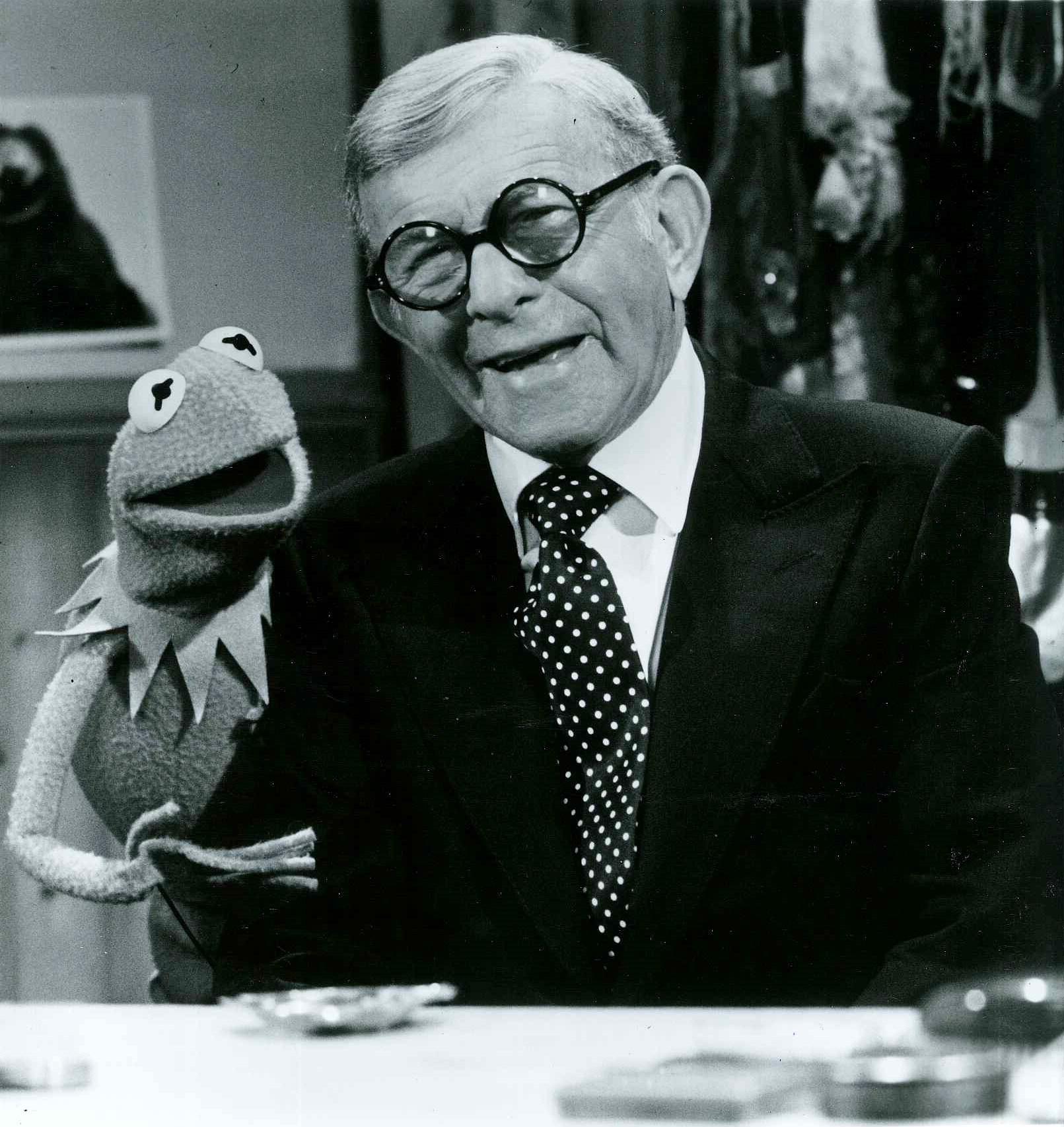
Kinda funny, though not intentionally: BBC – Capital – The tricks to make yourself effortlessly charming.
Some thoughts:
This piece in the New York Times is great advice for anyone young and struggling with networking. Is networking useless? Not at all. But like direct mail or many other forms of outreach, the effort to success ratio is far from 1:1.
If you are an extrovert, then you likely get something out of networking even if it isn’t a leg up at work. If you are are introvert, however, articles like that one are likely to make you never want to even try. For you introverts, I recommend you find ways to network that are pain free. You may not even have to directly talk to people: just be contributing to platforms that have alot of participants, you can get the benefits of networking. Networks are everywhere these days and embedded in much of the technology we use: take advantage of that fact to network in the ways most effective for you.
Hard work and luck are the keys to success. Networking is also a form of hard work, and if you work at it, it can bring luck! (After all, good luck is the residue of hard work.) Therefore include networking as part of what you are doing to be successful. Just hav the right expectation of what comes from such work.

If you can see clearly ahead, you can make better directions on how to steer. It’s true for any mode of transportation. It’s also true about life. Take a look at this piece in the 99u: What I Wish I Knew at Every Age – 99U. Whether you are young or old, it will give you the ability to see what’s ahead in life though the wishes of others and it will help you steer your one wonderful life.
Drive well.
(Image from here).

I highly recommend checking this out: Pictures of Venice in the Fog – Fubiz Media. Beautiful images of a beautiful city in a form I have rarely seen.

There can be many lessons that can be drawn from the story here: The Rise and Fall of the ‘Freest Little City in Texas’
The ones I drew were
It’s a good story. Read it for yourself and draw your own conclusions.
(Photo above is Amish women on the beach)

Statues and awards and the naming of things (schools, hospitals, museums) are about many things, but first they are about power. Those with political or organizational or financial power decide what names go on things, what statues and monuments go where, and who should get awards. Sometimes it is simple, and an award or a thing gets named after someone or something powerful as a direct result of their power. Other times it is subtle, and the award or the statue or the naming of a thing reflects the values of those with power.
When people want to tear down statues or rename things or revoke awards, there is an outcry. That outcry is because of a group fearing their loss of power. You won’t hear people talk of it in those terms: you will hear people talk about values instead. But the change is the result of a shift in power. History isn’t erased because something is renamed or revoked or torn down: anyone who wants to know the history can know it in other ways. And history isn’t changed by putting up more statues or naming things differently.
Of all the ways of understanding history, objects are the worst. They are a crude reminder that a history exists, and they are put in place by powers that be or powers that were. As a place changes, the statues should change, the awards should be redistributed, and the things should be renamed. And this will indeed happen, and it will happen due to the new people in power.
If you feel yourself out of sorts or not your best in the month of August, you are not alone. August can trigger bad emotional responses in us for a number of reasons, whether we love the summer or hate it. To see what I mean, see this: August Blues Are Like Sunday Blues, But for a Full Month — Science of Us.
I would add for some, August can be the most extreme month in terms of weather (just like February) and that can make it difficult to deal with too. If you find yourself struggling at this time of the year, cut yourself some slack and prepare yourself for the true start of the new year: September. (A much nicer month than August for many reasons).
If you struggle with stress and don’t know where to start, start here: Reduce Your Stress in Two Minutes a Day – Harvard Business Review – Pocket. It is general advice, but even adopting a few of these practices in daily life should help releave your levels of stress. It is especially good advice for driven people who need to succeed in the areas of life they focus on, but find that their usual approach doesn’t help them when it comes to stress.
This: Is it okay for a city to track what’s in your poop? – Macleans.ca, is a provocative question that headlines a good article.
Now for most people, the answer would be a loud “no!”. But as you can see in the article, smarter cities lead to municipal governments gathering more information about you. Certainly in the case of smart meters, the government agency can tell alot about you just from when you use power. Digital technology and the need to better manage government resources can lead to further tracking, including to what is in your waste water. Expect to see more such tracking in the future.
Ideally for any information being gathered about you, there would be strict control over who has access to the information and what they can do with it. As well, there would be some accountability with regards to that information. I would expect there is a mixed record for much of that information, but the fact that I can only speculate tells me there is more work to be done with regards to accountability.
Read the article. It helps to be informed about such tracking so you can know how you can be tracked and how you can ask questions about such tracking to government officials and elected politicians.
With the rise of right wing extremists, including neo-Nazis, I see it often said on social media that the German people of the 1920s and 1930s did little if anything to oppose Adolf Hitler and the National Socialist Party’s rise to power. This is untrue. There was a lot of opposition to the Nazis rise to power, opposition that the Nazis spent much time and effort to overcome. Ideally you should read this history to see this, whether you read works by AJP Taylor, Ian Kershaw, John Toland, Joachim Fest, or others (but not David Irving). For a start, you can read this: Adolf Hitler’s rise to power, beginning with the Beer Hall Putsch. As you read along, you can see many opposed to the rise of the Nazi party. You can argue that they were ineffective: you cannot argue that they did not exist. Many of the opponents were killed (members of the Red Front) and many others, like Ernst Thälmann, were sent to concentration camps. Some fled, others became silent, and still others become supporters. Many died in the war to come.
The Nazis were supported, of course: that is how they managed to be in a position to take over power in the first place. But the idea that they met with little or no opposition is wrong.
For more reading, you can find a link to
Reason #1: Apple is seeing growth in sales of the Watch, and plans to give it cellular capabilities will drive growth further. If cellular networks allow you to share your number across your phone and watch, it could really support people who may want to go without their phone from time to time.
Reason #2: is my belief that the Watch will provide Apple with a platform to develop miniaturization. Having different platforms and different scales allows Apple to innovate and gets their partners like Intel to do the same. This will support Apple in being either first or best in the areas they have products.
I'm glad to see the Watch continue to grow. I would not be surprised to see some of the features we once saw in the Shuffle morph into the Watch. That would make up some for the lost of that other once great platform of Apple, the iPod, which was loved and now lost.

According to this, chatbots in China have been removed after being critical of the Chinese government. This to me is not unlike what happened to Microsoft's chat bot that became racist after being feed racist input from users. If you put AI out there and allow any form of input, then the equivalent of vandals can overtake you AI and feed it whatever they choose. I'm not certain if that was the case in China but I suspect it was.
AI researchers need to expect the worst case use cases if they allow their software to do unsupervised learning on the Internet. If they don't, it's likely that their projects will be a disaster and they will do damage to the AI community in general.
And the New York Times has a good analysis of here work so far. I really enjoyed the analysis. As for me, I found it interesting that she has transitioned the account from a basic one that recorded events the way most of us do into something that extends her art in a way few of us can do. I also like that great artists like Sherman can take new media and incorporate it into their work but also extend it. David Hockney did something similar with the Brushes app. Here's hoping more artists do such things.
There seems to be many opponents and few supporters of the new series planned on HBO, Confederate. It’s easy to see why. This piece by Bree Newsome is a good example of what many think of the upcoming series:
HBO’s Confederate is just a fantasy — unless you’re black – The Washington Post
In some ways, though, I think this piece can be an argument FOR the series, though it argues the opposite. That’s not just me being Devil’s Advocate. My belief is that science fiction has a way of presenting ideas in a way that gets people to think about them and think about them unlike any other form of fiction. From Star Trek to the Handmaid’s Tale, science fiction (especially on TV) has gotten people to think about ideas that they might normally avoid. Ideas that people might escape from in real life get in front of them when they escape into science fiction. Newsome cites a number of facts about the current suffering black Americans undergo now, facts that many white Americans would just as soon avoid or ignore. The series Confederate could be a forum to bring those ideas and facts to the foreground in a way news editorials or regular TV news cannot. The series could lead to changes in a way other media cannot.
That’s a potential pro for Confederate. I don’t believe it is enough of one. There are many alternative timelines that the producers of the show could have chosen: they seem to have chosen a terrible one. An alternative history that went in a utopian direction would have had issues of its own, but instead they seem to have gone with a dystopian vision. This is certain to cause more pain for black Americans now and likely encourage racists to interpret the series in a way to support their racism.
As artists, the makers of Confederate might argue that a dystopian view is the best way to emphasize the themes and ideas they want the show to carry. However, the makers of Confederate and HBO are in the entertainment business. Alot of money is going into the show, and no doubt they expect to make alot of money from it. To make all that money by causing pain and encouraging racists is wrong.
This is a key thing: big TV series, like big movies, are not just a forum for ideas. They are big business, and you can’t separate the two. I think artists should have a lot of freedom to present ideas, including ideas that cause suffering and including ideas that are wrong. But artists that make big films and TV shows are artists-capitalists. And that means they need to expect not just people debating their ideas, but people pushing back on their ability to make money from their ideas, including people organizing strikes and boycotts and promoting competition for your show.
HBO and the makers of Confederate have a choice: they can communicate that the show will have good ideas and that the artistry and intelligence of the show will be of a benefit, even if it is dystopian. Or they can just ignore the obvious problems they are causing and proceed. If they chose that route, they should expect to lose both the battle of ideas and the battle of the marketplace. Let’s hope they choose for the best.
Economists write a lot about the mystery of why productivity is not increasing, with pieces such as this. There’s even a section on it in Wikipedia.
My own theory is that limited wage increases is also limiting the benefits of productivity aids. How I think this works is so:
Look at this chart:
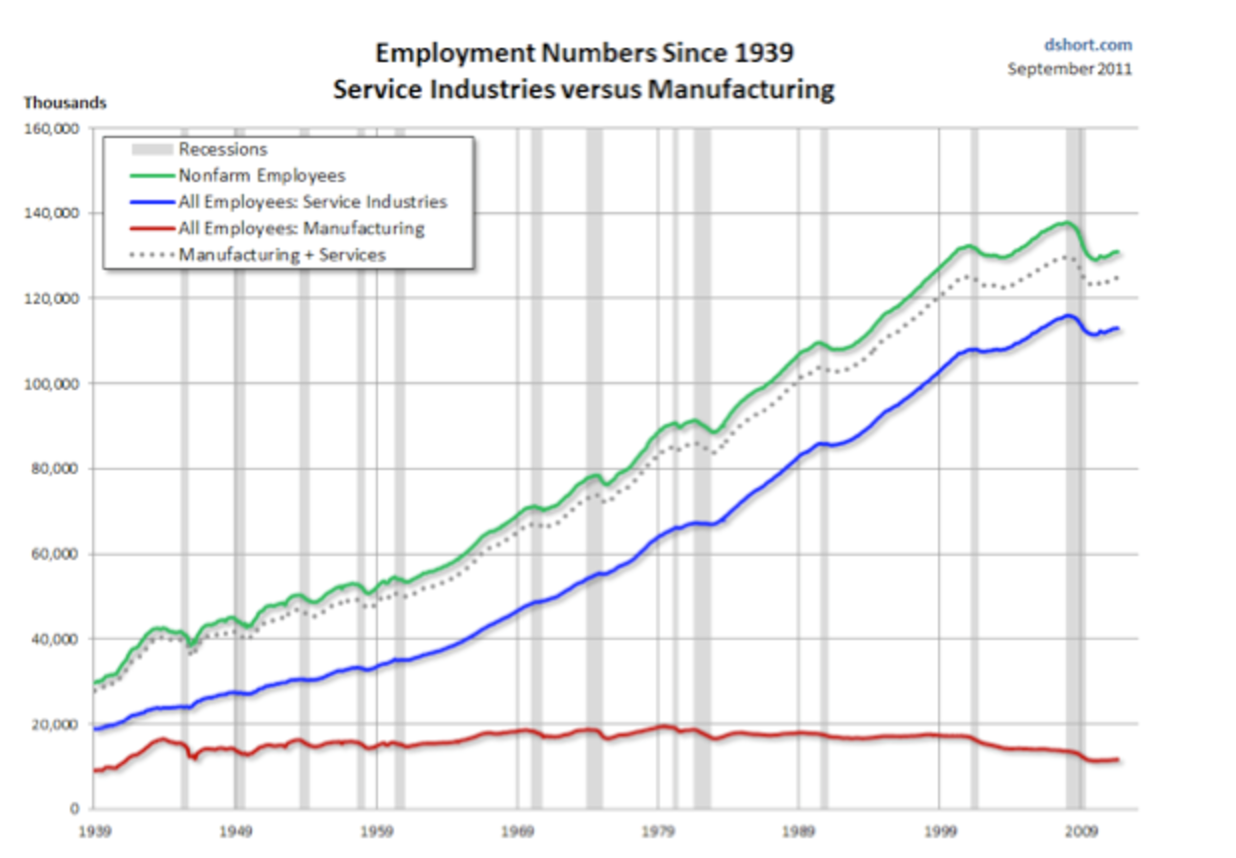
In much of the world economy, all the job growth is in the services sector (green line), not the manufacturing sector (red line). Achieving productivity gains in the manufacturing sector is more straightforward: replace people with robots and you are done. It’s not as straightforward as that in the services sector. In some services sector jobs, it is not possible to decrease effort without it being visible. But in many services sector jobs, it is. If employees cannot improve their lives by making more money, they may decide to do so by working less and working right up to the point where they don’t lose their job.
If you look at employment as a game, then we currently have a Nash equilibrium where the employees know that they won’t get paid more working for the same company, because that is the best strategy for the company. Therefore the best strategy for the employee is to minimize their effort without getting fired and while showing little if any productivity gains.
That’s to me is key reason why I think we have the productivity paradox.
I would add that the reason this is a paradox is because no one wants to admit that this is happening. It seems like a failure on both the employers and the employees side. The employee wants to be seen as a good worker and the employer doesn’t want to admit it could be paying more. Instead technology is brought in to solve an organizational problem, which is something technology cannot do.
(Chart from Business Insider).

 Smart People I Know