Some thoughts on Philip Pullman, free speech and de-platforming

I think often of this speech Philip Pullman gave regarding the rights and limits associated with free speech. I like what he says, and I like how he says it.

I’d like to see a similar one for de-platforming. No one has a right to be popular on social media. No one has a right to access and use a specific platform. No one has a right to stay on the platform if they don’t abide by the rules. If they get kicked off, they can complain on other platforms. They can complain to the owners of the platform. They can build a platform of their own and make their own rules and say what they want in a law abiding way.

But wait, isn’t that a violation of someone’s free speech? I don’t think it is. It gives too much power to existing platforms to treat them like utilities. They are not utilities. If they are utilities, then they should be heavily regulated. Better that they are not regulated, that they do not gain too much power, and that people that want to exercise their free speech build their own platforms.

Free speech should be defined within the context of a citizen and their government. People should be able to say what they want within the law. People should also be willing to accept the social consequences if they say something that offends others. That is what Pullman is saying in some ways. If his book shocks and offends you, you can take action that may harm him by reducing the number of books he might sell. That is the consequence he is willing to take in order to write the book he wanted to write. He understands that free speech has consequences. The one consequence he is not willing to accept is to be prevented from speaking. (I would add that the other consequence he is unwilling to accept is to be physically threatened, an all too common threat that hangs over discussions of free speech on the Internet.)

People who are deplatformed are not prevented from speaking either. They are being prevented from speaking the way they prefer, and that is a different matter. They want to speak their way without the consequence of being deplatformed.


Sara restaurant in Toronto has a cool way to deal with cell phones at restaurants

According to blogTO, the tables are of a ….

…Design by ODAMI and MiiM (that) incorporates innovative tabletop cubbies with heavy, spill-proof lids designed to stow your phone at the beginning of the meal. Servers remove the lid at the end to remind you to return to your phone, and emerge from the period of serenity Sara offers diners.

Nice restaurant, great idea. For more on it, see:  Sara – blogTO – Toronto

Finding your way with maps (via @austinkleon)

Austin Kleon has a great piece here on the importance of maps, and not as a means of getting around: Finding your way with maps

I love maps too. Especially hand drawn maps. And ancient maps.

I worry that our phones may be ruining hand drawn maps. When I used to take my son to hockey, I would draw my own maps to get to various obscure rinks. Later, I found out about Waze and it was so superior I stopped drawing my own maps. It’s too bad: it would be fun for my son years from now to have those old maps (which I never kept).

This is a map too.

It’s not really about how to get around. It’s a map showing the relationship between things. In this case, the organizations and their computers that made up the Internet in 1969. It does something old maps do: they show us the two dimensions of space and the one dimension of time.

Read Kleon’s piece. You’ll want to go look at maps afterwards, and you’ll be glad.

How to grow gardens in the desert? Jordan has an answer


How to grow gardens in the desert? If you are the country Jordan, you use a combination of salt water and sunshine. Lots of both. To see how this engineering miracle occurs, see: BBC – Future – How to use seawater to grow food – in the desert.

It’s a great story, well told. Here’s to it scaling up in the future.

Why math is great, and other interesting ideas, from Steven Strogatz

It’s hard to say why this interview with Strogatz is so good, other than to say he covers much ground on a variety of interesting topics and speaks lively on them. (Ok, I find game theory, “elegant” math, math education, etc, interesting, but you likely will too).

If you enjoyed this interview, he has a recent book out, “Joy of X: A Guided Tour of Math, from One to Infinity.” Worth a look. 

Interview is here: Steven Strogatz interview on math education and other related topics

Where American live in their houses and why you need a smaller one

This is fascinating. Among other reasons, it shows so many people have significant amounts of their living space that they rarely use (the living room, the dining room). I imagine many eat their meals either in the kitchen or the family room. Based on this diagram, I can easily see people being able to get by with almost half the square footage pictured above.

It is nice to have that extra space, but if you wished you could live in a larger space but cannot afford it, you might console yourself with knowing you might not use it anyway. Save your money and live with what you need.

How to be a better conversationalist, starting with 100 questions


When you meet someone at an event or at a party, the inevitable questions come up: What do you do for a living? Where do you live? Whom do you know? These are safe questions, and they lead to tepid conversation most of the time. If such conversations had a colour, it would be beige.

For a list of colourful questions, try some of these (unless beige is your favorite colour)” 100 questions to spark conversation & connection. | Alexandra Franzen

Some of them would still be pretty safe at a work function, such as: What’s your most urgent priority for the rest of the year? Others could lead to some pretty funny stories, such as: What’s something you’ve tried, that you’ll never, ever try again? or What’s the strangest date you’ve ever been on? (These may result in the same story!) Some are fairly personal, such as: What’s one mistake you keep repeating (and repeating)? (You may want to have your own example in case you stump someone). Finally, the last question is one most people should have an answer for, and is likely one that will tell you lots about the person: What are you most grateful for, right now, in this moment?

A great list. Throw some of them in a list on your phone and use them at the next get togther you attend. Better conversations await.

What is wrong with minimalism (and how to fix that)

What is wrong with minimalism? If you were to read this piece by Mark Manson on the Disease of More, you would be right in thinking that less is what we need. The less you have, the better off you should be. In which case, approaching minimalism should be the idea.

Yet minimalism taken to an extreme is just another form of More is Better, which seems to be the point of this Guardian article, Minimalism: another boring product wealthy people can buy.  (And the truth is, minimalism can be difficult to achieve, as this article shows.)  So, is minimalism a good idea or not? Should you give up on minimalism?

What both minimalist and anti-minimalists miss in their arguments is what is required to have a good life. What should be pursued is not to have more because more is better, or having less because less is better, but to have just what is essential for you to have a good life.

Of course what is essential depends on who you are. For some, this is a perfect environment:


For others, it’s this:

There is nothing wrong with a minimal environment if that is essential for you to be happy and content. Likewise, having a room jam packed with stimulating items may be essential to you.  You have to decide for yourself, rather than sticking with a simple formula of Less is More or More is More.

What you should have is  what is essential for you to live a good life. The fix for minimalism is essentialism. Preferably a lean essentialism. But again, that is up to you.

On parenting and the freeing and closing of your mind

There are stages in parenthood when your children occupy all of your mental time, and when they do, you may find your mind is closed. If before parenthood you found yourself open to contemplate and examine ideas, after parenthood you may find that your ability to do that has shutdown. I found that for certain stages of the life of my child, all of my time was spent either focusing on their care or worrying about them. But then there were stages when they settled down and there was less to worry about and my mind freed up again.

If you are a parent and you find yourself wrapped up in the state of your child, you should believe that that will pass, and while you never stop thinking about them, you will find you think / worry about them less. This is a good thing.

YouTube’s fight with its most extreme creators highlights the problem big IT has on it’s hands

Here’s a really good piece highlighting a big problem the Frightful Five / Big IT have right now with user generated content: YouTube’s messy fight with its most extreme creators – Vox.

Some background is in order. For years, content creators on Youtube (part of Google/Alphabet) have been jacking up the extremism in their videos to get more views. Extremism in all senses of the word, including political extremism. Some do it for Fame, but many do it for Fortune. This was going well for them until….

In March this year, 250 advertisers pulled back from YouTube after reports that ads were appearing on extremist content, including white supremacist videos. As a result, YouTube demonetized a wide range of political content, including videos that didn’t include hate speech but might still be considered controversial by advertisers. Creators called it “the adpocalypse” — they saw their incomes from YouTube evaporate without fully understanding what they’d done wrong or how to avoid demonetization in the future.

And this is the problem for Youtube and other platforms…how to maximize both traffic and profit. For a long time the formula was simple: more extreme videos = more traffic = more profit. Now they are hitting a wall, and advertisers and consumers are fed up.

The question big IT will be struggling with is: how to draw the line? In case you think the line is easy to draw, I recommend you watch the video by Carlos Maza of Vox. He makes a case that it is very difficult, even if at first glance it should be obvious what should be removed.

I don’t think there is a simple answer to this. If anything, it is going to be one of the major political debates of the first part of the 21st century, as global IT companies deal with national laws and policies.

A math lover’s post

I knew that Paris had streets named after politicians and historical figures, but I didn’t know how many Paris streets are named after mathmaticians. Apparently quite a few! Amazing. One more reason to love Paris.

Dover publishers have the best books when it comes to math. If you want to see some of their better ones, see this list.

Good stuff.

Published on 9/29 at 9:29 🙂


Some good philosophy links for amateur thinkers

The word Philosophy
These are all links I’ve come across recently and thought worthwhile:

If you are not used to reading philosophy, the first one is a must read. Otherwise, you may find yourself trying to read philosophy in a way that leaves you frustrated.

I’ve seen references to virtue ethics (as well as stoicism) frequently these days: if you aren’t familiar with it, that link is a good starting point to get to know it.

Finally, the last link is useful if you are new to philosophy and want to know it better but find it hard to get started.

(Image from http://uucch.org/morning-philosophy-group)

On being alone

What does it mean to be lonely? Here are two good pieces exploring the aspect of being lonely. First up, a review of the book, The Lonely City: Adventures in the Art of Being Alone, which is something of a memoir, but a memoir focused on exploring the idea of loneliness. The second piece, The future of loneliness | Olivia Laing | Society | The Guardian, examines the idea of loneliness in the context of our current technology and our current society.

How you think of aloneness and being alone depends on your own personal experiences and context. For some, it can be a terrifying idea, being alone, while others find it liberating and exciting. To some, being alone is a foreign place, to others, the state of aloneness is the place they call home.

One of the best things, and hopeful things, ever made about being alone, is this video:

Enjoy.

On statues and awards and the naming of things

The Edmund Pettus Bridge
Statues and awards and the naming of things (schools, hospitals, museums) are about many things, but first they are about power. Those with political or organizational or financial power decide what names go on things, what statues and monuments go where, and who should get awards. Sometimes it is simple, and an award or a thing gets named after someone or something powerful as a direct result of their power. Other times it is subtle, and the award or the statue or the naming of a thing reflects the values of those with power.

When people want to tear down statues or rename things or revoke awards, there is an outcry. That outcry is because of a group fearing their loss of power. You won’t hear people talk of it in those terms: you will hear people talk about values instead. But the change is the result of a shift in power. History isn’t erased because something is renamed or revoked or torn down: anyone who wants to know the history can know it in other ways. And history isn’t changed by putting up more statues or naming things differently.

Of all the ways of understanding history, objects are the worst. They are a crude reminder that a history exists, and they are put in place by powers that be or powers that were. As a place changes, the statues should change, the awards should be redistributed, and the things should be renamed. And this will indeed happen, and it will happen due to the new people in power.

Some thoughts on HBO’s Confederate, some pro but mostly con

There seems to be many opponents and few supporters of the new series planned on HBO, Confederate. It’s easy to see why. This piece by Bree Newsome is a good example of what many think of the upcoming series:

HBO’s Confederate is just a fantasy — unless you’re black – The Washington Post

In some ways, though, I think this piece can be an argument FOR the series, though it argues the opposite. That’s not just me being Devil’s Advocate. My belief is that science fiction has a way of presenting ideas in a way that gets people to think about them and think about them unlike any other form of fiction. From Star Trek to the Handmaid’s Tale, science fiction (especially on TV)  has gotten people to think about ideas that they might normally avoid. Ideas that people might escape from in real life get in front of them when they escape into science fiction. Newsome cites a number of facts about the current suffering black Americans undergo now, facts that many white Americans would just as soon avoid or ignore. The series Confederate could be a forum to bring those ideas and facts to the foreground in a way news editorials or regular TV news cannot. The series could lead to changes in a way other media cannot.

That’s a potential pro for Confederate. I don’t believe it is enough of one. There are many alternative timelines that the producers of the show could have chosen: they seem to have chosen a terrible one. An alternative history that went in a utopian direction would have had issues of its own, but instead they seem to have gone with a dystopian vision. This is certain to cause more pain for black Americans now and likely encourage racists to interpret the series in a way to support their racism.

As artists, the makers of Confederate might argue that a dystopian view is the best way to emphasize the themes and ideas they want the show to carry. However, the makers of Confederate and HBO are in the entertainment business. Alot of money is going into the show, and no doubt they expect to make alot of money from it.  To make all that money by causing pain and encouraging racists is wrong.

This is a key thing: big TV series, like big movies, are not just a forum for ideas. They are big business, and you can’t separate the two. I think artists should have a lot of freedom to present ideas, including ideas that cause suffering and including ideas that are wrong. But artists that make big films and TV shows are artists-capitalists. And that means they need to expect not just people debating their ideas, but people pushing back on their ability to make money from their ideas, including people organizing strikes and boycotts and promoting competition for your show.

HBO and the makers of Confederate have a choice: they can communicate that the show will have good ideas and that the artistry and intelligence of the show will be of a benefit, even if it is dystopian. Or they can just ignore the obvious problems they are causing and proceed. If they chose that route, they should expect to lose both the battle of ideas and the battle of the marketplace. Let’s hope they choose for the best.


Some somewhat objective thoughts on the new Trudeaumania

Lots of chatter on this recently, Justin Trudeau: Canadian Prime Minister, Free World’s Best Hope? – Rolling Stone.

It’s good that the world thinks highly of our leaders, whomever they are. Canada is a significant nation in the world with the ability to influence other nations, and having a leader that is looked up to makes a positive difference.

As a Canadian citizen, I’m more interested in the substance than the PR. And I’m more interested in what the government is doing, not just the Prime Minister. I try to look at the government’s policies, competency in executing on those policies (either through legislation or direction to federal agencies), and how the government supports democracy (through actions to make our country more democratic) or hinders it (by making the country less democratic or by being corrupt).

That means I spend less and less time reading pieces like this, which are along the lines of “if you people were as smart as me you’d realize how bad Trudeau is” . Instead, I look to sites like this which track the government’s progress. For example, this site, TrudeauMeter, has ongoing ratings of the government. Other commentators, like John Ibbitson, provide periodic ratings: Video: Opinion: John Ibbitson rates the Trudeau government as Ottawa wraps up for the summer – The Globe and Mail. Finding sources of information you find comprehensive and objective are always your best bet.

If you don’t support the Liberal government’s policies, then I can see why you would not want the government in place.  Likewise there will be times when you do support the government’s policies but you feel the level of corruption or incompetence is so high you want to turn to a different group. If you are going to rate the Prime Minister and his government, those are good criteria to evaluate them on, not PR like the Rolling Stone magazine, or any other specific good or bad focus pieces on them. The government works for you, and if you are a good boss, you evaluate them mainly on the entirety of their efforts, not just things here and there.

Some other thoughts on Trudeau:

From what I can see so far, his government is starting off unsurprisingly: being successful over things the government has control over (like spending) and having less success over things that requires working with other groups. I suspect they will make no progress on electoral reform unless there is a major push from Canadians. Likewise, there are so many issues and problems with regards to Aboriginal peoples that any progress there will be modest, at best. I wish neither of them were true, but I am not optimistic on those fronts.

I suspect that as long as the economy is doing fine, the government does not appear corrupt or incompetent, and people aren’t tired of his government, then Trudeau and his team will be in power for some time to come. The first one, the economy, will be the one that is most likely to hit him. Corruption takes time to seep in (although major scandals can occur at any time and make the government appear corrupt), and government fatigue takes longer still. Whatever you thought of Chretien or Harper, that was true for them and I suspect it will be true for Trudeau as well.

I will continue to ignore articles that underestimate Trudeau (like the one above). He’s flashy and sometimes appears smarmy, but he’s smart, he has a good team, and politics is in his DNA.  If you oppose Trudeau, underestimating him only works to his advantage and not yours. In addition,  he is as much his mom’s son as his Dad’s. The combination makes him much more effective than his Dad could ever be. His Dad may have had a higher IQ than him, but he has a higher EQ than his Dad ever had and that will make him more challenging to defeat than people who approach politics intellectually realize.

Likewise, I will continue to ignore articles that compare Trudeau to Trump. There is little if anything to be gained by them. Trump is an anomaly. Almost any leader looks good in comparison to the 45th President of the United States.

I like Trudeau for alot of reasons.  That said, it doesn’t matter if I like him or not, anymore than it matters that you dislike him or not. What matters is his ability to do the job. He’s not an entertainer: he’s an elected official. When the next election comes, it won’t matter how good or bad Trudeau’s PR is. What matters is that in comparison to other politicians looking to lead the country, is the government he proposes to lead the best one for the job based on the criteria I have.  That’s the only thing that matters.



Jean-Luc Mélenchon, a candidate right out of a Philip K Dick Novel

Melenchon hologram
In France, politician Jean-Luc Mélenchon plans to be in seven places at once using  something similar to a hologram. According to Le Parisien:

Strictly speaking, these are not holograms. Jean-Luc Mélenchon will be present in seven different places thanks to … an optical illusion discovered for the first time half a century ago by an Italian physicist

Virtual Mélenchon reminds me of the politician Yance in Philip K Dick’s novel, The Penultimate Truth. We may not be far off where we get virtual candidate that look like people but behind the scenes we have AI or some combination of AI and people.

For more on the technology, see the article in Le Parisien. For more on Dick’s novel, see Wikipedia. Read up now: I think we can expect to see more of this technology in use soon.

Is everything political? What is wrong about thinking that way?

Albert Camus, gagnant de prix Nobel, portrait en buste, posé au bureau, faisant face à gauche, cigarette de tabagisme.jpg

I was thinking this when reading this quote from Orwell: “The opinion that art should have nothing to do with politics is itself a political attitude.” The idea, implied by this quote, is that everything is political. This idea springs like a trap on people who want to escape from politics and focus on other areas of human concern, like arts or sports or science.

Is this trap avoidable? There is an argument, found here, Only a Game: The Activist’s Argument (Everything is Political), that says that saying “everything is political” renders it meaningless. It’s worthwhile reading the piece, but I don’t think the argument that the statement is meaningless holds true.

Instead, I would first accept it and I would expand the notion of “everything is political” to say that

  • everything is political
  • everything is scientific
  • everything is religious
  • everything is philosophical
  • everything is art

For if you can make the case that everything is political, you can also make the case that everything is scientific, religious, and so on. (In fact, you can extend this list to other areas of human thought and human interest.) But how can everything be all of those things at the same time? To see how that can be the case, that I would refine the statements above and replace “everything is” with “everything can be viewed through the lens of”, as in:

  • everything can be viewed through the lens of politics
  • everything can be viewed through the lens of science
  • everything can be viewed through the lens of religion
  • etc.

More than that, everything can be viewed from each of those lens at the same time. For example, if I go see a film about Alan Turing, I can view it through the lens of science and I can view it through the lens of politics or the lens of art. The film has political and artistic and scientific themes and ideas, and anyone watching it can view it from those differing viewpoints. You may not care to do so, but it is possible to do so.

Now take the list and change it to read this way:

  • everything should be viewed through a political lens
  • everything should be viewed through a scientific lens
  • everything should be viewed through a religious lens
  • everything should be viewed through a philosophical lens
  • everything should be viewed through an artistic lens
  • etc.

For some political activists, the phrases “everything is political” and “everything should be viewed through a political lens” are practically the same. Their worldview is a political worldview and they think everyone should have this worldview too. The same can be said for scientists, artists, philosophers, etc.

I disagree that everything should be viewed through only one lens or mainly one lens. For example, if a crowd is watching a film, they may watch it through any or all of these lens, or none of them. If asked later if the film she made is mainly political, the director may agree that there is a political aspect to it, but the main themes and elements of the film for her could be religious or aesthetic or scientific. The film may have something to do with politics, but if you see it only or mainly as political, you miss out on the other aspects of the film.

What is true of a film is also true of our lives. Our lives, and the things that matter to us in our lives, can be seen through a political lens, and a religious lens, and many other lens we may pick up. Sticking with only one such lens provides us with such a restricted view. It is better to look at our lives and the lives of others with as many lenses as possible. We will see more that way. We will hopefully understand ourselves better. And we will acquire a view and a wisdom that those stuck to peering through only one lens will never achieve.

(Image is not of Orwell but Albert Camus, which I felt to be more appropriate. Photograph by UPI –  image  from the United States Library of Congress‘s Prints and Photographs division under the digital ID cph.3c08028.
http://www.loc.gov/pictures/item/93507512/ and Wikipedia)

On the superior virtue of the oppressed

Unlike other essays in this collection, Unpopular Essays by Bertrand Russell (Google Books), “The Superior Virtue of the Oppressed” continues to be relevant today. It made a big impression on me when I read it, and I recommend it to anyone who has not read it.

You can read pieces by progressive writers still and find examples of this form of thinking. In some cases, oppressed groups do demonstrate exceptionally virtuous behavior in the face of adversity. My belief is they would rather be treated equally, fairly, and justly, and be free to go about their own business without having to take on the difficulty of pushing back on oppression. And rather than assign them a morally superior role, people in a position to break down that oppression should do so without elevating or denigrating them. (In other words, treating them equally).

Read the essay. Then read more of Russell. Regardless of your thoughts on his arguments, he is a good read for many different reasons, not the least being that he is a fine example of what philosophical writing can be: clear, concise, thoughtful, and accessible.

Derek Parfit: Why anything? Why this? 

The great philosopher Derek Parfit died recently. At the time, many things were posted about him, including where you can find his works online. One such work is this:: Derek Parfit · Why anything? Why this? Part 1 · LRB 22 January 1998.

In it, he asks:

Why does the Universe exist? There are two questions here. First, why is there a Universe at all? It might have been true that nothing ever existed: no living beings, no stars, no atoms, not even space or time. When we think about this possibility, it can seem astonishing that anything exists. Second, why does this Universe exist? Things might have been, in countless ways, different. So why is the Universe as it is?

Worth reading, and accessible, even if you aren’t a philosopher (although we are all philosophers, from time to time).

Thoughts on automation, from the WSJ (and me, someone who specialized in automation)

Robots
Christopher Mims has a good piece here that touches on many of the recent arguments concerning automation, here: Automation Can Actually Create More Jobs (WSJ). Well worth reading.

For my own perspective, early in my career my job was automating many of the systems operations tasks in my part of IBM. In one year I automated essentially the work of 10 people. No one lost their job as result, because while it was good to have these activities automated, the activities were not valuable enough to justify hiring people to do the work. Essentially the automation improved the quality of our work. Automation using IT to improve the quality of work is a good use of automation, be that automation be a lowly shell script or very expensive robot with A.I. Quality aside, how the automation affects staff depends on the culture and the makeup of an organization.

There is talk of places like McDonald’s replacing workers with kiosks as a result of a drive by some for a higher minimum wage. First off, McDonald’s are rolling out those kiosks in Canada, too, which makes me think they are going to deploy them regardless of what the minimum wage is. Second, I have used the kiosks a number of times, and they are of a limited benefit to a McDonald’s customer. The kiosks are good if there is a long line for a person to take your order: they kiosks are bad if there is a small line or no line. They are bad because it will take you many more minutes to place your order, due to the kiosk’s user interface. (Try one and you will see.) The kiosks some time will fail to print out your receipt: if you don’t remember your order number, then you have to go in line, tell them what you ordered, and then get your number. Overall the kiosks are not bad: they are especially good if you like to special order. But if the lines aren’t long and your order is standard, skip them and go in line.

Besides that, McDonald’s will still have plenty of staff and likely will for the future. Kiosks can’t cook, can’t pack your order, and can’t clean the restaurant. If you think robots can do that and do it cheaply, you need to learn more about robotics. I can see why McDonald’s and other fast food places need automation: they are constantly trying to retain people while trying to keep costs down. But the notion they are automating to spite people looking for a higher wage is ridiculous. McDonald’s is not going to become a glorified vending machine and they should not try to be. People go to restaurants and coffee shops to socialize and to come in contact with other people, and automation will provide less of that, not more.

As well, smart fast food places will learn that human contact makes for better business (see Starbucks). There are many ways to be successful as a fast food business, and a positive experience in dealing with staff is one of those ways.

Automation changes work. However, how it changes work is complex. It is tempting to assume that it will eliminate all work, but that is too simplistic. In addition, we need to think about work, income, and why we do what we do. Automation can help us do that, and that is one clear benefit of automation.

(Image: link to image.freepik.com)

Zeitgeist links for December, 2016

I often come across links that capture the spirit of the time, links that I save using Pocket or Instapaper.  Here are some of them, with quick comments.

Politics, mostly American:

Culture:

Psychology, mostly links about glumness in America

Work, mainly grim or putting a good face on work.

Sixteen ways to think about and improve your life

Over the last year or so, I’ve found these worthwhile pieces on how to think about life and how to improve it. If you find one of these worthwhile and it improves your life as a result of you reading it, then I think collecting and writing about these is worthwhile.

  1. If you are feeling lonely and want to understand and deal with it better, consider this: The Science of Loneliness: How Isolation Can Kill You – New Republic
  2. One idea you can consider: talk to strangers. Hello, Stranger – NYTimes.com
  3. If you need new ways to live a better life, courtesy of a famous person….7 Steps to Living a Bill Murray Life – Vulture
  4. Or if you like to write, try to improve your life via writing: Writing Your Way to Happiness – NYTimes.com (I am guessing some writers would not agree with it)
  5. If you struggle to be happy, this could help: Everyone wants to be happy. Almost everyone is going about it wrong. – Vox
  6. If you want to be more optimistic, consider the big picture, presented here: A Cockeyed Optimist – NYTimes.com
  7. If you think you are working too much and are often thinking of cutting back, this could help you: Keynes’ 15 Hour Work Week Is Here Right Now
  8. Lots of good ideas via a collected stream of tweets, here: Things @GhostfaceKnitta Learned in 2015 (with tweets) · valerieinto · Storify
  9. Why should you give away money and be happier: Giving money away makes us happy. Then why do so few of us do it? – Vox
  10. Don’t hesitate when it comes to improving your life. You have less time than you think. See this to see why: These graphics will make you rethink your life – Tech Insider
  11. Being laid off will happen to everyone. If that’s you now,  and you are struggling with it, consider: Advice For the Recently Laid Off – Medium
  12. Self Confidence makes for a better life. Here’s how to become that way and more so: The Truth On How To Become Self Confident
  13. Change your mind, change your life. How? One way: Rewire your brain: Why Practice Makes Perfect: How to Rewire Your Brain for Performance
  14. If you struggle with your thoughts (e.g., worry too much), read : BBC – Future – Why we should stop worrying about our wandering minds
  15. Sometimes the way to improve our lives is not to have more, but to seek less and not be caught up in the trappings of status. To live a simpler life, like this: Here’s why one of the world’s richest men wears hand-me-down clothes – The Washington Post
  16. More on how to live with less. Living With Less. A Lot Less. – The New York Times

(Image from one of the articles linked to on NYTimes.com)

Palo Alto vs. Tokyo: some modest thoughts on housing 

Image of Palo Alto linked to from Wikipedia

Two pieces on housing got me thinking of housing policy and what if anything can be done to improve it. The two pieces are this:

  1. Letter of Resignation from the Palo Alto Planning and Transportation Commission — Medium
  2. Tokyo may have found the solution to soaring housing costs – Vox

(Note: I don’t have much expertise on housing policy. These are just some notes I jotted down after thinking about these pieces. Take the following with a (huge?) grain of salt.)

The first piece describes how housing in Palo Alto, California is becoming too expensive for all but the rich. Part of what is causing this is the limits placed on adding new housing in the area. The second piece describes how Tokyo gets around this, namely by removing the decisions about housing from city politics and making it at a national level.

It seems pretty straightforward then: all cities should remove decision making about housing from the local level and assign it to a body at a national level. But is this true? And would it work in North American cities?

It depends on what you expect your housing policy to be and how effectively you can impose it. If the policy is to have affordable and available housing for a city, then the Tokyo model makes sense. However, there is an assumption that decisions made at a national level will be in line with the desires of the residence of the city. This is a big assumption.

There are at least two sets of desires that home owners have for their homes and their city. One, that their homes and the neighbourhood they live in remain stable or improve. Two, that their homes appreciate in value. The first desire could be wrecked by the Tokyo model. The second desire would definitely be affected by the Tokyo model. With cities like Palo Alto, you have the two sets of desires met, at least in the short term. In the longer term, the second desire could level off as people and industry move elsewhere.

The ideal is to have a national policy that takes into account the need for neighbourhoods to grow organically, for house values to appreciate over time but still allow for affordability, and for cities to  allow for new housing as well as account for when neighbourhoods become depopulated. Having such a policy would support vibrant cities at a national level. You would treat cities as a network of systems, and you would allocate or remove resources over time to keep all cities vibrant, regardless if they are growing or declining.

This is the ideal. Practically, I just can’t see this happening in North American cities. North Americans are too strongly capitalist to allow what is happening in Japan to happen here. If national organizations tried too hard to manage cities and resulted in cooling off housing markets, people would oppose that. For many people, their house is their chief asset, and any efforts to restrict that from appreciation would be met with defiance.

Sadly, I think there are going to have to be many failures within cities such as Palo Alto and San Francisco before there is enough political will to change the way housing is managed. I think the Tokyo/Japan model is out of reach for my continent for decades, still.

It’s unfortunate: you have cities in the U.S. in the rust belt suffering great decline, while cities on the coasts struggling to come to terms with growth. A national policy on housing would help all cities and have a greater benefits for people than the current approach.

I like Palo Alto. It’s a great city, in a great region. I think it would be greater still if it had more housing.

A great primer on self driving trucks that everyone should read. (Really!)

This piece, 1.8 million American truck drivers could lose their jobs to robots. What then? (Vox) is a great primer on self driving trucks and how they are going to have a major impact sooner than later.

If you are interested in IT, AI or robots, it really shows one of the places where this technology is going to have a significant impact.

If you are interested in economics, politics, or sociology, then the effect of robots replacing all these truck drivers is definitely something you want to be aware of.

If you drive on highways, you definitely want to know about it.

In any case, it’s a good piece by David Roberts. That is his beat and I find he always does a great job of breaking down a topic like this and making it easier to understand and relevant to me. I recommend any of his pieces.

The Superbook, the decline of the Personal Computer, and the future of computing

Superbook, a $99 computer project on Kickstarter, is impressive in itself. Based on the sponsorship of this project, many agree with me.

Essentially it extends your phone like a Smart Watch does, but instead of the form factor diminishing, it’s increasing. In some ways, it does what the Chromebooks do, but with the use of your phone. If it works well, it is one more nail in the coffin of the personal computer. Already tablets and other devices have distributed computing away from the personal computer. I can only see this trend increasing as displays and memory and CPUs get better. Sooner than later, the attachment of the display to the keyboard will dissolve, and people will assemble “personal computers” from a variety of tablets and other displays, keyboards, and whatever smart phones they have. The next step is better designed and detachable keyboards, along with more powerful phones. (The phone isn’t a phone anyway: it’s a handheld computer with built in telephony capability).

Networks are going become more pervasive, faster and cheaper. Displays are going to become cheaper. Phone makers are going to need to give you more reasons to buy phones. All of these things point to computing devices like this becoming more prevalent and personal computers getting further and further displaced.

You can find out more about the project, here here.

What drives A.I. development? Better data

This article, Datasets Over Algorithms — Space Machine, makes a good point, namely

…perhaps many major AI breakthroughs have actually been constrained by the availability of high-quality training datasets, and not by algorithmic advances.

Looking at this chart they provide illustrates the point:

I’d argue that it isn’t solely datasets that drive A.I. breakthroughs. Better CPUs, improved storage technology, and of course new ideas can also propel A.I. forward. But if you ask me now, I think A.I. in the future will need better data to make big advances.

The Real Bias Built in at Facebook <- another bad I.T. story in the New York Times (and my criticism of it)

There is so much wrong in this article, The Real Bias Built In at Facebook – The New York Times, that I decided to take it apart in this blog post. (I’ve read  so many bad  IT stories in the Times that I stopped critiquing them after a while, but this one in particular bugged me enough to write something).

To illustrate what I mean by what is wrong with this piece, here’s some excerpts in italics followed by my thoughts in non-italics.

  • First off, there is the use of the word “algorithm” everywhere. That alone is a problem. For an example of why that is bad, see section 2.4 of Paul Ford’s great piece on software,What is Code? As Ford explains: ““Algorithm” is a word writers invoke to sound smart about technology. Journalists tend to talk about “Facebook’s algorithm” or a “Google algorithm,” which is usually inaccurate. They mean “software.” Now part of the problem is that Google and Facebook talk about their algorithms, but really they are talking about their software, which will incorporate many algorithms. For example, Google does it here: https://webmasters.googleblog.com/2011/05/more-guidance-on-building-high-quality.html At least Google talks about algorithms, not algorithm. Either way, talking about algorithms is bad. It’s software, not algorithms, and if you can’t see the difference, that is a good indication you should not be writing think pieces about I.T.
  • Then there is this quote: “Algorithms in human affairs are generally complex computer programs that crunch data and perform computations to optimize outcomes chosen by programmers. Such an algorithm isn’t some pure sifting mechanism, spitting out objective answers in response to scientific calculations. Nor is it a mere reflection of the desires of the programmers. We use these algorithms to explore questions that have no right answer to begin with, so we don’t even have a straightforward way to calibrate or correct them.” What does that even mean? To me, I think it implies any software that is socially oriented (as opposed to say banking software or airline travel software) is imprecise or unpredictable. But at best, that is only slightly true and mainly false. Facebook and Google both want to give you relevant answers. If you start typing in “restaurants” or some other facilities in Google search box, Google will start suggesting answers to you. These answers will very likely to be relevant to you. It is important for Google that this happens, because this is how they make money from advertisers. They have a way of calibrating and correcting this. In fact I am certain they spend a lot of resources making sure you have the correct answer or close to the correct answer. Facebook is the same way. The results you get back are not random. They are designed, built and tested to be relevant to you. The more relevant they are, the more successful these companies are. The responses are generally right ones.
  • If Google shows you these 11 results instead of those 11, or if a hiring algorithm puts this person’s résumé at the top of a file and not that one, who is to definitively say what is correct, and what is wrong?” Actually, Google can say, they just don’t. It’s not in their business interest to explain in detail how their software works. They do explain generally, in order to help people insure their sites stay relevant. (See the link I provided above). But if they provide too much detail, bad sites game their sites and make Google search results worse for everyone. As well, if they provide too much detail, they can make it easier for other search engine sites – yes, they still exist – to compete with them.
  • Without laws of nature to anchor them, algorithms used in such subjective decision making can never be truly neutral, objective or scientific.” This is simply nonsense.
  • Programmers do not, and often cannot, predict what their complex programs will do. “ Also untrue. If this was true, then IBM could not improve Watson to be more accurate. Google could not have their sales reps convince ad buyers that it is worth their money to pay Google to show their ads. Same for Facebook, Twitter, and any web site that is dependent on advertising as a revenue stream.
  • Google’s Internet services are billions of lines of code.” So what? And how is this a measure of complexity?  I’ve seen small amounts of code that was poorly maintained be very hard to understand, and large amounts of code that was well maintained be very simple to understand.
  • Once these algorithms with an enormous number of moving parts are set loose, they then interact with the world, and learn and react. The consequences aren’t easily predictable. Our computational methods are also getting more enigmatic. Machine learning is a rapidly spreading technique that allows computers to independently learn to learn — almost as we do as humans — by churning through the copious disorganized data, including data we generate in digital environments. However, while we now know how to make machines learn, we don’t really know what exact knowledge they have gained. If we did, we wouldn’t need them to learn things themselves: We’d just program the method directly.” This is just a cluster of ideas slammed together, a word sandwich with layers of phrases without saying anything. It makes it sound like AI has been unleashed upon the world and we are helpless to do anything about it. That’s ridiculous. As well, it’s vague enough that it is hard to dispute without talking in detail about how A.I. and machine learning works, but it seems knowledgeable enough that many people think it has greater meaning.
  • With algorithms, we don’t have an engineering breakthrough that’s making life more precise, but billions of semi-savant mini-Frankensteins, often with narrow but deep expertise that we no longer understand, spitting out answers here and there to questions we can’t judge just by numbers, all under the cloak of objectivity and science.” This is just scaremongering.
  • If these algorithms are not scientifically computing answers to questions with objective right answers, what are they doing? Mostly, they “optimize” output to parameters the company chooses, crucially, under conditions also shaped by the company. On Facebook the goal is to maximize the amount of engagement you have with the site and keep the site ad-friendly.You can easily click on “like,” for example, but there is not yet a “this was a challenging but important story” button. This setup, rather than the hidden personal beliefs of programmers, is where the thorny biases creep into algorithms, and that’s why it’s perfectly plausible for Facebook’s work force to be liberal, and yet for the site to be a powerful conduit for conservative ideas as well as conspiracy theories and hoaxes — along with upbeat stories and weighty debates. Indeed, on Facebook, Donald J. Trump fares better than any other candidate, and anti-vaccination theories like those peddled by Mr. Beck easily go viral. The newsfeed algorithm also values comments and sharing. All this suits content designed to generate either a sense of oversize delight or righteous outrage and go viral, hoaxes and conspiracies as well as baby pictures, happy announcements (that can be liked) and important news and discussions.” This is the one thing in the piece that I agreed with, and it points to the real challenge with Facebook’s software. I think the software IS neutral, in that it is not interested in the content per se as it is how the user is responding or not responding to it. What is NOT neutral is the data it is working off of. Facebook’s software is as susceptible to GIGO (garbage in, garbage out) as any other software. So if you have a lot of people on Facebook sending around cat pictures and stupid things some politicians are saying, people are going to respond to it and Facebook’s software is going to respond to that response.
  • Facebook’s own research shows that the choices its algorithm makes can influence people’s mood and even affect elections by shaping turnout. For example, in August 2014, my analysis found that Facebook’s newsfeed algorithm largely buried news of protests over the killing of Michael Brown by a police officer in Ferguson, Mo., probably because the story was certainly not “like”-able and even hard to comment on. Without likes or comments, the algorithm showed Ferguson posts to fewer people, generating even fewer likes in a spiral of algorithmic silence. The story seemed to break through only after many people expressed outrage on the algorithmically unfiltered Twitter platform, finally forcing the news to national prominence.” Also true. Additionally, Facebook got into trouble for the research they did showing their software can manipulate people by….manipulating people in experiments on them! It was dumb, unethical, and possibly illegal.
  • Software giants would like us to believe their algorithms are objective and neutral, so they can avoid responsibility for their enormous power as gatekeepers while maintaining as large an audience as possible.” Well, not exactly. It’s true that Facebook and Twitter are flirting with the notion of becoming more news organizations, but I don’t think they have decided whether or not they should make the leap or not. Mostly what they are focused on are channels that allow them to gain greater audiences for their ads with few if any restrictions.

In short, like many of the IT think pieces I have seen the Times, it is filled with wrong headed generalities and overstatements, in addition to some concrete examples buried somewhere in the piece that likely was thing that generated the idea to write the piece in the first place. Terrible.

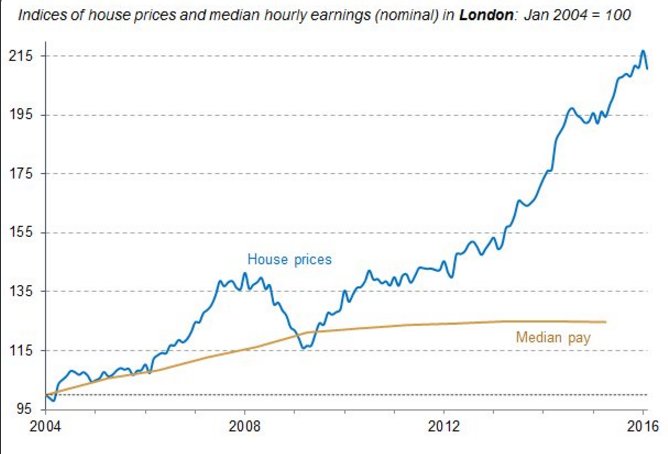
Houses aren’t homes: they’re capital

And in the richest cities, like London, they are greatly appreciating capital, as this shows:
Media preview

With some reflection, this makes sense, if you take as a given that:

  •   Stocks and bonds and even wages are fairly stagnant in terms of return on investment
  • Urbanization means homes in cities that are desirable to live in are becoming more scarce

The result is homes becoming one of the forms of capital that can has the means to greatly appreciate in value.

To reverse this will require a greater supply of homes on the market, either through greater density in desirable cities or through more cities becoming desirable to live in. I can see both of these occurring. What I don’t see occurring is other forms of capital becoming more capable of great growth.

It will be interesting to see what happens in 10 years. But right now, bet on homes in key cities to continue to do this.


This article about body cameras is asking the wrong questions, which is not surprising, since everyone is.

This article,  Will Body Cameras Work? – The Atlantic, is asking the wrong questions. The wrong questions are occurring because the initial answer to the question of “how do we deal with bad policing?” was often, “body cameras”. The better question to repeatedly ask: “how can we make police more accountable?” because if “body cameras” is the first answer to that question, the next question should be concerning the information captured by those body camera. How are police accountable for that? Which should then lead to another question: how are police accountable for information they capture generally? Because with new technology, police will soon be able to capture alot more information about you than just images. It will soon be possible for police to look at you or your vehicle and have that information feed back to centralized computer systems, essentially collecting information about you without you even knowing it. How will police be accountable for that?

Police accountability will come, likely through the courts. In the meantime, we will likely struggle with the fallout of police forces capturing more information.

If you feel you are stuck in the Procrastination Doom Loop, there’s help (by the Atlantic and yours truly)

Do you ever get stuck in this loop?

If so, then the Atlantic has an article for you. According to this article, The Procrastination Doom Loop—and How to Break It – The Atlantic,

Delaying hard work is all about your mood.

And it goes on to talk about how to defeat this.

Seven additional suggestions I have on defeating this doom loop:

  1. set a regular schedule of tackling difficult tasks and stick with it.
  2. dilute the difficulty by giving yourself a ridiculous amount of time to do it. If it will likely take 20 minutes, schedule 2 hours and just sit there and do nothing else until you get it done.
  3. set up a reward for getting it done.
  4. set up significant negative consequences for not getting it done. You might need help from a friend or coach here.
  5. log the positive feelings and thoughts you feel after you get it done. Review that often.
  6. log the negative feelings and thoughts you have before you do it. After you do it, analyse what you wrote and revisit your thinking and feeling. You will likely find it wasn’t as bad as you had expected.
  7. have a list of things you are procrastinating on. For example, if you have two things you are avoiding, try to avoid doing one of them by doing the other. It’s better to get one thing done than getting none done

This may just be the stupidest defense of Amazon’s workplace practices

This piece may be the stupidest defence of Amazon’s workplace practices: Replace Just 2 Words in the New York Times Amazon Article and Something Amazing Happens | Inc.com.

Amazon employees are not entrepreneurs. There is nothing in the NYTimes.com article that gives any inkling that they are. If anything, they have all the downside of being an entrepreneurs with little if any of the upside.  If someone can point out an article showing how Amazon consistently rewards employees as if they are true entrepreneurs, I’d love to read it.

There’s nothing wrong with being an entrepreneur. In fact, for some people, being an entrepreneur is the best type of work there is. Everything about it appeals to them, and working for a large corporation would kill them.

The Amazon employees are not entrepreneurs.  If you want to be an entrepreneur, be one. Don’t try to be one working at a large corporation. That is antithetical to what being an entrepreneur is.

Forget self driving cars – the first big thing will be self driving trucks

While there is lots of discussion about self driving cars, it’s much more likely that self driving trucks will become standard and accepted first. Here are two stories that support that. First this: How Canada’s oilsands are paving the way for driverless trucks — and the threat of big layoffs. Second, over at Vox, is:  This is the first licensed self-driving truck. There will be many more. Key quote from Vox:

Last night at the Hoover Dam, the Freightliner company unveiled its Inspiration Truck: the first semi-autonomous truck to get a license to operate on public roads.

The Inspiration is now licensed to drive autonomously on highways in Nevada. It works a bit like a plane’s autopilot system: a driver will get the rig on the highway, and can take control at any time once it’s there. But the truck will be able to drive itself at high speeds, using cameras to make sure it stays within its lane and doesn’t get too close to the vehicle in front of it.

Self driving trucks are already up and operational. Additionally, the business case and the hurdles to overcome with self driving trucks will be easier to achieve than that of self driving cars in urban areas. Sooner than you think, you will commonly see self driving trucks on highways, especially during the hours when most highways are 80-90% trucks.

Transportation is changing. Self driving trucks are going to be leading that change. Self driving cars will be a distant second.


ICYMI: What is code, by Paul Ford

Happy Monday! Are you affected by code at work? Of course you are! Do you code at work yourself? Very likely, even if it is to use formulae in a spreadsheet program like Excel (which, years ago, would have required been considered coding). However code affects you, I highly recommend you read this:
Code. It’s a very rich piece on code (i.e. software) and what it means to you (and everyone else).

Among other things, it is brilliantly designed. Lots of hard work went into this piece. If you can’t get started yet this week at work, read this as a research project.