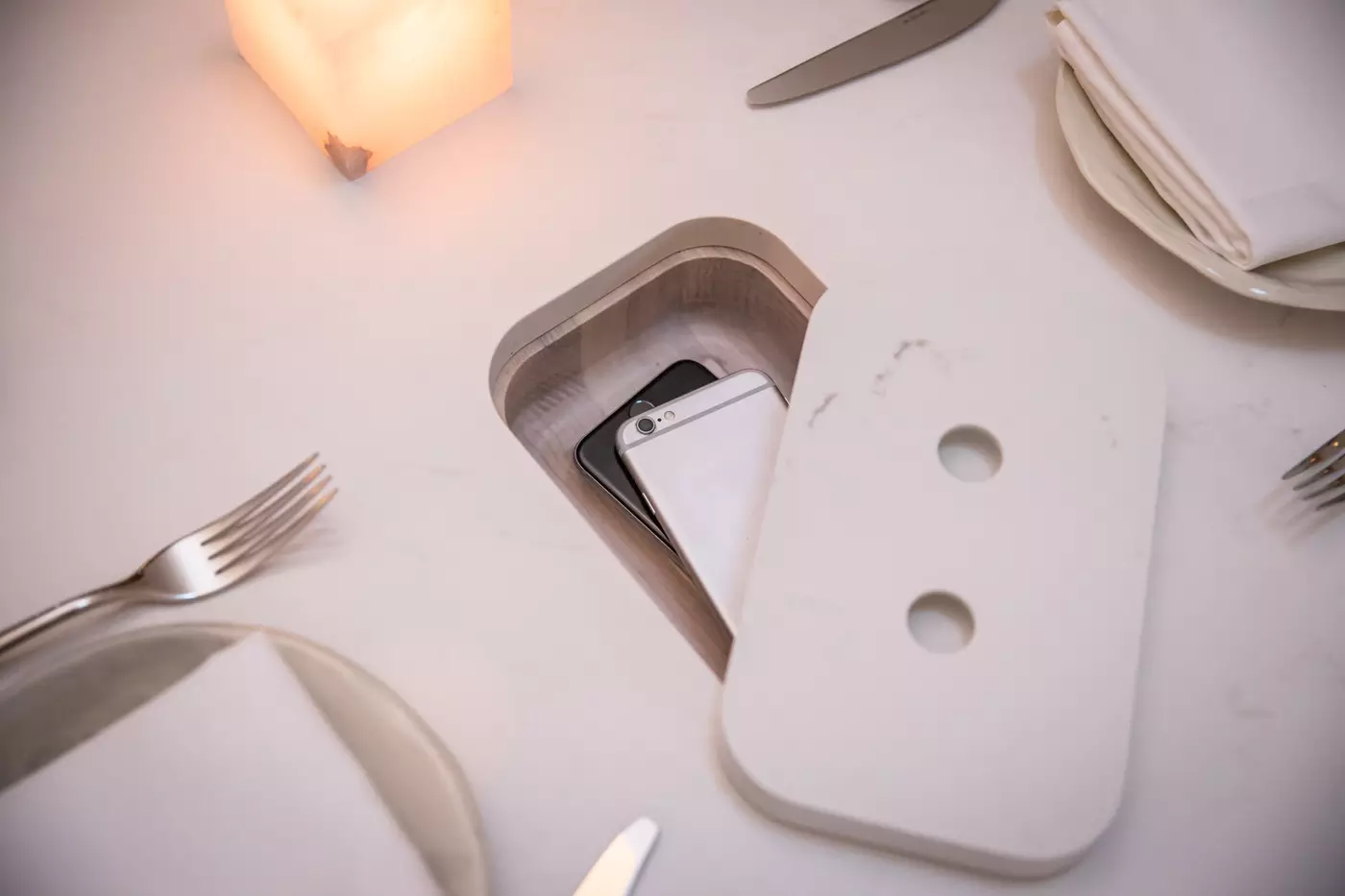
Sara restaurant in Toronto has a cool way to deal with cell phones at restaurants

According to blogTO, the tables are of a ….

…Design by ODAMI and MiiM (that) incorporates innovative tabletop cubbies with heavy, spill-proof lids designed to stow your phone at the beginning of the meal. Servers remove the lid at the end to remind you to return to your phone, and emerge from the period of serenity Sara offers diners.

Nice restaurant, great idea. For more on it, see:  Sara – blogTO – Toronto

Some thoughts on my new Amazon Fire 7 8GB FireOS 7″ Tablet for $59 at Bestbuy.ca


I saw this in Best Buy the other day, Amazon Fire 7 8GB FireOS 7″ Tablet With MediaTek MT8127 Quad-Core Processor – Black : Android Tablets – Best Buy Canada, and after reading some reviews and other articles (see below), I decided to get one. The $59 price tag had a lot to do with this.

My first thought was to try to use it as much as I could out of the box without making modifications to it. I set it up according to instructions, which were simple. I think you really want to have an Amazon account/userid to do this. I did and so things went smoothly.

The Amazon Fire has a modified version of the Android OS, which means it’s like an Android tablet, but not exactly. Likewise, Amazon has an App store, which is a limited version of the Google Play App store. You can get a number of apps from the Amazon App store, but not everything you can get on the Google Play store.

I wanted this device mainly as a place to consume media. Good news is it runs Netflix, Twitter, Instagram, Facebook, Mail, Texture and a modified version of YouTube.  I was especially interested in Texture, which allows me to read magazines like New Yorker, Bon Appetit, Wired and others. I have been trying to read them on my phone and the experience was poor. On the tablet, the experience was much better, and the resolution was good. Likewise, YouTube videos are better on the tablet than the phone.

Downsides?  First the device is slow compared to my iPhone 6. You notice it with things like Twitter and Instagram. You don’t notice it for things like Texture because there is more reading time and less scrolling.  It’s not terrible, but it is noticeable if you have a newer device. If you have an up to date phone or tablet, you will notice this.

Another downside is the limited number of apps, especially media apps. I could not get the New York Times, Guardian or CBC app for it. It comes with the Washington Post, not surprisingly.

The browser that comes with it is slow. You cannot download other browsers without hacking the device.

One upside is you can get quite a few apps working for it. I downloaded Remember the Milk (for todos), Simplenote (for notetaking), WordPress (for blogging), Dropbox and more. I mainly want to use it for media consumption, but those things make it better.

To summarize: for $59, I think it is a great device for media consumption and basic functionality. If that’s all you want, I think you’d be happy with it. I’m glad I got it. Some reviewers said it is better to get the Fire 8 or 10, but for the money, I think the Fire 7 is surprisingly good.

P.S.Originally I was going to hack it to make it more like an Android tablet, but for now I think I’ll leave it as it is. If you did want to hack it, here’s some links to articles along that line:

P.S.S. This is not sponsored content.

The internet says: follow your passion. But what if you have no specific passion to follow?

You can find many places on the internet where you are encouraged to Follow Your Passion. One such place is here: Why Following Your Passions Is Good for You (and How to Get Started) – The New York Times

Love to cook? Love to write? If those are your passions, then the internet wants you to follow them.

But what if you don’t have specific passions. The NYTimes piece has an answer for that too:

No passions? Cultivate skills instead
While hobbies both enrich our lives and can turn into rewarding careers, those of us who don’t have a particular obsession aren’t hopelessly out of luck. Instead, cultivate skills that will give you a leg up in your field. We all carry a “toolbox” to work in the form of specific abilities that make us better at our jobs. Some experts say leveling up on some of these will improve your job satisfaction more than initial enthusiasm ever will.

It’s easier to improve yourself in an area you are passionate about. But taking pride in your skills and your qualities and working to hone them is worthwhile. If there’s not an area you feel a strong passion for, at least improve in the areas you can.

Passion is a strong word. So is pride. If you can follow your passion, follow your pride and be justly proud of the things you are good at.

What you need to accomplish extraordinary things

I liked both of these articles:

  1. A Lone Man Spends 53 Years Building a Cathedral by Hand | Colossal
  2. Janitor secretly amassed an $8 million fortune and gave most of it away

Both men accomplished significant acts of creativity and generosity without having much resources. In both cases, the things they had in abundance were

  1. drive
  2. dedication
  3. faith

They didn’t have a great amount of money or genius or things that people think you need to accomplish extraordinary things.

Alternatives to Cloud White: two other Benjamin Moore white paints to consider

If you want an off white paint for your interiors, you can’t beat Cloud White from Benjamin Moore. However, if you do want to consider alternatives then these two articles agree that you want to look at either White Dove or Simply White, also by Benjamin Moore. These two pieces also go into detail as to when you want to use them (e.g. trim, kitchen cabinets). Before you start painting, check them out:

    1. Colour Review: Benjamin Moore 3 Best Warm White Paint Colours
    2. The Three Best Off Whites By Benjamin Moore – Warline Painting

How to take your git skills to the next level

One way is to read this: How to become a Git expert – freeCodeCamp.org. There’s a lot of good pages on how to get started on git, but if you are joining a software project, you may be expected to know more than the basics. You may be required to know the kind of things that piece talks about. Of course you can ask people on your team for help, but why not get as much skill as you can first and then ask better questions? There’s always something new to learn when it comes to git and software management: learn as much as you can by yourself and increase your skill set and your value to the team.

How to make french fries at home with this amazingly simple recipe

This recipe is amazing:  easiest french fries – smitten kitchen.

I have always been intimidated by the idea of making fries/frites at home. It turns out it could not be easier if you follow that recipe. It’s really a case of set it and more or less forget it.

Some notes:

  • I used corn oil because of it’s high smoking point. You could use other oils too.
  • I used a Dutch oven to make the fries.  It keeps the oil from splashing over onto the oven or burner.
  • I found a potato the size of a baseball feeds one person. A potato the size of a softball feeds two people.
  • I used Yukon gold potatoes.
  • I put big flaky salt on the fries right after I fish them out of the oil.
  • Regardless of how long the recipe says, remove the fries when they are a brown gold colour. It could be 20 minutes but it could be less.
  • Serve hot!


The Beatles / White Album Box Set

Likely only for hardcore Beatle fans, this box set of the White Album promises to be the White Album on steroids. Rolling Stone has plenty of detail on it, via White Album Box Set: Exclusive Preview of Unheard Beatles Archives – Rolling Stone. It even has a description of one of my favorite odd pieces by McCartney:

12. “Can You Take Me Back?”
The snippet on Side Four that serves as an eerie transition into the abstract sound-collage chaos of “Revolution 9.” Paul toys with it for a couple of minutes, trying to flesh it out into a bit of country blues—“I ain’t happy here, my honey, are you happy here?”

Like “Her Majesty”, it’s a sketch of something, but inserted in such a way as to make the whole album something more original. It’s always haunted me.


What makes a house a home? IKEA has the answer (no, it’s not a new Billy bookcase)

(

This is a really good study put out by IKEA: IKEA Feeling Of Home Study – Emotional Needs At Home | Apartment Therapy.

According to the summary piece in Apartment Therapy, what makes a place feel like home are:

  • privacy
  • comfort
  • ownership
  • security
  • belonging

It makes sense. Sadly, those are feelings that people may not have towards the place they live. People struggling to pay rent, or sharing with others, may not feel like they have privacy or ownership or security. People always moving lose that sense of belonging.

It’s a good thing to read, and a good thing to contemplate about your own living space. Here’s hoping you have all those feelings about where you live right now.


Finding your way with maps (via @austinkleon)

Austin Kleon has a great piece here on the importance of maps, and not as a means of getting around: Finding your way with maps

I love maps too. Especially hand drawn maps. And ancient maps.

I worry that our phones may be ruining hand drawn maps. When I used to take my son to hockey, I would draw my own maps to get to various obscure rinks. Later, I found out about Waze and it was so superior I stopped drawing my own maps. It’s too bad: it would be fun for my son years from now to have those old maps (which I never kept).

This is a map too.

It’s not really about how to get around. It’s a map showing the relationship between things. In this case, the organizations and their computers that made up the Internet in 1969. It does something old maps do: they show us the two dimensions of space and the one dimension of time.

Read Kleon’s piece. You’ll want to go look at maps afterwards, and you’ll be glad.

The state of meetings

I’ve had this saved from some time ago but I want to post it for two reasons: The Modern Meeting: Call In, Turn Off, Tune Out – The New York Times.

One reason is just as a placeholder for how work is now in this time period. I will be happy to go back in five or ten years from now and see how much has changed.

The second reason is that no matter what happens in five or ten years from now, people who work in offices will always struggle with meetings. There is no solution to effective meetings: there is only managing your time and how best to be effective in the time you are working and meeting. If you work with people, you will have meetings. Nowadays you have too many meetings and you need to manage them and your time as best as you can.

Once meetings were hard to schedule. There were no digital calendars, no videoconferencing. You had to call or talk to someone and arrange to meet them, they would write it down on a piece of paper, and then physically show up and have the meeting. You likely worked with a limited number of people. And even then, even though they were hard to set up, meetings were a pain. Meetings will always be a pain. If they weren’t occasionally useful, no one would ever have them.

But meetings are occasionally useful. Sometimes they are essential. As long as people work together, there will be meetings. If you are working on many different things with many different people, you will have many meetings. Try to be as effective as you can in them. For those holding the meeting, don’t expect so much of people: get what you can and then end the meeting.

Everything you need to know for sheet-pan cooking can be found here

Everything you need to know for sheet-pan cooking can be found here at this page: How to Make a Sheet-Pan Dinner – NYT Cooking

It’s a comprehensive review on how make any meal using a sheet-pan. If you are a fan of cooking that is easy like slow cookers then you want to check this out.

How to guides are great for people who like to come up with their own recipes. It’s also great if you are trying to use up various ingredients in your fridge.

The weather is getting cooler. It’s time to start using your oven again. This guide will help with this.

Do you want to read more women writers but need suggestions? The Hay Festival of Literature and the Arts has your back

How so? Here is a list of one hundred books by great women authors on a wide range of topics, including graphic novels like Persepolis. Hay Festival of Literature and the Arts – #VOTE100BOOKS. 

Regardless of the voting and which book gets the most, it is safe to say that everything listed is worth seeking out.

It’s unlikely even well read people haven’t read all these. If you find you want to read more women, you’re bound to find things on that list.

The crumbling and outright destruction of “brutalist treasures”

If you are a fan of Brutalism, you will want to visit this: Attack the blocks: brutalist treasures under threat – in pictures | Cities | The Guardian

You might want to even visit them, because for some of them, their days are numbered.

I imagine that in the next 50 years, the number of Brutalist buildings currently existing will be significantly reduced. That would be a shame. Brutalism gets knocked hard, and I can see why. But worse than Brutalist building are boring buildings from all different architectural styles. I’d like to see those go first. The world could use good Brutalism in their cities. Here’s hoping it doesn’t undergo severe decline.

How economic hardship traumatizes people individually and as a culture

This piece, Opinion | Still Haunted by Grocery Shopping in the 1980s – The New York Times, by a Brazilian economist highlights the emotional scars that economic hardship has on a person. Key quote for me was this:

Research has found that children living in poverty are at increased risk of difficulties with self-regulation and executive function, such as inattention, impulsivity, defiance and poor peer relationships. It takes generations until society fully heals from periods of deep instability. A study in the early 2010s showed that Germans were more worried about inflation than about developing a life-threatening disease such as cancer; hyperinflation in the country ended almost 100 years ago.

Not only does it touch people individually, but you could make the case that it gets embedded into the culture. Germans are still worrying about inflation! Indeed, I remember my mom telling me how the Great Depression affected her mother to the point that she adopted behaviors she could never shake, not matter how much she had in the future.

Economics can seem dry, especially when people focus on numbers. But those numbers paper over how people are really affected. What is the emotional impact of high (or low) unemployment? What do we see happening in the culture when housing becomes unaffordable or work impossible to get. The numbers are an essential part of the story but they are also just the start of the story.


Why does this not surprise me? Jacobin Accused of Reneging on Wage Deal

The owner of left-wing magazine Jacobin stiffs his workers for his play to take over other property.

In his bid to take over the historic British left-wing magazine, The Tribune, Jacobin publisher Bhaskar Sunkara is being accused of reneging on wage deal by employees of the paper, who kept the publication alive during struggling times. Tribune was once the home of such greats as George Orwell and has since become the leading publication associated with the influential Momentum faction within the Labor Party.

For the details, see this: Jacobin Accused of Reneging on Wage Deal in British Takeover of Tribune Magazine – Payday Report

Do you know someone who wants to learn how to code? (Maybe it is you!)

Then this is a good page for them to go to: How I Learned How To Code Using Free Resources | Home | Bri Limitless. 

There’s plenty of good links to information, and they are all free. I can vouch for a number of them, such as Codecademy and Coursera.

One problem people run into is: why should I learn to code? One obvious answer is to learn a set of skills to help them gain employment. Two other reasons I have:

  1. build a website to promote yourself or any future business you might have.
  2. automate things you do on your computer

For #1, being able to build a website is a great way to promote yourself and show yourself to the world. As for #2, that’s the main reason I still keep coding. There’s lots of information I want to process, personally and professionally, and coding is the best way to do that.

Regardless of your reason, if you want to learn to code, check out Bri Limitless’s web page.

How to grow gardens in the desert? Jordan has an answer


How to grow gardens in the desert? If you are the country Jordan, you use a combination of salt water and sunshine. Lots of both. To see how this engineering miracle occurs, see: BBC – Future – How to use seawater to grow food – in the desert.

It’s a great story, well told. Here’s to it scaling up in the future.

Some thoughts on insurance companies and the use of wearable technology

When it comes to insurance and wearables, I think the effect of these devices will be limited. I think this because:

  1. I don’t believe people are consistent about using wearables. I have been using wearables and fitbits for some time. I believe most people are prone to not wearing them constantly. Inconsistent use will make it harder for insurers to guarantee you a  better rate or for you to achieve one.
  2. You are more likely to wear it and use it when you are trying to keep in shape. If you are not, you will likely not wear it. The insurer can’t know if you are getting out of shape or just no longer wearing it. (I used to use a Nike+ device for running, and I ran consistently, but I did not use the device consistently. Many days and weeks I just didn’t feel like it.) The use of wearables is mostly an upside for you, and of limited value to the insurer.
  3. One reason I gave up on using wearables consistently is that they don’t give you much new information. I walk and exercise consistently and so they often give me the same information consistently. Which means I tend to not wear them often. I don’t need the fitbit to tell me I walked 10,000 steps. I know I did because my commute to and from work plus my lunchtime walk consistently gives me that.
  4. My fitbit scale is great for tracking my weight over time, but an insurer could also just ask me my weight, height and waistline and get a sense of my eligibility for insurance, just like how they ask if I smoke. A very low tech way to measure things. Men with a waist over 40 inches are more prone to heart disease then men with much smaller waists, regardless of what a high tech scale says. A insurer needs a limited number of data points to assess your health risks.
  5. I believe there is limited return for insurers to get this much data. I base this on my current life insurer. I can get life insurance from 1-6X my salary (assuming I pay the corresponding rise in premiums) without providing medical data. They only ask for medical data if I ask for more than 6X. It likely isn’t of benefit for them to process the data for lower amounts, so they proceed without it.
  6. Insurers are data driven, for sure, but I think they are good at picking out a limited number of good numbers to determine what to charge you for insurance. I don’t think the numbers coming back from wearable tech is all that good.

So in short, I don’t believe people or insurers will get much benefit from wearable tech. People will not get breaks on their insurance, and insurers will not be able to reduce their risk substantially with the use of wearables.

MindMup 2: a good web based mindmapping too

I’m a fan of mindmapping tools in general. One I’ve been using and enjoying lately is MindMup 2. 

Two things I like about it:

  1. It’s simple to modify your mindmaps on the go. You don’t need to do much to add or modify your map.
  2. It’s also simple to export your mindmap into a number of different formats. If you occasionally use mindmaps or you want to start with a mindmap to generate ideas but then you want to do the majority of the work in Word or some other tool, this is a good feature.

Mindmup_2 is a good tool. Go map your thoughts.

How to ask for help (it’s not as obvious as you think)

If you are uncomfortable asking for help, read this: How to Ask for Help and Actually Get It – The New York Times. After you read it, write out the type of help you need and use the article’s guidelines to insure your request for help is more effective.

We all need help from time to time. Read that and you will be more effective in getting the help you need.

One last thought: show appreciation before, during and after someone helped you. Even if they say it is no big deal to help. If for no other reason, it acknowledges the effort someone has taken to help you.

Get help. Your life will get better as a result. And the people who help you will often feel better about themselves for helping you, so you are helping them too.

Good advice on how to get started on that project / hobby / adventure you have always want to start


Good advice on how to get started on that project / hobby / adventure you have always want to start can be found here: How to Dare to Begin.

Beginning is often the biggest hurdle. Before you begin, you can imagine all the difficulties you will have, and such imaginings stop you before you can even start. If this applies to you, read the article. You may find yourself getting started after all.

Another thought: take an athlete’s approach to getting started and keeping at it. Get a coach. Get cheerleaders. Talk it up while you are doing the thing you’ve held off doing. Give yourself as much encouragement as you can. Give yourself a goal. Do all those things and you will find you not only get started but you keep going.

Good luck. Dare to do good things. Great things, eventually.

(Image from the article linked to.)

Bill Murray’s advice on being a father

From a 2012 Bill Murray Interview in Esquire comes this:

If you bite on everything they throw at you, they will grind you down. You have to ignore a certain amount of stuff. The thing I keep saying to them lately is: “I have to love you, and I have the right to ignore you.” When my kids ask what I want for my birthday or Christmas or whatever, I use the same answer my father did: “Peace and quiet.” That was never a satisfactory answer to me as a kid — I wanted an answer like “A pipe.” But now I see the wisdom of it: All I want is you at your best — you making this an easier home to live in, you thinking of others.

Sounds right.

When to think about your life, and when not to

There are times to think about your life, and times not to. Austin Kleon has a very simple rule to help him decide:

I have a very simple rule that serves me well: Don’t think too much about your life after dinnertime. Thinking too much at the end of the day is a recipe for despair. Everything looks better in the light of the morning. Cliché, maybe, but it works.

I first agreed with this. Afterwards, I concluded it depends on each individual. For me, I found a good time to think about my life was between midnight and two. It’s quiet then, I am tired but also relaxed. There’s no distractions, nothing else left to do but sleep. If I accomplished things in the daytime, it was especially good to think about what’s next in my life. Likewise if I had a good weekend, the best time to think about my life is Monday morning: I’m rested, energized, and feeling I can get a lot done during the week.

I found the time to not think about my life was any time I am really tired or sick or having a very bad day. Then the goal is not to reflect but to recover.

If anything, my rule is: if I need to recover, then I should not be reflecting.

I think we should all find times to reflect upon our lives and assess ourselves and where we’re heading. We just need to find the right times to do it, and do it then. And find the wrong times to do it and not do it then.

Cooking at home sucks. It’s also great.

I like this piece: Opinion | Never Cook at Home – The New York Times

The title is deceptive: it is not entirely anti-cooking, and it does talk about the benefits of home cooking, but it does throw a bucket of very cold water on all those excited ideas about how great it is to cook at home.

There are many benefits to cooking at home, just like there are benefits to working out. But there are significant efforts associated with achieving those benefits. Those efforts are likely the thing that can cause you to stop getting out your pans and turning on the oven and head to the local diner.

The other drawback about cooking at home is social media. Now so many people (including me) post photos of the food they make. You might look at your own cooking outcome and get discouraged. When you combine the effort and the outcome, plus the indifference you get from those you cook for, you may never want to cook again.

Like exercise, the trick is to find the right level of cooking that works for you, and not get down on yourself when you aren’t cooking at some level you think you should be cooking, whatever that is. Some days you just need to eat, and a piece of fruit and a frozen meal is all you need to no longer be hungry. Other days you may be enjoying making pasta from scratch. If you find you are in a rut, start a simple log of what you are eating over a week and then look for ways to improve slightly: replace boxed cereal with a cooked egg, make a simple pasta rather than get take out pizza. (Bonus: if you make pasta, you could have lunch made too.)

Good luck. There are rewards to cooking at home, if you find the right level of cooking that works for you. Enjoy the fruits of your labour, however great or humble.

How to sleep better – Vox

More good advice about sleeping from Vox: How to sleep better

I agree with most of this, but there is one part I want to highlight:

If you’re not sleeping and getting anxious about not sleeping, just get out of bed and leave the bedroom. Sleep specialists have established that staying in bed while you’re anxious or not sleeping is one of the most common contributors to chronic insomnia, because it trains the brain and creates bad associations.

The part in italics is key. If you are not getting anxious about it, you likely can stay there until you fall asleep. At least that works for me. I have tried getting up and I find that more disruptive. Now when I can’t sleep, I tell myself that at least I am getting rest and I will likely fall back to sleep, and almost always I do.

The philosopher Karl Popper in Scientific American

This is one of those things that popped up via Pocket, yesterday: The Paradox of Karl Popper – Scientific American Blog Network

It’s odd, because the interview is old, and Popper has been dead for sometime. Odd or not, it is still a worthwhile interview of the philosopher. The interviewer seems to capture the spirit and the essential ideas of the man in the three hours he spoke with him.

Worthwhile for anyone interested in philosophy or science.

Knowing more women artists: Berthe Morisot


Sadly, I don’t know enough women artists. If this is you as well, then you want to check out this piece: You know Monet and Manet. This female Impressionist deserves your attention, too. – The Washington Post.  I agree: Morisot is one artist you should know better.

As well as doing a good job of summarizing this great artist, hey highlight the travelling show that is currently running and highlighting her work. If you can, it would be well worth visiting it if it coming near you. (Currently it is Quebec City.)

Can housing be affordable?

Based on many affluent cities currently, the answer is “no”. But there are exceptions we can learn from like Vienna. As this piece shows,  Vienna’s Affordable Housing Paradise | HuffPost, it’s possible even in affluent cities and countries to have affordable housing under the right conditions.

Well worth reading that if you are feeling it is impossible to have affordable housing these days.

A good clear look at Antifa

Can be found here: Unite the Right rally: the counter-protesting group Antifa, explained – Vox.

It covers the things most people can agree with (opposing Nazis) and other things many people would disagree with (opposing liberalism).

Antifa is a term taking in many different groups, some very fringe, some violent.

Read this post before just assuming they are simply positive (or simply negative).