On the fall of SBF (Sam Bankman-Fried) and FTX


I got excited last week watching things unravel for SBF and FTX. It’s hard not to get excited when someone/some org goes from being worth $16B to $0 in the matter of a few days. It’s a story that reminds me of something between the Big Short, Theranos, and Enron.

This isn’t even the end of the story, as far as I can see. I suspect we will find out more in the next few weeks. I also suspect it won’t be pretty. It will definitely be interesting.

Meanwhile here are some good pieces covering the story for anyone interested:

Sunday reads on just about anything, from Inflation to Reversing Death

Sunday is a good time to catch up on our reading. If you are looking for something interesting to get you thinking, I recommend these eight pieces:

Inflation is on everyone’s mind these days. Back in the late 20th century, Paul Volcker was credited with solely bringing it down. This Vox piece argues the decline in inflation at the time was much more complicated. An excellent revision to the common wisdom on the greatness of Volcker.

We think a lot about scarcity. Maybe too much. We need to think more about abundance. Read this: Unblocking Abundance – by Sarah Constantin and see if you agree.

Here’s some good pieces on history worth reading even if you don’t think history is interesting.  For example, this is a fascinating article: Who owned slaves in Congress? As was this, on the rare coins of ancient Israel. Who were the radium girls? This piece explains.

Is death reversible? In some ways, yes. For more things philosophy related, here are the best philosophy books of the last decade. 

Lastly, I recommend this: Why Gen X Failed. Even if you are not Gen X.


If you want to run a marathon but struggle with running


It’s Fall, and Fall means marathon season. Many of the big marathons, like the one in NYC, happen at this time. If the idea of running one next fall is appealing to you and you want some advice on how to approach it, the Washington Post has some fall marathon running tips that can help. And you can find advice everywhere on the Internet, including this blog!

However, for this post, I want to recommend some links for people who find running a struggle. For instance, if  you want to run but honestly hate running, then this piece could help. Likewise, this piece is useful: Try This One Simple Trick the Next Time You’re Struggling in a Race or Workout. But what should you do if you can’t even run slowly? Read that. If you think you can never get over your problems with running, this piece can give you hope: enjoy running and actually look forward to it.

Last but not least, this article on Violet Piercy might help you find some  inspiration: Overlooked No More: Violet Piercy Pioneering Marathoner.

Good luck! Get out there and do your best, whatever that is. It gets better, for sure.

Friday night cocktail: the QEII

Ok, technically it’s not called the QEII. But what you see is Queen Elizabeth’s favorite drink: a Dubonnet and Gin. It’s a rather straightforward concoction, but still, if you want the recipe, head over to Food and Wine and they will not only tell you how to make it, but they’ll fill you in on the details.

Here’s to her Majesty, gone but not forgotten.

On starter wines, or how to go about learning about wine (if that’s what you want to do)

Wine is like art or food or fashion: you can devote a lot of your time and attention to it and you will get a lot from it. Like many topics, though, not everyone wants to do that. Some people just want to know the basics and leave it there. Both approaches are valid.

If you do want to learn more about wine, one thing to do is pick a starter wine. A starter wine should be one that you can afford and that’s easy to drink and ideally goes well with the food you like to eat. Of course it should also be fairly well made and worth drinking for more than just the fact it contains alcohol. 🙂

If you want to pick a starter wine, I recommend two things: one, this list from Food and Wine to get going: 50 Affordable Wines You Can Always Trust. Two, this book, Wine Simple, by Aldo Sohm, the sommelier at Le Bernardin in NYC.

Both the wine list and the book will get you get started on the path to drinking better wine. For example, let’s say you try some of the listed cabernet sauvignons and  you prefer the first one: the Beringer. That’s a good start. From there you might try more expensive Cabernets from Beringer to see if you can determine what distinguishes them from each other. Maybe you find you prefer one more expensive (or maybe you can’t tell the difference in taste). Or you can compare it to other cab sauvs on the list, like the Penfolds. Perhaps the Californian wine goes better with the food you like and has a taste that you like. While you are considering the wines you try, dip into the book. The book will give you more insight into the wines you are drinking and why you might like it and what types of wine you want to try next.

Wine is something enjoyable, and something you can learn much about. That said, you should enjoy it at the level you want. Just like some people just want to wear jeans and T shirts all the time, other people just want to drink the same thing all the time. And that’s ok. But if you want to learn more about wine, pick a starter wine you are comfortable with and enjoy them and then go from there.

Cheers!

P.S. One thing I like about the list of 50 wines is that they are very easy to find. Most of them can be found all across Canada and certainly in the LCBO.

Also, Food & Wine has a list of affordable whites. Some people have problems with red wine due to tannins (though there are low tannic reds). If that is you, that list is a keeper.

P.S.S. I’ve been meaning to write this after reading this critique of starter wines that I read some time now: The Myth of So-Called “Starter Wine”. It’s written by someone knowledgeable and passionate about wine. I respect that. I don’t agree with it, but I respect it. I recommend you read it and think for yourself.

What’s cool? I thought these things were all pretty cool

Alan Rickman’s diaries have been published. You can see excerpts from them here. What I thought was cool was how he not just wrote a journal, but he wonderfully illustrated it.

Also cool is this cassette shaped white noise machine (shown above).

To me, Blade Runner is cool and more Blade Runner is also cool. So I was pleased to see that there will be an new TV show of it coming to Amazon Prime..

Libraries of course are cool. So to is the Libby App, which gives you free ebooks & audiobooks from your library.

Finally, here’s a cool story of how a British writer rediscovered what it means to be European by train. Train travel is the coolest.

Great advice for anyone from 6 to 66, from Nick Cave (be foolish and be basic)

So someone named Chris wrote to Nick Cave and asked, “I’m 62 years old and decided to learn how to play guitar. Rock guitar. Is such an endeavour a fool’s errand for someone of my age?” To which he replied “Yes… AND…”. I think anyone considering starting something new should read it. (It can be found here: Nick Cave – The Red Hand Files – Issue #210 – I’m 62 years old and decided.) It reminds you that you can suck and you may be too old (or too short, tall, thin, fat, shy, awkward, etc.) but that good things can come out of it if you keep at it.

Reading it, I was reminded of the classic three chord recommendation: learn three chords and form a band! Why not? If this got you thinking hey maybe I should learn to play the guitar, then you might find this useful: Guitar card cheat sheet. Start with E. 🙂

BTW, I think the advice “learn the basics” and then get out there and make something is good for any creative endeavour, be it drawing or making a web page. Don’t try to learn a lot at first. Learn enough to get started and go from there.

P.S. I think “Yes….AND…” is a great way to answer things. It acknowledges the concerns someone might have while opening them up to possibilities they might not have considered or appreciated.

(More on three chords and form a band, here (and where I got the image from))


13 good pieces on 12 good artists (and Damien Hirst :))

I’ve been reading much on artists lately. (If you follow this blog, you know.) I thought these 13 pieces on different artists were all good, even the one on Damien Hirst.

Was Andy Warhol a Lame Copier? Some judges think so. I think that this is crazy, but read it and just for yourself.

Gone and once overlooked, but overlooked no more: here’s something worth reading on Lee Godie, the eccentric Chicago Street Artist.

If you are interested in Keith Haring, this talks about a new showing of his work in LA

For fans of philosophy and art, you might want to read about the links between Nietzsche and Rothko. Intreguing.

This is for fans (and there are many) of Hilma af Klint .

A good obit on a fascinating painter: Pierre Soulages, who painted in one colour ( black).

Ho hum: Artist Damien Hirst just burned 1000 of his paintings and will soon burn more. 1000 paintings? More like 1000 photocopies. Anyway, Hirst continues to do what he does best: make money.

This is a good question: How Did a Minister Come to Own Hundreds of Edward Hoppers?

As a fan of John Atkinson Grimshaw, I recommend this 5-Minute History.

This is a good piece on General Idea.

And this, on Maud Lewis forgeries, is a sign her work is bringing in big money.

I don’t know too much about Rodney Graham but this obit made me want to learn more.

There was lots of buzz recently about how a Mondrian painting has been hanging upside down for 75 years!

(Image is of Paintings by Soulages at the Musée Fabre (photo by Fred Romero via Flickr) – linked to in the piece on him)

It’s Sunday. Let’s make some art. Here’s some links to help with that.

First off, if you are stuck on the the never ending question:  Why make art ? then read that. Austin Kleon has an answer: art gives you a chance to study something you love in depth.

Ok, let’s talk tools. I love these pens. If you’re wondering how to use them: How do you use a Micron pen to draw? | In My Sketchbook. Speaking of tools, I love conte…more on that hereConte Crayon – Drawing Techniques – Joshua Nava Arts. and  Drawing with Conte crayons.

Instagram has some good advice for artists. For example: here’s some good drawing advice from Instagram. Also from IG: how to make flesh color with paint.

For people struggling with this: draw a head with a 5×8 box, read that. If you are  drawing on toned paper, then read that.

You may not be Andy but you can silkscreen like Andy Warhol.

This is helpful if you are stuck wondering what to paint: DPW – The DPW Painting Challenges. This is a good way to get better: get faster …How to draw faster 

I just like these: Amy Beager’s Dreamy Paintings.

Finally, a cool way to turn photos into images you can collage with Photo Editor: BeFunky.

Cool furniture for cool people like you

I love the site Yanko Design. They highlight some amazing designs, especially when it comes to furniture. Here’s some of the ones I’ve been collecting from them that I thought were really good.

First up, I thought this was a cool chair. It reminds me of the old telephone tables people used to one have.

Something that would go really well with it is this very cool coffee table.

If you want to get something really amazing for your walls, I would suggest this beautiful but  very high end (Raf Simons) shaker furnishing. Or this thing: an odd device to help you relax. It’s hard to describe: you really have to go to the piece.

I love that crazy but beautiful shelving you see above. It’s incredibly modular, too. Over at Yanko Design they have a variety of configurations showing what you can do with it. Quite a lot!

P.S. This is not Yanko but good if you are interested in 4k TVs . Hey, TVs are furniture. 🙂 Finally, this from the New York Times: Have You Seen This Table Lamp? If You Eat Out in New York You Will. It’s a cool lamp. Good for restos, but good for you too.

Have a great Autumn weekend!

One of the ideas that I really like, from one of my favorite blogs, are the posts they have every Friday. Posts like this: Have a Lovely Weekend. It’s a great idea. Who doesn’t like a nice positive and update piece to read on before you start your weekend?

On that note, here are some links that I think are positive and upbeat and perfect to read on a Friday:

If you are going to try and get a better sleep this weekend, here are some sleep tips from experts that might surprise you.

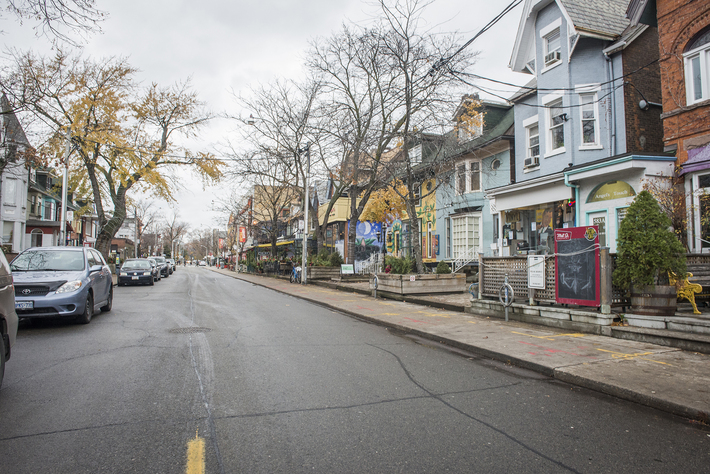
I might use my free time to take a walk in the Dundas West area of Toronto. It’s been highlighted as being one of the coolest neighborhood ever, and I can see why.

Or maybe I’ll go and get some steak frites (here are some of Toronto’s best, though they did not include my fav, Cote de Boeuf, shown below).

Did you know that asking yourself  one simple question can change entirely how you feel? It’s seems too much, but I agree with it.

Do you fear that people thing that you are a bit much? I think that’s a good thing. So does that piece. Also a good thing: A gratitude zine from Austin Kleon.

Does Arthur Brooks Have the Secret to Happiness? I don’t think so, but you might read that and think differently.

If it’s time, you may want to read this first:  How to Clean an Oven by Wirecutter.

But maybe you’d prefer to read something lovely instead of practical. If so: The Ponds poem – Mary Oliver poems.

Kudos to this artist who puts mosaics in potholes.

How crazy is this: a Fish tank for cats!

If you want to watch a classic this weekend, I recommend: All that Jazz.

Here’s the opening:

(Top image is a link to Toronto Life. Second image is a link to BlogTO).

This has style, this has grace, this here watch has a minimal face. (Get your fill of fashion here)

I’ve been wanting to to simplify and minimize my style lately. If that’s appealing to you, check out this link to minimal classics that never go out of style. Want to simpify your watch? Well you could get this one. But maybe that’s too minimal.  This might be better. (shown above)

Also pretty minimal are these New Balance 327:

I’m a big fan of the 327s in general. Those would go great with this very casual men’s wardrobe. It’s not really my style. Personally I prefer this gray wardrobe:

Very minimal and simple. The over shirt in it is featured here.

Speaking of great clothes to put over things, this very cool Bestall Astern Peacoat is all that. You can see it included in this striking wardrobe:

All gray is great, but you can’t beat a black on black wardrobe.

What’s cool and fashionable? This T shirt: “The Garbage T-shirt diverts waste like old clothes and plastic bottles from landfill and repurposes it into sustainable clothing.” Relatedly, the New Balance 57/40 are also using sustainable material. Also cool and minimal AND vegan:  Oliver Cabell Vegan 481 sneaker. This  scooter is cool. These Yeezy Shades are cool no longer.

(All images: links to Uncrate).

On Joan Didion’s estate (our life in objects and what they say about us)

Joan Didion died last year. On Nov. 16, there will be an estate sale auction of her possessions. The New York Times covers it here. The piece is titled: Joan Didion’s Life in Objects.

It’s a good piece. Among other things, it got me thinking once again that we leave an impression on the world in several ways. One of those ways is what we collect from it. Some of those objects are mundane and collected by many:

Others are unique to ourselves:

Some of them, by how we collect them, tell a particular story:

Our objects are not just things laying about: they say something about us. They say what we were interested in.  They indicate what our passions were.  They tell a story about the person who owned them and what type of person they were or wanted to be. The books on shelves, the overused and the underused cookware, the tools either on display or tossed away: each and every one of them are like a shadow or a sketch of their owner. They don’t say everything about us, but they say a lot.

Perhaps after you read this you may want to go over your own objects and ask yourself: what does this thing say about me? Because it does, perhaps in ways you don’t even realize.

The BBC had a series, The History of the World in 100 Objects. Like the world, if we were to take 10 or 20 or even 100 objects in our lives, they would tell the history of ourselves.

(All images: links to the story in the Times. All items belonged to Joan Didion.)

A ramble through what was new in the world, Oct. 2022 edition

Here’s a month end cornucopia of things I found interesting and worth reading but don’t really fit into any specific category. (I would have posted it yesterday, but I had that very important 12 foot skeleton post to submit. :))

As I’ve said before, I like posting these because I will be curious to see how they read in the next 5-10 years. I hope you find it worth reading now, though. And thank you!

AI and art: Artists and non-artists continut to make art and play around with AI. Microsoft is even going to incorporate some of the tools into their software. Where this goes, I am not sure. But here’s something on an artist in Amsterdam using it. Not everyone is keen on it: the Getty is banning it.

NFTs: speaking of the art world and new technology, they continue to flirt with NFTs, as you can see here: MoMA and NFTs. Also here’s a piece on what Christie’s is doing:  Meet The Artist Who Just Launched Christie’s New Platform For NFT Sales. This investment by museums does not seem like a good idea to me, as this shows: NFTs and art going bust. Not to mention that NFTs are tanking on Opensea and these six-figure NFTs are down 99%. That won’t stop people trying to make money from them, such as these private clubs using nfts. But there has been some payback: Kim K getes a fine for crypto flogging. NFTs have been terrible forever and that doesn’t look like it is changing soon.

Pandemic/Inflation: we continue to make our way through the pandemic as COVID remains a threat. Even though we also continue to try and live with it, the disease has brought big pandemic life changes,  Fortunately there are more booster coming out. Also a number of people I know are using  CO2 monitors to measure CO2 in indoor spaces. There is still some mask wearing.

In Canada there’s been some complaints about the cost of the arriveCAN system. It was expensive, for sure.  This piece breaks down the costs. Meanwhile, some jokers convinced some in the media it could be built for next to nothing at a Hackathon. This just tells me the media needs to get more tech savvy to such boasts.

One holdover from the pandemic is the rise of tipping for everything. I get it, but I also think it has gotten out of control. This piece touches on that: Why tip requests on touchscreen tablets are everywhere (and make us feel guilty.

Part of the problem is that everyone feels they have to cut back due to inflation, tipping and otherwise. So we get pieces like this from Consumers Reports on how we save money now . Or this on how inflation is costing lives. Relatedly, car prices are crazy right now, so you see lots of pieces like this  How to Negotiate With Car Dealers as Prices Keep Rising.

Canada: We’ve had some political changes in Canada. A new premier in Quebec. A new one in Alberta. The PM is promising money to the folks out east to recover from Fiona.

Meanwhile in Toronto we had an election with poor turnout and mostly incumbents voted back in, including the mayor. People in the city are worried about the fact that the city is cashed strapped and the mayor isn’t going going to do anything about it other than cut services like the Toronto Public Library. Grim. The Mayor was even mocked in this art installation called austerityTO.

Totally unrelated but not grim: the Canadian legend Mr. Dressup is getting a documentary! Nice.

Work: employers continue to struggle with remote work. The Times argues: Remote Work Is Here to Stay. Lean In Employers.. The flip side of that is we get many stories of employers tracking workers. It’s a strange new working world. Speaking of that, here’s a piece arguing for using AI to supercharge workers. As a long time automation specialist, I agree.

The World: In the US, here’s some pieces on the January 6th commision: Jan 6th and the Oath Keepers and Laws passed to prevent another Jan 6th. Lizzo played a historical crystal flute and racism broke out. Never mind, Lizzo: you sounded great. The right wing is morphing into something ugly in America, so you get things like this:  We Need To Stop Calling Ourselves Conservatives. I think the word they are looking for is Fascist. Finally, here’s a piece on the US Supreme Court: Inside the law school chaos caused by SCOTUS decisions. More on SCOTUS .

In China, everyone was shocked by what happened to  Hu Jintao. More on Hu Jintao here.  Meanwhile, Noah Smith uses game theory to explain why he thinks an invasion of Taiwan probably means WW3. Yikes. In other news, China Delays the Release of G.D.P. and Other Economic Data. Never a good sigh.

Elsewhere in the world, the right wing leader is unusual to say the least, based on this: How Lord of the Rings Inspires Italy’s Giorgia Meloni. Ok. Meanwhile lots of speculation on the  Russian nuclear threat. Clearly a sign of how bad things are going for Putin. Speaking of going badly, we have the chaos currently underway in UK Strong and stable? Maybe maybe not.

Signs of the times: A weird chess scandal broke out recently. I thought these pieces in the WSJ here and here did a good job on assessing it. As did this piece in the Atlantic.

Cheating is not just a chess thing either. The Times had a story on the  Fishing Contest Rocked by Cheating Charges After Weights Found in Winning Catch. Lots of money and fame can bring the cheaters out everywhere.

Meanwhile, social media continue to dominate some people’s lives, based on this:  Want to Get Noticed by a Celebrity? Snag Their Username on Social Media. Speaking of social media, Facebook/Meta is tanking and Elon Musk took over Twitter. Oh well. Blogging is still going strong! As are you if you are reading this: thanks very much!

Happy Autumn!

It’s Hallowe’en! Here’s everything you need to know about the Home Depot 12 foot skeleton!

For Hallowe’en, people have become more involved in decorating their homes. Nowadays a mere jack o’lantern is not enough. Instead, homes have yards filed with things, from fake tombstones to inflatable animals. A new member of those  spooky menageries and a favorite of many is the 12 foot skeleton from Home Depot.

People love the 12 foot skeleton. They are making Tik Toks and Reels with them driving around town. Other people leave them in their yards all year round. They have a weird likability to them, those bony giants.

If  you have one or want to get one, then read this: How to Maintain Your 12-Foot Skeleton and Other Giant Halloween Decorations – The Home Depot. Home Depot has all the info you need to take care of the new addition to your home/haunted house.

Some thoughts on the genre of food writing, after reading about Chantal Braganza’s cake

Good genre writing tends to make us forget it belongs to a genre. Atwood and Kafka and Borges all can write in the genres of SF and fantasy, but we don’t think of them as genre writers. They are good writers who happen to (sometimes) write genre fiction.

I thought of that when I read this piece by Chantal Braganza in Maisonneuve: An Ugly Sweet Thing. Food writing is also a genre, and while Braganza is a food writer here, she is first a good writer who in this case is writing about food. It’s a really fine piece and I encourage you to read it. It’s about food, of course, but it’s about so much more. That’s what good food writing does.

Food writing gets knocked about these days, and that’s too bad. So many food writers that include a recipe in their writing have a button at the top that allows people to skip just to the recipe. People who click on that button are missing out. The writing is important too, not just the recipe. If you just want a recipe, go to AllRecipes.com. If you want to learn more about food and what the author thinks about this particular dish and why it is important to them and perhaps you, too, read the writing. You’ll be glad you did.

More and more I buy food books not for the recipes, but to get inspired to cook and to create in the kitchen. Preparing food is work, and some times that work gets us down. (Ok, it gets me down.)  We need things to lift us up. One of those things is good food writing. Here’s to more of it.

Now go get some cake.


The history of technology and telecommunications is also a history of Cape Breton


Cape Breton is known for many things, including a great deal of history. One part of that history that I wish were played up more is the part it played in telecommunications at the beginning of the 20th century. I thought of that when I read about how a Cape Breton town (North Sydney) knew about the end of WW I before the rest of North America. It knew about it because of the Western Union offices there. It was a leader at the time. Sadly that Western Union building in North Sydney was torn down.

While that place is lost, there are still other sites on the Island that recognize that history of technology. There is the Alexander Graham Bell museum in Baddeck that is worth visiting. And while it is small, The Marconi Museum in Glace Bay is also good. There are some fine museums in Cape Breton: if you are going there to there to see that sort of thing, make sure you include those two.

Cape Breton had a significant role to play in the history of world telecommunications. That role should get recognized and more museums should be made to promote that era, in my opinion.

For more on North Sydney, see:   wikipedia North Sydney Nova Scotia.

(The image above is the Marconi National Historic Site of Canada in Glace Bay, linked to at goCapeBreton.com)

Friday Night Cocktail: the freezer martini

On my Instagram feed I am seeing lots of reels on how to make fridge cocktails. Essentially you have a bottle of liquor in your fridge but instead of it being simply vodka or gin, it is a full on cocktail, premixed and ready to drink. Why not?

In the same vein, I propose you consider making the freezer martini. Like the fridge cocktail, the freezer martini sits in your…well, you know. So when you need a martini this weekend, just pull this out and pour a splash in your martini glass. All you need to add is some olives or a lemon twist and you are set.

For more on this and how to best make them, see Imbibe Magazine or Eater. It’s slightly different than you typical martini.

Speaking of olives, you can freeze them too! I mean who wants a warm martini? No one of good taste.

For an alternative way to keep your martinis cold, see this nice hack: How to Make a Pitcher of Martinis That Stays Cold at the Thrillist.

Cheers!

(Image link: to Imbibe magazine)

The great Steve Keene is having a moment

As Fineartsglobe.com says, Steve Keene is having a moment. Perhaps it’s because there is a new book on him: The Steve Keene art book. Whatever the reason, I am glad that he is getting more attention and recognition. Not that he is unknown. There’s been profiles done on him in Garden and Gun , Gothamist.com, BKMAG.com, Artsy.net…even the the New York Times.

if you don’t know him and wonder why you should care, read any of those pieces. In a nutshell, he’s an incredible artist who is the direct opposite of people like Damien Hirst or Jeff Koons. Keene makes a lot of art and sells it for next to nothing. Despite that, he is a good painter with a strong technique and a fine use of colour. I admire him. I hope he and the book continue to have success.

For more on the book, see Pitchfork. Image above is a link to a page from the book.

Crowns: kings and queens and royalty, then and now.

A lot has changed with European Royalty since this (colorized) photo of Nine Kings was taken in 1910 at the funeral of Edward VII. For one thing, many of these monarchies these Kings represented have disappeared. And of the ones remaining, they are slimming down quite a bit, such as the one in Denmark, with Denmark’s Queen Margrethe stripping 4 grandchildren of their royal title. Harsh but fair if the monarchies are to survive. And it’s not just happening in Denmark: Charles is likely to do it in England, too. Monarchy ain’t what it used to be.

Perhaps that’s why we look back in history with series like the Crown. The success of which has lead to this German Royal Drama about the heads of Austria-Hungary coming out next. The farther we go back, the grander it all seems.

Speaking of grand and wanting to go back in time, here’s a good piece on King Charles’s Poundbury Town. Going forward in time, this AI portrays how famous people like Princess Diana would look like today.

That’s the thing about Royalty. In many ways it is about a life other than the one most of us lead. There’s an unrealness about it that somehow attracts us.

In closing, I want to include a clip of one of the most real people in The Crown, Tommy Lascelles. No one is more grounded than him, which makes him highly effective and often dangerous:

P.S. I am fascinated by that photo of the nine kings. Here’s a good post with lots more detail: Nine Kings in one photo 1910.

Would you pay $200,000 for a Mac SE??

You might not but I bet someone might. Because it’s not just any old SE….it’s Steve Jobs’ Macintosh. Uncreate has the details:

(Jobs) didn’t stop using Apple products, though, instead working on this Macintosh SE until 1994. Amazingly, it still has files from its days on Jobs’ desk on its drive, and as an incredibly desirable artifact from his “Wilderness Years”, is expected to bring over $200,000 at auction.

For rich fans of Apple, this would be some crazy good thing to have in your collection.

What makes you happy about your job. Think Maslow, not Brooks

Too often when I see pieces on work and what makes a good job, they downplay certain aspects, like pay or job title. That comes up in this piece by Arthur Brooks, How to Pick a Job That Will Actually Make You Happy, where he writes:

… this belief is based on a misunderstanding of what brings job satisfaction. To be happy at work, you don’t have to hold a fascinating job that represents the pinnacle of your educational achievement or the most prestigious use of your “potential,” and you don’t have to make a lot of money. What matters is not so much the “what” of a job, but more the “who” and the “why”: Job satisfaction comes from people, values, and a sense of accomplishment.

I don’t think he is wrong with this, I just think he is missing out on the bigger picture. The way to see the bigger picture is to focus on Maslow’s hierarchy of needs (shown above).

According to Maslow, we have several needs: basic needs, psychological needs and finally self-fulfillment needs. The lower needs are simple and obvious: the higher ones are complicated.

Our jobs provide for some or all of these needs. For example, our work environment should provide us with our basic needs, while our pay satisfies both basic and psychological needs. Things like job titles, promotions, awards, perqs, and other acknowledgements also help with psychological needs. As for the work itself, and the things Brooks is discussing, they satisfy our self-fulfillment needs. If you are fortunate, you have a job that provides for all those needs to a high degree.

That said, we all measure our needs differently. For people who work dangerous outdoor jobs, their basic needs may not be met nearly as well as someone who works in a warm office. For those outdoor workers, the satisfaction from the work itself (e.g. rescue work, emergency repair work) may more than make up for the discomfort and difficulty they face. Likewise, for a person working in an office, doing interesting work that fulfills their potential may be much more important than promotions and pay raises and other things their co-worker with different psychological needs has.

In Brooks’s piece, he emphasizes self-fulfillment needs and minimizes basic and psychological needs. That’s a common mistake, and the reason people might become dissatisfied with their job, even though on the surface what they have appears to be a great job. We all know about people quitting because of bad management: in that case you can see people’s needs at all levels not being met. But people can also struggle because they have a conflict that some of their needs are being met while others are not. For example, people can have a good job with lots of benefits, but it is very unfulfilling, or they can have a good job that is very fulfilling but it doesn’t meet their basic needs.

The best job can fulfill all of your needs to a satisfactory level. That’s the job that will make you happy, not just a job that satisfies your top needs. When you look to work at a new place, make sure you can get all your needs met to the level you need. You’ll be much happier.

On the joy of train travel compared to air travel


Train travel is good.  Train travel from Toronto to Montreal and back exceptionally so. Let me count the ways by comparing it to airline travel.

It starts off before you even get on the train. In Toronto you can catch a subway or an Uber to Union Station downtown. Once there, it’s a short walk to get to where you board the train. There’s no getting stuck in traffic on the 401 trying to get to the airport. No paying for expensive cabs or limo. Fast and cheap.

Then you get to the station. There’s no multiple checkpoints to get on the train. You find out where the train is boarding and you line up to get on. Quick and easy.

Once on the train, you have lots of room to move around. No having to sit in your seat all the time. No seatbelts. Wide chairs. Comfortable.

If you take the business class train, you get a constant supply of food and drinks. Wine, caesars, port and cognac is all available and included. Plus hot towels, snacks and full meals. Satisfying.

Then there’s the scenery. There’s lots of it and it’s easy to see out the big windows. Tired of the scenery? You have a good amount of time to watch a movie, read and even nap. Relaxing.

Finally, you start in one downtown and end up in another downtown. You don’t have to get in still another cab to get to your final destination. Sweet.

Sure you can take Porter at Billy Bishop, but you still need to cab into Montreal from Dorval. And while the flight itself is short, the time you take getting to the airport, getting through security, building in extra time so you don’t miss your flight….it all adds up. 

Air travel is essential for long distances. But for shorter distances, you owe it to yourself to take the train.


Cameras aren’t dead yet. Here are four fun ones.

First up, this may be the only Leica camera most can afford, and then it is still around $1700: Leica D-Lux 7 Vans x Ray Barbee Camera.

To see what I mean, check out the Leica M-A Titan Camera… it costs around $20,000. And while that is extreme, it is closer to the median than the d-Lux 7.

Maybe you need this Pixy Selfie Drone  to follow you around and take selfies all day. Your own paparazzi!

Or perhaps you just want a new webcam. This one, Opal C1 Webcam | Uncrate, will set you back around $300.

Thanks to Uncrate.com for all these. Still one of my favourite sites for all things cool and wonderful.

What’s the best way to deal with inflation? Are we in a recession? Here’s some pieces that address these good questions.


First up, inflation. As inflation heats up….

Central bankers around the world are lifting interest rates at an aggressive clip as rapid inflation persists and seeps into a broad array of goods and services, setting the global economy up for a lurch toward more expensive credit, lower stock and bond values and — potentially — a sharp pullback in economic activity.

…according to the New York Times. Not all economist and thinkers agree with this. Here’s Hadas Their providing a socialist’s view on why price controls are a better idea. More on her argument in Jacobin. For a counter to that, here’s someone from the Fed arguing that price controls should stay in the history book. I tend to side with the Fed’s view over Their’s, but she raises valid criticisms of the central bank’s approach.

Perhaps I am too used to economics only coming from a male perspective. Perhaps you are too. If so, we might all benefit from reading this: We all play by economic rules set by men. What could a feminist economics look like?

But back to the Fed. If they want to bring down inflation, how does they go about doing that? You can learn about their methods to control the economy here: The Federal Reserve’s Open Market Operations.

Besides dealing with inflation, many economists are looking to see if and when we will be in a recession. One surprising way to do that is look at the price of copper. If you are asking yourself, what does the price of copper tell us about the economy, then read this. For more on this, see:  historical Copper price data. Here’s more on the Global price of Copper (PCOPPUSDM) from FRED.

One last thing. On the topics of inflation and the economy, the economist Larry Summers has been popping up more and more because he seems to me he’s been predicting bad inflation early on. Given that, here’s something to keep in mind: Summers Watch from The American Prospect. Let’s just say that I think there are better people to get your advice from.

What Mark Cuban can teach you about motivation is simple and powerful


Do you find it hard to motivate yourself? If you do, you should look to Mark Cuban for a valuable lesson. Mark Cuban recently started Cost Plus Drugs to allow him to bring low cost medicine to people who need it. It’s a great initiative. But it took someone awful like Martin Shkreli to get the ball rolling. As Cuban says, when he saw Shkreli’s company jacking the price up on some drugs to obscene amounts, he concluding that the opposite could happen as well. Then he went and did something about it.

So kudos to Martin S for inspiring Mark C to start this new company: your greed has not been for naught.

Here’s the lesson in a nutshell: find someone doing something wrong that you strongly disagree with and then decide to behave in the opposite way to counteract that.  You will be plenty motivated, I am sure. And you will be doing the world some good too.

For more on this, read how Mark Cuban says Martin Shkreli inspired him to start Cost Plus Drugs in Vox.

Save the Jack o’ Lanterns from the rats with nice tails


Walking around my neighborhood this weekend I noticed two things:

  1. People have done a great job decorating for Halloween
  2. Squirrels do not give a fig for Halloween and seem to like wrecking people’s good work. Especially their pumpkins/jack o’lanterns.

If this is happening to you, I recommend you at least read this: How to Keep Squirrels From Destroying Your Pumpkins.

You’re welcome. Thank you for decorating: the kids from 6-96 love it.

Gawker existentialism (some thoughts on the piece titled, Failure to Cope “Under Capitalism”)

This article, Failure to Cope “Under Capitalism” in Gawker touches on several areas of difficulty many young people face today. It ends with the following recommendation:

This is your life. You do not have time to wait for the revolution to begin living it. You will always be able to find someone to give you permission not to live it. But no one is coming along to live it for you.

This struck me as a form of existentialism. Gawker existentialism, if you will. It does not deny the problems that are foisted upon you: downward social mobility, addictive and manipulative social media, or an upbringing that has left you disappointed. It does not deny that, but it does insist that it is up to you to do something about it. You have to make choices, chief of which is to live your life. Your circumstances may shape you, but you are responsible for how you move forward. Perhaps the existentialism of Gawker is not as noble as the existentialism of Sartre or Camus, but it is a form of it nonetheless. (You could make a case it is somewhat close to the existentialism of Kierkegaard or Kafka.)

I leave you with this, the angst of Charlie Black, who is struggling with the perceived downward mobility of himself and the whole preppy class, in “Metropolitan”:

Like existentialism, struggles with capitalism are not new. 🙂

The suit is dead! Long live the suit!

The suit is dead! Well, if not dead, likely on death’s door. To see what I mean, read this: The end of the suit: has Covid finished off the menswear staple?  The suit has been already dying off somewhat in the last few years, with the decline in necktie use and the introduction of more casual shoes to go with it, among other adaptations. Perhaps it will be gone altogether in the next few years.

I was thinking about the death of the suit when I was eyeing this work above in London last spring. That form of business attire has been dead for centuries! No doubt in centuries from now people will be standing in galleries looking at painting of men with neckties and double breasted  blazers and thinking how odd it looks, just like how we think the Dutch men above look odd. Suits — of all eras — eventually die off.

What will not die off, though, is the need for some form of fashion to indicate the person wearing it has a specific business function. What form that will take, I don’t know, but there will be something, some form of “suit”, that indicates you are talking to a doctor or a lawyer or a banker or a businessman (or woman) of some stature. Of that you can be sure.

The suit (as we know it) is dying: the suit (will come to know) is being born. Long live the suit.


Not to be overlooked: five great women of the 20th century you should know about


Here are two good essays on five great women. First up is this piece on the Oxford Quartet: The Women Who Took On the Philosophical Establishment. And then there is this piece on Regina Jonas, who was officially ordained as the world’s first woman rabbi.

Both are well written essays featuring outstanding women who accomplished so much, despite the hardships they had to deal with. (In Jonas’s case, that is an understatement.) I recommend both as good things to read on a Sunday.

The story of Rabbi Jonas is part of the Overlooked series by the New York Times. I admire that series, and I’m glad the Times has it. If you want to read good bios of exceptional people, go deeper there.

(Image is of Regina Jonas, link to image in NYT)

The PO-80 Record Factory Kit from Teenage Engineering is very cool

The smart folks at Teenage Engineering have produced another cool product. As Yanko Design explains….

The PO-80 Record Factory Kit is a record cutter that engraves audio onto 5″ vinyl discs, giving kids the ability to record their own LPs the old-fashioned way, quite like how millennials made mixtapes and burned their own CDs. The Record Factory, created in collaboration with Yuri Suzuki, lets you engrave and playback 5″ discs with an ultra-analog lo-fi sound. This isn’t studio-grade equipment, after all, but it does add a creamy muffled, effect to your audio that totally sounds like the 40s and 50s in a nutshell.

Love it! For more on the PO-80, see these write ups in Yanko Design and the Awesomer.com.

(Image link to Yanko Design)

Friday Night Cocktails: some very good ones and a few not so much

Rather than recommend just one, I have a few cocktails for you to consider:

Those all sound good. As for the not so good, here’s two articles to consider:

Cheers!

PlantUML: not just for UML. Also good for Gantt Charts, Mindmaps, etc


If you are an IT architect or specialist, you may have used PlantUML. I have and I really like it: It makes doing technical diagrams dead easy.

What I would like you to know about are non-UML capabilities of the tool. PlantUML has the capability to draw Gantt charts and Mindmaps. You can quickly write out your plans and ideas and PlantUML will convert them into the diagram you want. It’s fantastic and I highly recommend it. If you use Visual Studio Code from Microsoft, plug PlantUML into it and you can get your diagrams made that way. But the PlantUML website can also do the job.

For more on this, go to the sections on Gantt charts or mindmaps.


On Mark Zuckerberg’s Legs and other stupid things we have to try and ignore

So in Mark Zuckerberg’s hot new remake of Second Life, avatars will soon have legs. Woo. It’s something I’d rather not think about.  Just like I don’t care about Elon Musk and whether or not he spoke with Putin. Or anything to do with Kanye’s opinion on pretty much anything. But that’s the problem with social media these days. Even if you don’t want to know about these things, other people want you to. People whose opinion you’d normally are interested in. I mean, even I am guilty of this right now. So why do this?

What I would hope for is to nudge folks a little so that they find other things to share on social media. Things like stories about themselves. Or good things that they’ve discovered, be it big or little. Maybe facts or ideas about people other than those manic attention seekers that are everywhere on the Internet. That would be great if that could happen.

Will it? Likely not. That’s why I expect to see new forms of social media taking off. Perhaps it will be Discord. Perhaps someplace else. But some place you can go and avoid those that are so hard to avoid currently.

Meanwhile, congrats to Mark Z on growing a pair…of legs. Happy for you.

P.S. Turns. out Mark Z’s legs were a lie. Amazing.

Wordle is fun again. Here’s why that is for me….

Like many of you, I started playing Wordle during the pandemic. It was fun for a long time, then it wasn’t.

I’m not sure what got me playing again, but I think the Wordlebot had something to do with it. Every time I play now, I consult the little bot to see how it did and what it recommends in terms of words. As a result, I have become better at the game. Some of the go to words I use frequently now because of what I’ve learned from Wordlebot are:

  • Crane
  • Slate
  • Sloth
  • Unhip
  • Guilt
  • Croup
  • Alter
  • Chirp
  • Crony
  • Corny

the other day I played CRANE and first and then went with SLOTH and got it in two. If only I had made SLOTH my starting word! Oh well. It’s fun for me again, and that’s what counts.

Also I play it quickly these days. Before I could spent easily 30 minutes on it: now I try and be done in 5.

For more on it, see this good piece: Wordle and the starting word. Adieu!

What do Brad Pitt, David Salle, Steve Keene and Diane Arbus have in common?

What do Brad Pitt, David Salle, Steve Keene and Diane Arbus have in common? They all are artists I’ve been reading about over the last few weeks and months. Now you can too.

In addition to reading about those four, there are additional pieces below on other artists of note. Most of them are painters but there are some sculptors too. Quite a mixed bag! Enjoy!

(Images linked to those in the Washington Post and Colossal).

Happy Thanksgiving, Canada! Here’s a really good guide to roasting a turkey, planning the meal, and keeping it simple


Happy Thanksgiving, Canada! Last year I shared with you what I was making for the celebration here. Our meal was delicious, and all made from scratch, thanks to the fact I had help! (Thanks, Lisa!) So if you have help, I recommend what I did last year.

However if you don’t have help and you are doing it all by yourself, let me suggest you get some stuff off the shelf. I always make the turkey, some form of veg, and mashed potatoes from scratch. Always. But if it’s just me cooking, I will get Stove Top stuffing, packaged gravy, baked rolls, and canned cranberries. Hey, even doing all that is a lot of work with 4 burners going, not to mention the oven and the microwave. My foodie friends may disown me, but I learned this lesson from Anthony Bourdain years ago: simplify simplify simplify your prep even if the food isn’t the level you want. Trust me. My main goal is to get a pretty good dinner on the table reasonably, not show off I can make everything from scratch by myself. However, YMMV.

Speaking of trusting me, I would also recommend going with the simplest form of turkey roasting possible. Here’s my approach. I tend to get a 12-16 pound turkey and I roast it unstuffed at 325F at 15 minutes / pound. I write out the time I put it in, how long it should roast based on that formula, and when I believe I should take it out. I put it in the oven uncovered, and when it gets to the golden brown you see below, I cover it simply with aluminum foil but keep on cooking it until it is done. I check on it more towards the end, basting it every time I do. 

How do you know it is done? If you use a meat thermometer, many current guides will say the turkey is done when the meat is 165F. Back in the 1980s the meat was said to be done at 185F. 165F will leave you with a moister turkey, and 185F will mean everything is well done. If you are nervous, go with 185F. In the worst case, at 185F some of the breast meat may be a bit dry: that’s fixed with some gravy. 🙂

Oh, and while meat thermometers are great, a simple plastic pop up pin put in the breast works good too. If you don’t have a meat thermometer or a pop up pin, cook to the time calculation you did above….you’ll be fine. 

If you want more guidance on turkey roasting, go here. I generally get unfrozen turkeys: it makes life simpler. If you have a frozen one, you want to read this.

Enjoy your dinner, whatever form it comes in. Cheers!


On Fred Franzia, the creator of Two Buck Chuck wines

Fred Franzia, the creator of two-buck Chuck, has died. He was quite the maverick in the wine industry. Heck, his company was called Bronco Wines. While he did much to strengthen the idea that wine should be more affordable and accessible, I tend to agree with Eric Asimov in his assessment of his product. I think there is a better middle ground, and his Charles Shaw wine did not occupy it. But like all things, taste is subjective.

For more on the man and his wine, here’s a good piece by Priya Krishna on him. And here’s Eric on Fred Franzia and the Legacy of Two-Buck Chuck.

P.S Speaking of Eric, here’s a good piece of his on riesling. Like him and others, I wish more people would discover this grape and grow a liking to it.

Also, this piece on a maker of orange wine was a great read.