And what a library! Napoleon had asked for it to be as follows:
The Emperor wishes you to form a traveling library of one thousand volumes in small 12mo and printed in handsome type. It is his Majesty’s intention to have these works printed for his special use, and in order to economize space there is to be no margin to them. They should contain from five hundred to six hundred pages, and be bound in covers as flexible as possible and with spring backs. There should be forty works on religion, forty dramatic works, forty volumes of epic and sixty of other poetry, one hundred novels and sixty volumes of history, the remainder being historical memoirs of every period.
Even with slimmed down books, that is a lot of paper to be carrying around as your conquer Europe and other parts of the world. I’m sure he would have loved the Kindle.
We all get in ruts where we use the same tools every day for our office work. When that happens, what we need is someone to come along with a new list of tools and what makes them great.
Here is such a list. I didn’t create it, but I have used 3 of the 11 tools here and I can say they are key to making me more productive every day. I plan to use the rest of them too, based on the description of them.
The success of Pärt’s work – the repertory of choral works he has composed over the last four decades, the instrumental works, even the new symphony he composed in 2008 – is, I think, much more than simple popular acclaim for a composer who uses some familiar chords. Pärt told me that what he wants his music to express is “love for every note”, and in turn, communicate the spiritual power that he sees as music’s essential purpose. Pärt is too modest to say that he has achieved that, but for the listeners who love his music, it’s an irrefutable truth.
There are lots of places to find his music, including YouTube. Here’s one of my favorite pieces, Spiegel im Spiegel
Enjoy that piece, and hopefully enjoy many hours listening to the music of Part.
If you are using Google’s DNS services (i.e., you are using 8.8.8.8 for DNS services), then there is a new provider on the block you should consider: Quad9. The following links detail why you might want it, as well as how to set it up.
Fortunate souls walking along New York’s High Line can catch a glimpse of the magnificent building pictured above. Now, thanks to Design Milk, you can get to see what it looks like inside by going here: 520 West 28th Condominium Residence by Zaha Hadid – Design Milk.
Not surprisingly, it is as gorgeous on the inside as it is on the outside. I would love to live there. Take a peek inside and you’ll see why.
Social media bombards us with opinions. Such bombardment tugs at us to form our own opinions, but this is is a trap that leads us to be unhappy. As this piece (Free Your Mind by Having Fewer Useless Opinions) argues:
The more opinions you have, the more time and energy you end up wasting to defend those opinions, and the more small amounts of stress you accrue. But the less you have, the more time and energy you have to focus on the deep opinions you have.
I think this is a great idea. There are lots of reasons not to have an opinion on things: you don’t have knowledge on a topic, you don’t have interest on a topic, you prefer to focus your thoughts on other topics. Much of popular culture can be dismissed this way, as can many political scandals.
So let others spend their time fretting and fussing over such things and spend your time focusing on the things you think matter.
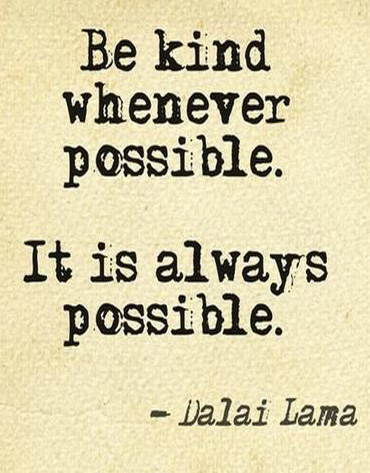
No doubt you are kind, but the world can always use more kindness. This post is a list of 30 things you can do to be more kind, to expand your sphere of kindness. Try doing one a day or even one a week. Thank you.
Why this list of movies? According to Five Thirty Eight, they are the most rewatchable movies of all time. Scanning the list, I see a few of the ones I tend to watch over and over again. Chances are you do too.
Enjoy.
Meanwhile, here’s one of the many great scenes from Casablanca.
For example, you can paint a door:
Or even just part of a wall, like the moulding:
The piece in Apartment Therapy is worth looking at to get ideas. If you’ve been tired of looking at the same old space and you don’t want to get new furnishings, a splash of paint can do the trick of improving the space.
I create a lot of Ubuntu test servers, and I find that as soon as I create a Ubuntu server on a cloud environment, it gets immediately attacked by automated software. This is obviously a concern. A bigger concern is that when I went searching for recommendations on how to harden such a server, I found a wide variety of recommendations! It can be hard to know what to do. Still, I needed something. As a result, I created this package of scripts. The scripts do a number of things:
prevent direct root login to your server via ssh. This was one of the things I saw consistently happen and once someone cracks the root access on your machine, it’s game over.
stop some basic security holes, like IP spoofing
download some useful software, like logwatch, ufw and others
upgrade all software on the server
This is just a very very limited number of things to prevent attacks. But it is better than nothing.
If you install Apache, PHP, MySQL or other software on your machine, there are even more attacks that will be launched against it. I recommend you get a firewall up and running and at least run logwatch on a regular basis to look for potential attacks being launched against you.
Finally, if it is important for you to secure your server, don’t stop with my scripts. Go out and consult with IT security specialists right away.
Read this list. Pick three. Do them. Your life will be better.
Why three? No reason, other than to make it seem possible. Skip three and just do one. That’s a good start. Or do one every two weeks for the next year. Whatever works for you.
The site Hyperallegic has a great piece on the abandoned City Hall subway station in NYC that is worth visiting. Beautiful stuff.
While no longer in use, there seems to be a chance you can tour the station from time to time. Read the piece, then make your plans to see the actual station.
(Images linked to from the piece. Many more great images in the piece you’ll want to see).
is this simple calendar:
A very effective way to motivate yourself to take on a new habit or break an old one.
For more on this, head over to Austin Kleon’s web site and this page: 30-day challenge
Before this piece, I had limited knowledge of Woodrow Wilson. Most of that was centered on the work he did at the beginning of the 20th century, and much of that came from Margaret McMillan’s book, “The Peacemakers” (in the UK) / Paris, 1919 (in North America)”. My impression of him was a giant, transforming the old world with his ideas and his actions, and it was a transformation that was much needed. The world transformed after the first World War, leaving behind much that was bad, and a lot of that was Wilson’s doing.
However, Wilson racism was a terrible thing, and there is no overlooking it. There is no way to say Wilson was simply a great man: his racism and the discriminatory actions he took stain him permanently. He is a complex man, though, and there is no one scale to measure him on.
This complexity is true for all American presidents. There is a part of Americans that want to revere their leaders. They build them monuments, they sanctify them, they constantly assess and reassess them, be they Wilson, or Grant, or even Reagan. No doubt this will happen to Obama, too. This desire to sanctify leads to trouble, just as it is leading to trouble in Wilson’s case.
Ideally Americans would spend less time idealizing their past leaders and building them monuments and centers like the one for Wilson. Anything like that should include all the history of the person and the time they lived in. Show the complexity of the person, their strengths and their weaknesses, and highlight both what they achieved and what they failed to achieve. Give a full accounting of the person.
(Image is a link to a photo by Mark Makela for the New York Times)
Here’s an assortment of 42 links covering everything from Kubernetes to GCP and other cloud platforms to IoT to Machine Learning and AI to all sorts of other things. Enjoy! (Image from the last link)
Something to consider for the work week is to try and not use any of the phrases found in this piece. I can’t say I agree with their substitutions. Best to leave the cliches behind and strive for clear English.
Once we get rid of all the bad business cliches, we can strive to clean the world of bad office stock photos like the one above 🙂
P.S. If you don’t use those cliches, that’s great. Another thing to consider is starting a bingo card and score it every time you see or hear one of those cliches at work. Chances are you will fill your card by Friday.
Perfect for early suppers, especially as the weather gets chillier. Great way to use up any vegetables in your fridge, too. With this recipe — really a guide more than anything else — you can make all kinds of different sandwiches.
The first time I saw Blade Runner 2049, I found myself continually comparing it to the first Blade Runner. I loved it but I could not think of it without thinking about the first film.
The second time I saw it, I watched it for the details. It is an incredibly detailed film, and I found myself watching it for the all fine workmanship in the film (like the Japanese characters on the buttons of the jukebox that you barely see).
The third time I saw it, I saw the film in itself. That was the odd thing. It took me three tries to see the film as a narrative about these mostly new characters. I saw the film the way I would normally see any film that’s new. The other odd thing was that the film seemed to move faster the third time around than the first time. I thought it was slow the first time around and it was compared to the original film. But without that context and having absorbed all the details, I found the storytelling tight and essential.
I plan to see it many times. I think it is a masterpiece and every viewing yields something I missed in previous viewings. You may not want to watch it several times but I recommend you watch it more than once. You will be rewarded the second (or third) time you see it.
The wire tree sculptures by Clive Maddison are worth a look. Amazing transformation of simple wire into a complex sculpture. From Colossal. Link here: Dense Wire Tree Sculptures by Clive Maddison
It’s worth checking out the article: some of the things architects build for their cats is really incredible. (Also there is a good chance the cat will just ignore it and go and squeeze into a nearby box).
What is wrong with minimalism? If you were to read this piece by Mark Manson on the Disease of More, you would be right in thinking that less is what we need. The less you have, the better off you should be. In which case, approaching minimalism should be the idea.
Yet minimalism taken to an extreme is just another form of More is Better, which seems to be the point of this Guardian article, Minimalism: another boring product wealthy people can buy. (And the truth is, minimalism can be difficult to achieve, as this article shows.) So, is minimalism a good idea or not? Should you give up on minimalism?
What both minimalist and anti-minimalists miss in their arguments is what is required to have a good life. What should be pursued is not to have more because more is better, or having less because less is better, but to have just what is essential for you to have a good life.
Of course what is essential depends on who you are. For some, this is a perfect environment:
For others, it’s this:
There is nothing wrong with a minimal environment if that is essential for you to be happy and content. Likewise, having a room jam packed with stimulating items may be essential to you. You have to decide for yourself, rather than sticking with a simple formula of Less is More or More is More.
What you should have is what is essential for you to live a good life. The fix for minimalism is essentialism. Preferably a lean essentialism. But again, that is up to you.
The original Blade Runner is a film about the past, present and future. The future part is obvious: replicants, flying cars, off world colonies. It also remains fixed in the present of its time, the early 1980s, with the film’s characters wearing neck ties, reading newspapers, smoking indoors, talking on payphones, watching small screen TVs, and dressing like punk rockers. The past part may not seem so obvious, but it is essential to understanding the film.
The past of Blade Runner is film noir of the mid 20th century. Not just in the way it looks, though the look of film noir is spread throughout the film: the clothes Rachel wears, the office that Bryant works in, the style of clothes and music in Taffy Lewis’s club, the constant smoking, the hats of Gaff, the trench coat of Batty. It is noir in its morality and outlook. The world is a bleak place, the characters are not who they appear to be, and the morality of everyone is compromised and complicated.
I thought about this again when I read this piece, There’s Something About “Blade Runner” | Balder and Dash | Roger Ebert, as well as reading comments about Blade Runner 2049. In this piece, the author tries to establish who the good guys are and who the bad guys are. Assigning who the good and bad people are in film noir is pointless. No one is entirely good, and more often than not, everyone is some degree of bad. Film noir characters have to make difficult choices in a bleak environment where there may be no happy outcomes.
Likewise, some people are critical of Blade Runner 2049 and the role of women in this future. The assumption should be that in the future there should be progress and women should have better roles. But the future of Blade Runner is not one of progress. It is a future where despite technological advances there is no progress. It may not be the future you want, any more than the worlds of film noir are not ones you want to inhabit. It is the future the filmmakers want to explore, and get you to think about.
More on film noir here and here. A great example of what Blade Runner might look like cast as just a film noir film is in that clip above. While Blade Runner is gorgeous in colour, I’d love to see a black and white (sepia and white?) version of it too.
Each of the first three pieces delve into themes and ideas and layers of the film, and among other things, what I took away from them is that the sequel to Blade Runner is going to be studied and discussed for as long as the original film was. I highly recommend these pieces.
The not so smart analysis comes from Vox. It makes the same mistake that others make, namely, in criticizing the film for being too slow and unlike the original Blade Runner. That is ironic, because Blade Runner 2049 seems to be intent on not making the same mistake as the original Blade Runner of shortening and dumbing down the film to make it more appealing. It took three tries until Ridley Scott could release the Blade Runner he wanted (the Final Cut version).
If you have seen the film, read the first three pieces (or any one of them) and then read the Vox piece, and you can see how they miss out on the richness and depth of the film.
I have seen Blade Runner 2049 twice now, and I understand the difficulty people might have with it. It is long. It doesn’t strive to entertain. It swerves away from the film noir genre that Scott stuck to. For all of his artistry, Scott is a traditional storyteller and filmmaker. He makes Hollywood films. Villeneuve strikes me more of an art film maker. He still works within the Hollywood system, but he is striving for something more. That something more is captured here in Blade Runner 2049.
Two stories worth reading about New York City, one set in 1981, one set in 2017. Read Jonathan Franzen’s recollection of being Hard Up in New York (The New Yorker) first, then read about the current state of the city in Why the Upper East Side Is Now Cooler Than Brooklyn. What struck me was not that New York has become wealthier and gentrified, but that it has gone from being a place that was unlivable in one sense to being unlivable in a very different sense. Once you avoided parts of New York because of the danger: now you avoid parts because they are too expensive.
Of course New York is a massive city, and there are people that live in parts of it that can be still considered dangerous while there are other parts that could still be considered affordable. But NYC has changed dramatically since the 80s, and these articles — especially the one by Franzen — highlight this well. It’s hard to imagine Manhattan ever declining to the state it was in the 1970s and 80s, but in the 80s it would be hard to imagine it being as gentrified as it is now.
P.S. If 70s and 80s New York is your thing, I also recommend this.
There are times of discomfort when you expect that you should experience constant distress and misery. In such times you will find there will arise moments where you can actually find ease and comfort in spite of your situation. In such difficult times you will find places where you gain rest and solace and a break from the things that assail you. They may seem illusory but they are not. They may not last long but they are not false.
In times of discomfort, savour such moments of comfort. Use them to gain perspective. Use them to gain some rest. Use them to relax and to recover.
Such times will not last, but they last long enough. Take time to appreciate what you have in such moments. Such moments will carry you through the darkness.
If you are fortunate, you have access to a great florist and they can arrange your favorite flowers for you. If you don’t have that, if the best you have is flowers from the supermarket or the corner store, you can still do great things, as these three articles show:
My advice: pick one or two of these rules or examples and then get some flowers based on them. If in doubt, start small and keep it simple. As you can see from the photo, you don’t have to spend a fortune on a big bouquet stuffed in a large vase: a simple collection of one type of flower in a simple bottle still looks wonderful. If you get a bunch of 4 or 5 different flowers from the supermarket, break them up into groups of 1, 2 or 3. Try different things. Flower arranging is an art in more ways than one.
Also, when cutting your flowers, take your time and cut away a bit at a time until you get the height you want. You can always cut further, but obviously you cannot lengthen them!
Flowers bring automatic beauty into your life. Go get some.
P.S. If you have to get vases and you don’t want to spend alot, consider the local dollar store. Most will have a collection of simple glass cylinders of all heights. Get a small, medium, and large size cylinder and you will be all set for whatever flowers suit your mood that day, be they a small bunch of daisies or a big batch of sunflowers.
One of my favorite sites is BlogTo. For some reason, I thought all of these links were interesting and worthy of keeping in my Pocket list of links I keep.
BlogTo.com has lots of great info for those living in and interested in visiting Toronto, even if you think the ones I chose are bonkers. If you didn’t already know about it, now you do. Go visit.
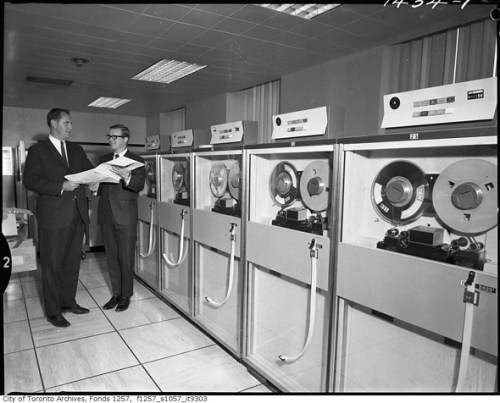
P.S. That old tech photo is weird. And the straps on the front of the tape drives go around the tape when you remove it. Don’t ask me how I know 🙂
Sure, to make a great film, great equipment helps. But as these links (and that photo of Zach Snyder shows), you can also make a good film using the latest smart phone technology. And not just Snyder: Gondry does it too. All the links below can help you get started making films using the technology in your pocket. Your films may not be as good as those, but the sooner you start making films with what you have on hand, the better your later films will be.
I found a collection of links on getting older, links I am drawn to as I get older. Some of them are essential but depressing. Others affirm there are possibilities for new things as one reaches middle age and then old age. There are difficulties, including discrimination due to ageism: some of these articles can help deal with that.
I’ll conclude with two pieces on much older artists still capable of doing great things. One of the biggest problems of being middle-aged is succumbing to fatalism and a pessimistic belief that almost everything is behind you, and that you have nothing to live for or work towards. As you can see in these pieces below, that’s not always true. You should fight that belief, and live your days like you have many, while taking care to enjoy each day as you can. You need a vision to care you forward, a way to get off the track labelled Dead End and on to the one the continues forward. I hope these links can help achieve that vision:
There are stages in parenthood when your children occupy all of your mental time, and when they do, you may find your mind is closed. If before parenthood you found yourself open to contemplate and examine ideas, after parenthood you may find that your ability to do that has shutdown. I found that for certain stages of the life of my child, all of my time was spent either focusing on their care or worrying about them. But then there were stages when they settled down and there was less to worry about and my mind freed up again.
If you are a parent and you find yourself wrapped up in the state of your child, you should believe that that will pass, and while you never stop thinking about them, you will find you think / worry about them less. This is a good thing.
Some background is in order. For years, content creators on Youtube (part of Google/Alphabet) have been jacking up the extremism in their videos to get more views. Extremism in all senses of the word, including political extremism. Some do it for Fame, but many do it for Fortune. This was going well for them until….
In March this year, 250 advertisers pulled back from YouTube after reports that ads were appearing on extremist content, including white supremacist videos. As a result, YouTube demonetized a wide range of political content, including videos that didn’t include hate speech but might still be considered controversial by advertisers. Creators called it “the adpocalypse” — they saw their incomes from YouTube evaporate without fully understanding what they’d done wrong or how to avoid demonetization in the future.
And this is the problem for Youtube and other platforms…how to maximize both traffic and profit. For a long time the formula was simple: more extreme videos = more traffic = more profit. Now they are hitting a wall, and advertisers and consumers are fed up.
The question big IT will be struggling with is: how to draw the line? In case you think the line is easy to draw, I recommend you watch the video by Carlos Maza of Vox. He makes a case that it is very difficult, even if at first glance it should be obvious what should be removed.
I don’t think there is a simple answer to this. If anything, it is going to be one of the major political debates of the first part of the 21st century, as global IT companies deal with national laws and policies.
What makes this development significant to me is that it signals that Sonos is concerned with Apple and others coming and taking away market share. Sonos has a great line of products already, but Apple is threatening to take a piece of that with their new home speaker with Siri/AI capability. Sonos has beefed up their AI capability to meet the challenge.
I expect that the next big thing in IT will be the vocal interface tied in with a speaker system in some form. I expect we will see them everywhere. Perhaps not for extended communication, but for brief and frequent requests.
If you are an IT person, I recommend you learn more about chatbot technology and how it will integrate with the work you are doing. More and more users will want to be able to communicate with your systems using voice. You need to provide a vocal interface for them to get information and send information.
Most homes will have one device acting as an aural hub. Sonos wants to make sure it is one they make, and not Apple.
According to the New York Times, the Frightful Five are Amazon, Apple, Facebook, Microsoft and Alphabet, Google’s parent company. What makes them frightening?
(The Frightful Five) have experienced astounding growth over the last few years, making them the world’s five most valuable public companies. Because they own the technology that will dominate much of life for the foreseeable future, they are also gaining vast social and political power over much of the world beyond tech.
These companies are getting alot more scrutiny lately. Any organization as wealthy and powerful as they are warrant it. Especially so because we aren’t even certain what impact they have on our societies. I hope the Times and other newspapers continue to give them focus and question their power. And I hope more writers like Scott Galloway examine what these companies do in books like the one he has just written. Most importantly, I hope you continue to seek out information on these companies and question how you interact with them, either directly or indirectly as a member of society.
Why? Because October can be one of the best times to go to Europe. Perfect weather, no crowds, great festivals…and cheaper. Don’t believe me? See this piece, which makes a strong case to pack your bags this very minute and head on out: The Best Time to Go to Europe | Kitchn
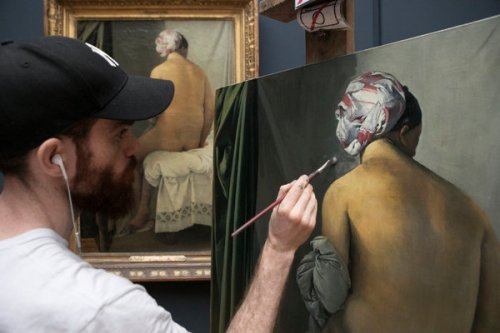
Apply for one of the 250 permits the museum gives out each year.
Bring your supplies and stand in front of the painting you want to copy. You can do this most days in the months of September through June from 9:30 a.m. to 1:30 p.m.
Start painting.
Ok, it’s not quite that easy. Even if you can perfectly reproduce the work you stand before, the staff of the Louvre take steps to insure no one mistakes your work for the original, as this NYTimes article points out. For example, in this article, they made sure that the copyists used
canvases that were one-fifth smaller or larger than the original, and that the original artists’ signatures were not reproduced on the copies. Then (the staff) stamped the backs of the canvases with a Louvre seal, added (the staff’s) own signature and escorted (the copyists) from the museum.
It’s a fine article highlighting a great tradition of the Louvre: well worth reading.
(Photo by IVAN GUILBERT / COSMOS and linked to in the article)
Over at Colossal they have a gorgeous collection of images by Visarute Angkatavanich of Siamese Fighting Fish in all their glory. Beautiful fish, captured beautifully in the photographs of Angkatavanich.









 (Image credit:
  (Image credit:


 The first time I saw Blade Runner 2049, I found myself continually comparing it to the first Blade Runner. I loved it but I could not think of it without thinking about the first film.



/cdn.vox-cdn.com/uploads/chorus_asset/file/9376599/blade2.png)









 Smart People I Know