Easy, with this beautiful map:

A link to a full sized version of the map is here.
More information on the map, here: New map charts parks near TTC stations

Easy, with this beautiful map:
A link to a full sized version of the map is here.
More information on the map, here: New map charts parks near TTC stations
What does it mean to be lonely? Here are two good pieces exploring the aspect of being lonely. First up, a review of the book, The Lonely City: Adventures in the Art of Being Alone, which is something of a memoir, but a memoir focused on exploring the idea of loneliness. The second piece, The future of loneliness | Olivia Laing | Society | The Guardian, examines the idea of loneliness in the context of our current technology and our current society.
How you think of aloneness and being alone depends on your own personal experiences and context. For some, it can be a terrifying idea, being alone, while others find it liberating and exciting. To some, being alone is a foreign place, to others, the state of aloneness is the place they call home.
One of the best things, and hopeful things, ever made about being alone, is this video:
Enjoy.
Yesterday I mentioned Robert Caro and his writing routine. Today, here’s a good piece by George Saunders and what writers really do when they write in The Guardian. Well worth a read.
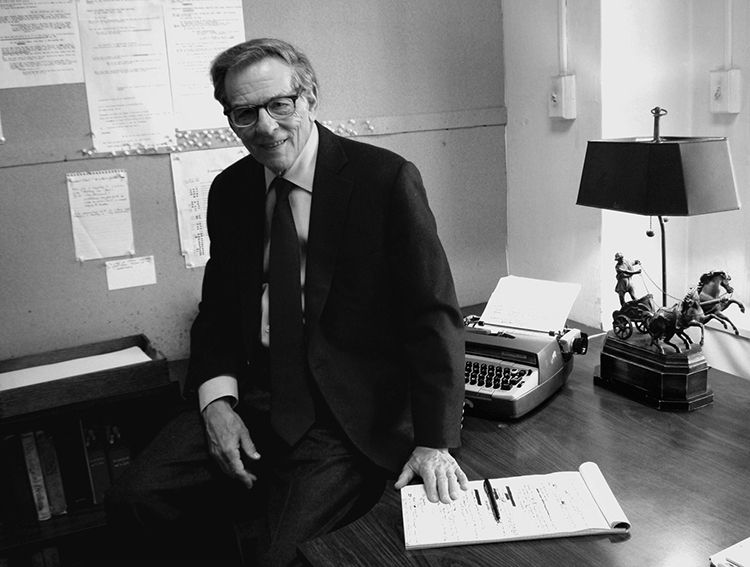
I find Caro a fascinating person and this portrait of him in this Paris Review interview is well worth reading: Paris Review – Robert Caro, The Art of Biography No. 5.
It’s worth comparing it to this piece on him in the New York Times that talks about his routine, including how he goes to a separate office in Manhattan just to work and that he wears formal business attire to do so. A rare life writing about another rare life.

The story of Bleecker Street’s Swerve From Luxe Shops to Vacant Stores in the NYTimes is one playing out in many cities throughout the world, though perhaps not as extreme as this. It’s a big problem when money comes flooding into neighborhoods and cities, disrupting the people that live there, and making those areas unlivable in some cases. Most people need somewhat stable places to live, but unstable social systems (capitalist or otherwise) can make that difficult unless other social systems (like local governments) come in and press back against such instability. As more of the world moves from rural to urban areas, the tools to make streets and cities livable need to be developed and put to use.
Anyone living in a growing city needs to read this piece. Recommended.
(PHOTOGRAPHS BY CHRIS MOTTALINI FOR THE NEW YORK TIMES)

There are many ways to raise money on line, from Patreon to Indiegogo to Kickstarter. A more modest way to raise money online is this site: Ko-fi. I think it is perfect for anyone wanting to share things with others in exchange for a modest amount of money (i.e. the cost of a cup of coffee, approximately). If you were looking for something like this for your site, I recommend you check it out.
By the way, if you want to check it out (and buy ME a coffee), here is my link. Thank you!
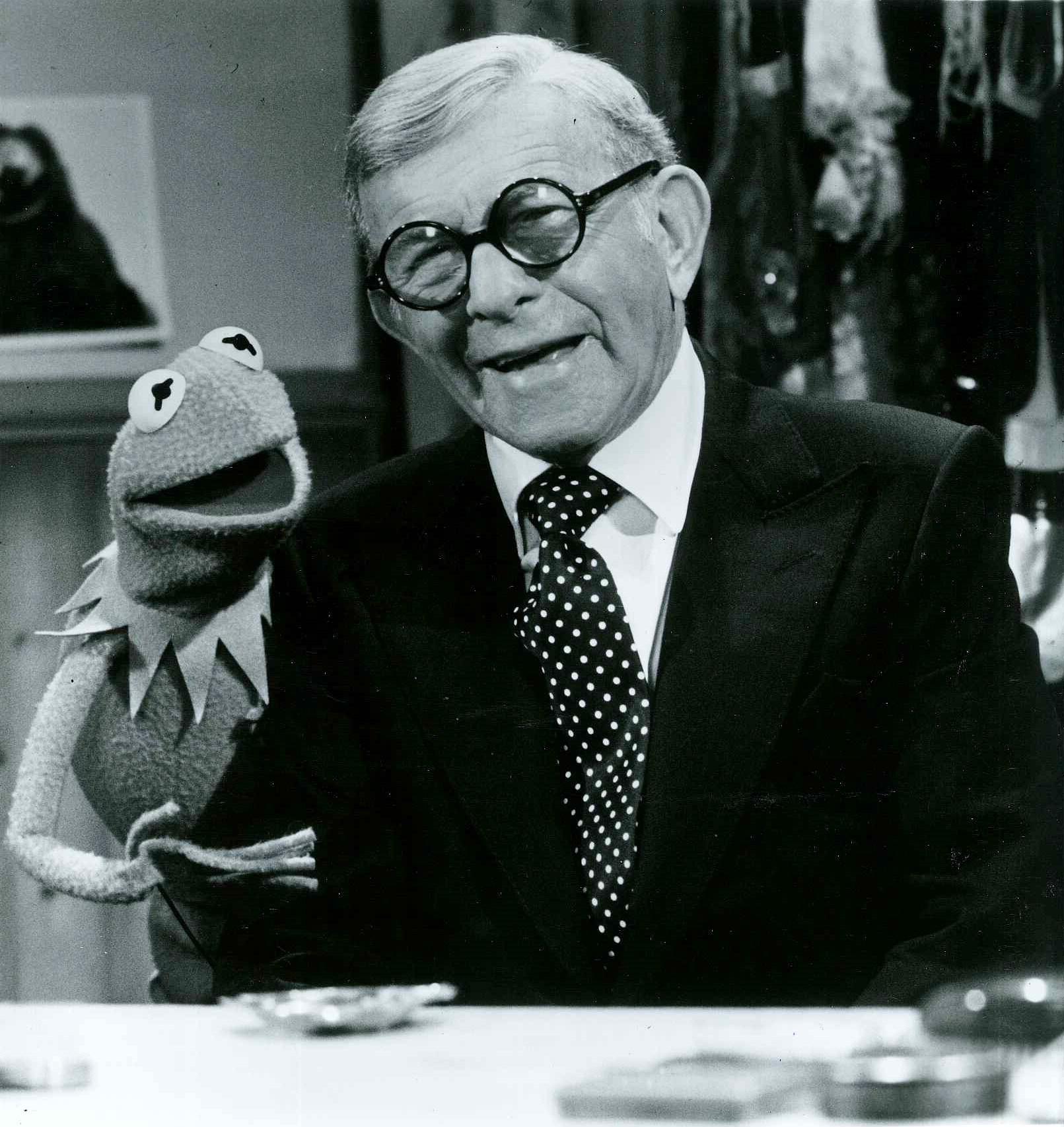
Kinda funny, though not intentionally: BBC – Capital – The tricks to make yourself effortlessly charming.
Some thoughts:
This piece in the New York Times is great advice for anyone young and struggling with networking. Is networking useless? Not at all. But like direct mail or many other forms of outreach, the effort to success ratio is far from 1:1.
If you are an extrovert, then you likely get something out of networking even if it isn’t a leg up at work. If you are are introvert, however, articles like that one are likely to make you never want to even try. For you introverts, I recommend you find ways to network that are pain free. You may not even have to directly talk to people: just be contributing to platforms that have alot of participants, you can get the benefits of networking. Networks are everywhere these days and embedded in much of the technology we use: take advantage of that fact to network in the ways most effective for you.
Hard work and luck are the keys to success. Networking is also a form of hard work, and if you work at it, it can bring luck! (After all, good luck is the residue of hard work.) Therefore include networking as part of what you are doing to be successful. Just hav the right expectation of what comes from such work.

If you can see clearly ahead, you can make better directions on how to steer. It’s true for any mode of transportation. It’s also true about life. Take a look at this piece in the 99u: What I Wish I Knew at Every Age – 99U. Whether you are young or old, it will give you the ability to see what’s ahead in life though the wishes of others and it will help you steer your one wonderful life.
Drive well.
(Image from here).

I highly recommend checking this out: Pictures of Venice in the Fog – Fubiz Media. Beautiful images of a beautiful city in a form I have rarely seen.

There can be many lessons that can be drawn from the story here: The Rise and Fall of the ‘Freest Little City in Texas’
The ones I drew were
It’s a good story. Read it for yourself and draw your own conclusions.
(Photo above is Amish women on the beach)

Statues and awards and the naming of things (schools, hospitals, museums) are about many things, but first they are about power. Those with political or organizational or financial power decide what names go on things, what statues and monuments go where, and who should get awards. Sometimes it is simple, and an award or a thing gets named after someone or something powerful as a direct result of their power. Other times it is subtle, and the award or the statue or the naming of a thing reflects the values of those with power.
When people want to tear down statues or rename things or revoke awards, there is an outcry. That outcry is because of a group fearing their loss of power. You won’t hear people talk of it in those terms: you will hear people talk about values instead. But the change is the result of a shift in power. History isn’t erased because something is renamed or revoked or torn down: anyone who wants to know the history can know it in other ways. And history isn’t changed by putting up more statues or naming things differently.
Of all the ways of understanding history, objects are the worst. They are a crude reminder that a history exists, and they are put in place by powers that be or powers that were. As a place changes, the statues should change, the awards should be redistributed, and the things should be renamed. And this will indeed happen, and it will happen due to the new people in power.
If you feel yourself out of sorts or not your best in the month of August, you are not alone. August can trigger bad emotional responses in us for a number of reasons, whether we love the summer or hate it. To see what I mean, see this: August Blues Are Like Sunday Blues, But for a Full Month — Science of Us.
I would add for some, August can be the most extreme month in terms of weather (just like February) and that can make it difficult to deal with too. If you find yourself struggling at this time of the year, cut yourself some slack and prepare yourself for the true start of the new year: September. (A much nicer month than August for many reasons).
If you struggle with stress and don’t know where to start, start here: Reduce Your Stress in Two Minutes a Day – Harvard Business Review – Pocket. It is general advice, but even adopting a few of these practices in daily life should help releave your levels of stress. It is especially good advice for driven people who need to succeed in the areas of life they focus on, but find that their usual approach doesn’t help them when it comes to stress.
This: Is it okay for a city to track what’s in your poop? – Macleans.ca, is a provocative question that headlines a good article.
Now for most people, the answer would be a loud “no!”. But as you can see in the article, smarter cities lead to municipal governments gathering more information about you. Certainly in the case of smart meters, the government agency can tell alot about you just from when you use power. Digital technology and the need to better manage government resources can lead to further tracking, including to what is in your waste water. Expect to see more such tracking in the future.
Ideally for any information being gathered about you, there would be strict control over who has access to the information and what they can do with it. As well, there would be some accountability with regards to that information. I would expect there is a mixed record for much of that information, but the fact that I can only speculate tells me there is more work to be done with regards to accountability.
Read the article. It helps to be informed about such tracking so you can know how you can be tracked and how you can ask questions about such tracking to government officials and elected politicians.
With the rise of right wing extremists, including neo-Nazis, I see it often said on social media that the German people of the 1920s and 1930s did little if anything to oppose Adolf Hitler and the National Socialist Party’s rise to power. This is untrue. There was a lot of opposition to the Nazis rise to power, opposition that the Nazis spent much time and effort to overcome. Ideally you should read this history to see this, whether you read works by AJP Taylor, Ian Kershaw, John Toland, Joachim Fest, or others (but not David Irving). For a start, you can read this: Adolf Hitler’s rise to power, beginning with the Beer Hall Putsch. As you read along, you can see many opposed to the rise of the Nazi party. You can argue that they were ineffective: you cannot argue that they did not exist. Many of the opponents were killed (members of the Red Front) and many others, like Ernst Thälmann, were sent to concentration camps. Some fled, others became silent, and still others become supporters. Many died in the war to come.
The Nazis were supported, of course: that is how they managed to be in a position to take over power in the first place. But the idea that they met with little or no opposition is wrong.
For more reading, you can find a link to
Reason #1: Apple is seeing growth in sales of the Watch, and plans to give it cellular capabilities will drive growth further. If cellular networks allow you to share your number across your phone and watch, it could really support people who may want to go without their phone from time to time.
Reason #2: is my belief that the Watch will provide Apple with a platform to develop miniaturization. Having different platforms and different scales allows Apple to innovate and gets their partners like Intel to do the same. This will support Apple in being either first or best in the areas they have products.
I'm glad to see the Watch continue to grow. I would not be surprised to see some of the features we once saw in the Shuffle morph into the Watch. That would make up some for the lost of that other once great platform of Apple, the iPod, which was loved and now lost.

According to this, chatbots in China have been removed after being critical of the Chinese government. This to me is not unlike what happened to Microsoft's chat bot that became racist after being feed racist input from users. If you put AI out there and allow any form of input, then the equivalent of vandals can overtake you AI and feed it whatever they choose. I'm not certain if that was the case in China but I suspect it was.
AI researchers need to expect the worst case use cases if they allow their software to do unsupervised learning on the Internet. If they don't, it's likely that their projects will be a disaster and they will do damage to the AI community in general.
And the New York Times has a good analysis of here work so far. I really enjoyed the analysis. As for me, I found it interesting that she has transitioned the account from a basic one that recorded events the way most of us do into something that extends her art in a way few of us can do. I also like that great artists like Sherman can take new media and incorporate it into their work but also extend it. David Hockney did something similar with the Brushes app. Here's hoping more artists do such things.
There seems to be many opponents and few supporters of the new series planned on HBO, Confederate. It’s easy to see why. This piece by Bree Newsome is a good example of what many think of the upcoming series:
HBO’s Confederate is just a fantasy — unless you’re black – The Washington Post
In some ways, though, I think this piece can be an argument FOR the series, though it argues the opposite. That’s not just me being Devil’s Advocate. My belief is that science fiction has a way of presenting ideas in a way that gets people to think about them and think about them unlike any other form of fiction. From Star Trek to the Handmaid’s Tale, science fiction (especially on TV) has gotten people to think about ideas that they might normally avoid. Ideas that people might escape from in real life get in front of them when they escape into science fiction. Newsome cites a number of facts about the current suffering black Americans undergo now, facts that many white Americans would just as soon avoid or ignore. The series Confederate could be a forum to bring those ideas and facts to the foreground in a way news editorials or regular TV news cannot. The series could lead to changes in a way other media cannot.
That’s a potential pro for Confederate. I don’t believe it is enough of one. There are many alternative timelines that the producers of the show could have chosen: they seem to have chosen a terrible one. An alternative history that went in a utopian direction would have had issues of its own, but instead they seem to have gone with a dystopian vision. This is certain to cause more pain for black Americans now and likely encourage racists to interpret the series in a way to support their racism.
As artists, the makers of Confederate might argue that a dystopian view is the best way to emphasize the themes and ideas they want the show to carry. However, the makers of Confederate and HBO are in the entertainment business. Alot of money is going into the show, and no doubt they expect to make alot of money from it. To make all that money by causing pain and encouraging racists is wrong.
This is a key thing: big TV series, like big movies, are not just a forum for ideas. They are big business, and you can’t separate the two. I think artists should have a lot of freedom to present ideas, including ideas that cause suffering and including ideas that are wrong. But artists that make big films and TV shows are artists-capitalists. And that means they need to expect not just people debating their ideas, but people pushing back on their ability to make money from their ideas, including people organizing strikes and boycotts and promoting competition for your show.
HBO and the makers of Confederate have a choice: they can communicate that the show will have good ideas and that the artistry and intelligence of the show will be of a benefit, even if it is dystopian. Or they can just ignore the obvious problems they are causing and proceed. If they chose that route, they should expect to lose both the battle of ideas and the battle of the marketplace. Let’s hope they choose for the best.
Economists write a lot about the mystery of why productivity is not increasing, with pieces such as this. There’s even a section on it in Wikipedia.
My own theory is that limited wage increases is also limiting the benefits of productivity aids. How I think this works is so:
Look at this chart:
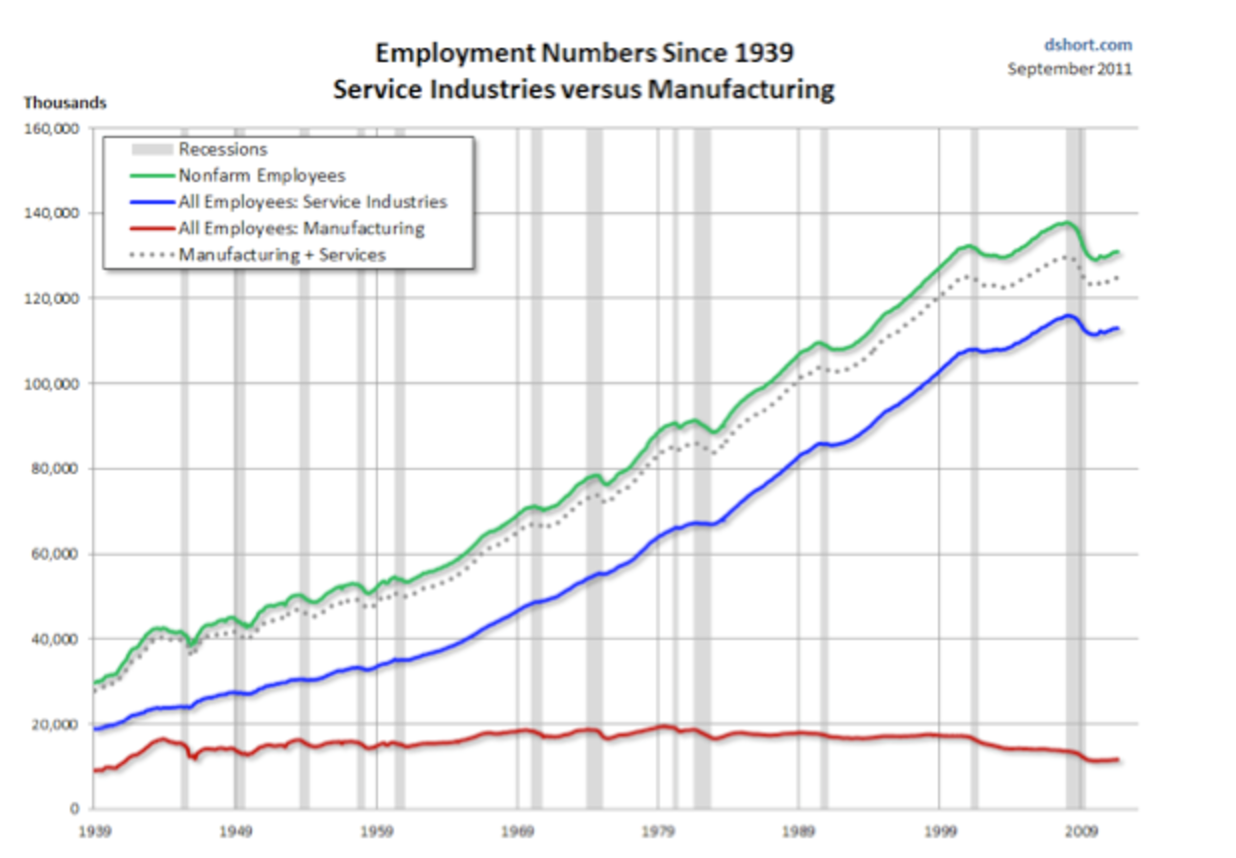
In much of the world economy, all the job growth is in the services sector (green line), not the manufacturing sector (red line). Achieving productivity gains in the manufacturing sector is more straightforward: replace people with robots and you are done. It’s not as straightforward as that in the services sector. In some services sector jobs, it is not possible to decrease effort without it being visible. But in many services sector jobs, it is. If employees cannot improve their lives by making more money, they may decide to do so by working less and working right up to the point where they don’t lose their job.
If you look at employment as a game, then we currently have a Nash equilibrium where the employees know that they won’t get paid more working for the same company, because that is the best strategy for the company. Therefore the best strategy for the employee is to minimize their effort without getting fired and while showing little if any productivity gains.
That’s to me is key reason why I think we have the productivity paradox.
I would add that the reason this is a paradox is because no one wants to admit that this is happening. It seems like a failure on both the employers and the employees side. The employee wants to be seen as a good worker and the employer doesn’t want to admit it could be paying more. Instead technology is brought in to solve an organizational problem, which is something technology cannot do.
(Chart from Business Insider).
Lots of chatter on this recently, Justin Trudeau: Canadian Prime Minister, Free World’s Best Hope? – Rolling Stone.
It’s good that the world thinks highly of our leaders, whomever they are. Canada is a significant nation in the world with the ability to influence other nations, and having a leader that is looked up to makes a positive difference.
As a Canadian citizen, I’m more interested in the substance than the PR. And I’m more interested in what the government is doing, not just the Prime Minister. I try to look at the government’s policies, competency in executing on those policies (either through legislation or direction to federal agencies), and how the government supports democracy (through actions to make our country more democratic) or hinders it (by making the country less democratic or by being corrupt).
That means I spend less and less time reading pieces like this, which are along the lines of “if you people were as smart as me you’d realize how bad Trudeau is” . Instead, I look to sites like this which track the government’s progress. For example, this site, TrudeauMeter, has ongoing ratings of the government. Other commentators, like John Ibbitson, provide periodic ratings: Video: Opinion: John Ibbitson rates the Trudeau government as Ottawa wraps up for the summer – The Globe and Mail. Finding sources of information you find comprehensive and objective are always your best bet.
If you don’t support the Liberal government’s policies, then I can see why you would not want the government in place. Likewise there will be times when you do support the government’s policies but you feel the level of corruption or incompetence is so high you want to turn to a different group. If you are going to rate the Prime Minister and his government, those are good criteria to evaluate them on, not PR like the Rolling Stone magazine, or any other specific good or bad focus pieces on them. The government works for you, and if you are a good boss, you evaluate them mainly on the entirety of their efforts, not just things here and there.
Some other thoughts on Trudeau:
From what I can see so far, his government is starting off unsurprisingly: being successful over things the government has control over (like spending) and having less success over things that requires working with other groups. I suspect they will make no progress on electoral reform unless there is a major push from Canadians. Likewise, there are so many issues and problems with regards to Aboriginal peoples that any progress there will be modest, at best. I wish neither of them were true, but I am not optimistic on those fronts.
I suspect that as long as the economy is doing fine, the government does not appear corrupt or incompetent, and people aren’t tired of his government, then Trudeau and his team will be in power for some time to come. The first one, the economy, will be the one that is most likely to hit him. Corruption takes time to seep in (although major scandals can occur at any time and make the government appear corrupt), and government fatigue takes longer still. Whatever you thought of Chretien or Harper, that was true for them and I suspect it will be true for Trudeau as well.
I will continue to ignore articles that underestimate Trudeau (like the one above). He’s flashy and sometimes appears smarmy, but he’s smart, he has a good team, and politics is in his DNA. If you oppose Trudeau, underestimating him only works to his advantage and not yours. In addition, he is as much his mom’s son as his Dad’s. The combination makes him much more effective than his Dad could ever be. His Dad may have had a higher IQ than him, but he has a higher EQ than his Dad ever had and that will make him more challenging to defeat than people who approach politics intellectually realize.
Likewise, I will continue to ignore articles that compare Trudeau to Trump. There is little if anything to be gained by them. Trump is an anomaly. Almost any leader looks good in comparison to the 45th President of the United States.
I like Trudeau for alot of reasons. That said, it doesn’t matter if I like him or not, anymore than it matters that you dislike him or not. What matters is his ability to do the job. He’s not an entertainer: he’s an elected official. When the next election comes, it won’t matter how good or bad Trudeau’s PR is. What matters is that in comparison to other politicians looking to lead the country, is the government he proposes to lead the best one for the job based on the criteria I have. That’s the only thing that matters.
Well, here it is!
Some initial thoughts:
Lots to think about and get excited about too! Looking forward to more trailers soon! In the meantime, what follows is a collection of the previous trailers. Enjoy!
P.S. Oh, I missed this featurette before. Need to add it, too!
The following webpage has detailed instructions for installing and configuring SonarQube on a RHEL/CentOS 7 Linux server (real or virtual) and it was one of the best guides I’ve seen (and I’ve reviewed half a dozen):
The webpage outlines how to update your Linux server, how to install MySQL (as a data repository) on it, and how to then install SonarQube software on the server.
Some things to note. First, this procedures has you using wget to get v6.0 of SonarQube:
Check out the page https://www.sonarqube.org/downloads/ and see the latest version of SonarQube (e.g. 6.4) and replace “sonarqube-6.0.zip” with the latest version (e.g. “sonarqub-6.4.zip”.)
One important thing to note: this procedure creates a userid and database called sonarqube.
Later in the process, the changes made to /opt/sonarqube/conf/sonar.properties needs to match this:
sonar.jdbc.username=sonarqube                                   sonar.jdbc.password=password

sonar.jdbc.url=jdbc:mysql://localhost:3306/sonarqube?useUnicode=true&characterEncoding=utf8&rewriteBatchedStatements=true&useConfigs=maxPerformance
If the userid, password and database you created in MySQL do not match what it is the sonar.properties file, you will see cannot connect to the database errors in the /opt/sonarqube/logs/web.log file and SonarQube will not come up.
Once you enter: sudo ./sonar.sh start
Get the IP address of the SonarQube server and then go to a browser and enter:
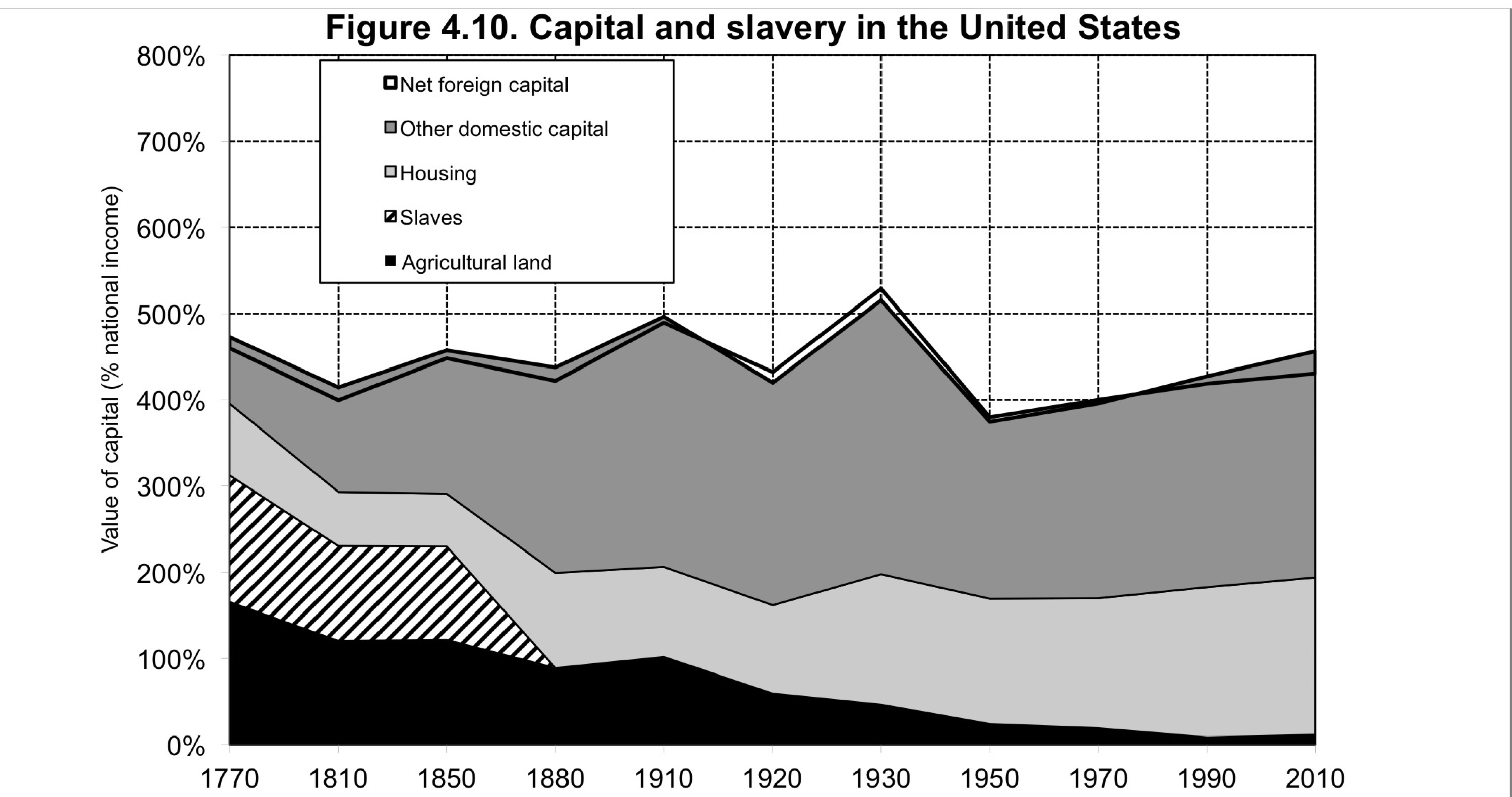
It is striking to see what percentage of American capital attributed to slavery in the 18th and 19th centuries (the striped section in the chart above). In the late 18th century only agricultural land counted for more, and there slavery contributed to that too.
The American Civil War and the emancipation of those bound in slavery destroyed all that capital, and that was great and necessary. While it is wrong to consider slavery only in terms of money, it is impossible to talk about slavery in the United States without considering its relationship to the economy and capital. The capital that derived from slavery was massive.
In the U.K. the abolition of slavery resulted in the government providing capital back to the slave owners. It was a terrible omission that neither the U.K. nor the U.S. provided capital to the freed slaves. There are those, like Ta-Nehisi Coates, who argue that such capital in the form of reparation is due. Based on the chart above, a case could be made that it would be a tremendous amount of money.
(Chart above taken from “Capital in the Twenty-First Century” by Thomas Piketty)
After reading this, The Arctic “doomsday” seed vault is supposed to ensure the future of humanity. It just flooded, I wondered why there is only one of these?! If this one gets destroyed, are we doomed?!
I should relax, though remain concerned: it turns out there are many seed vaults around the world. I discovered this after a few minutes on Google. It’s still bad that this one is being threatened. And I can see why so many stories are being written about it. But some context is important.
In addition, the people maintaining this vault have plans to deal with the threat to it. I expect that this one will survive along with all of its seeds.
Yes, global warming is still a major problem and it is threatening our future. The flooding at this seed bank is not.

I was prepared to argue with this article in Vox from some time ago: The problem with home-cooked meals , because I am a big proponent of such meals. However, the closer I read it, I think the main issue I have with it is the title. If it was titled “The difficulties in preparing home-cooked meals”, I would have been more receptive. Read the article. If you are a foodist like myself, it might seem hard to understand at first that people have difficulties with home-cooked meals, but like many things, the difficulties arise from lack of time, knowledge, and resources (money but also access to good food, even if you have money).
I believe that there are a number of ways to address those difficulties. First, I think city governments need to treat access to food the same way they treat access to other things such as transportation, water, parks and even sunlight. If housing doesn’t have access to water or electricity or transportation, then developers shouldn’t be allowed to build it and people should not be expected to move there. Access to good food should be part of that set of restrictions.
Second, we need to better educate people on how to prepare food. Too much of our education system is spent on academic topics. Kids should be taught a wide range of subjects, and one of those should be how to prepare food no matter how much time or a budget you have. (They should also be taught how to manage finances, how to do basic home repairs, and how to deal with personal difficulties, among other topics.) There is a wealth of information available on food preparation, but often to me it seems aimed at foodists and is aspirational. There’s nothing wrong with aspiring to make good food. In addition, though, people should learn how to make straightforward nutritious food, with anything from 2 ingredients on up, with or without a recipe, in 2 minutes or over 2 days.
Third, we need to change our emphasis on a form of eating. There is a belief that some North Americans have that home cooked meals should be prepared and eaten a certain way. Often this certain way involves 30 minutes to an hour of food preparation followed by an equal amount of time eating it. Culturally that may have been the way it was done, but there is nothing that says we must continue to eat that way. You should be able to prepare and eat good meals with the resources you have. If that means a 5 minute preparation and a 5 minute stand up meal, so be it. Better that than 30 minutes spent eating over processed food in a chain restaurant.
Finally, we need a more expansive and less snobby approach to what constitutes good food. If you are a foodist and you want to cook with homemade stock, fresh herbs, wine and hard to source ingredients, and that works for you, that’s great. For most people, if you have limited access to good food, then you can still make good meals with what you have available, and there is no shame in that. Besides, the social status of ingredients come and go: eat the best you can with what you have, be that a roasted chicken and a salad or a bowl of chunky vegetable soup.
For many people, food is a means to an end: I’m hungry, I eat food, I’m no longer hungry. For others, their life revolves around food. Wherever you fall on that spectrum, having an open mind about how others eat and being open to alternative ways to dealing with food will benefit everyone, including yourself.
(Image is of a ham, painted by Manet.)
P.S. In case you don’t think it is a word, here is the definition of definition of foodism, from the Oxford English Dictionary: “A keen or exaggerated interest in food, especially in the minute details of the preparation, presentation, and consumption of food.” Therefore people who have foodism are foodists.

The big art news this week was a record sale for one of Jean-Michel Basquiat’s paintings. Right after reading about that, I saw this tweet by Will Black: “Painting by street artist Basquiat, who lived in a cardboard box, sells for $110.5m in New York. Value PEOPLE while they are ALIVE”.
A few thoughts on that tweet. First, while Basquiat may have been poor starting out, by the time he died too young at the age of 27, he had a net worth of $10 million dollars. Second, that transition from poverty and obscurity to wealth and fame was fast. We should value people while they are alive, but there are better people to use as an example than Jean-Michel Basquiat.
As for my own thoughts, I have always loved Basquiat’s paintings since the 80s. Their greatness was there from the beginning. If we knew nothing else about the artist than his work, we would still think he was great.
But Basquiat was not just a painter: he was more like a rock star. Like Keith Haring, he had a public persona more akin to music superstars much in the same way that Andy Warhol did. It’s no surprise that Basquiat was influenced by Warhol in more ways than one. And now, at least in the world of the art market, he has surpassed Warhol. It’s good to see that too. For many reasons.
Jean-Michel Basquiat had something else that was great, and that was his sense of style. There’s a good piece in Dazed on the importance of clothing to him. They correctly note that:
Jean-Michel Basquiat was a fashionable man. He walked the Comme des Garçons runway for their SS87 collection and favoured the long, slim cut, slightly militaristic jackets of Issey Miyake. Biographers and friends recall the stories of Basquiat setting up tabs at his favorite clothing boutiques, trading canvasses for clothes.
Jean-Michel Basquiat was a legend for his time, and a star. It’s good to see that star is getting brighter.
For more on his fashion, see: The meaning and magic of Basquiat’s clothes | Dazed. It’s a strong piece.
…Then you want to go here and download and install the appropriate software for your Windows system: Security Essentials Download.
According to this, Microsoft has upgraded it’s security software to prevent similar attacks. That’s good. What’s not good is that you can be certain there will be a wave of copycat attacks coming. Get the software and install it today.
My new favorite productivity tool is this site: E.gg Timer – a simple countdown timer. Whenever I am procrastinating, I will use it to get myself to focus by starting it for 5, 10, or more minutes and telling myself: I will focus until the timer goes off. I have found this approach very effective, and this site helps me. It also helps because if I find myself going to my browser to mindlessly go on some time wasting site (hello, Twitter!) I will see this and I will remember to focus.
Fans of the pomodoro technique will see there is a special timer just for it.
As a bonus, you can use it to do a high intensity tabata workout.
Great tool. Highly recommended.
Whatever you think of George W. Bush as a president, most agree he is not bad painter. There are two reasons for the latter: one, he had good teachers, and two, he is a good student. How do I know he had good teachers? According to this, Art critics alarmed to discover that George W. Bush is actually a pretty good painter, Bush…
… didn’t have to sign up for classes at a local art school or the museum, of course. Instead, he took private lessons from a prominent Dallas artist named Gail Norfleet. Norfleet wrought a change in Bush’s worldview. He began to see the colors even in shadows, the subtle shifts of palette in a clear blue sky. “I was getting comfortable with the concepts of values and tones,” Bush writes in the introduction to his book. Norfleet also thoughtfully introduced the once monochromatic president to her mentor, another well-known Dallas artist named Roger Winter, and it was he who gave Bush the idea to paint world leaders. Bush also consulted a landscape painter, Jim Woodson, whose visions of the vast, untouched terrain of New Mexico are nothing like the conventional bluebonnet vistas many still associate with Texas art. It was Woodson who introduced Bush to, among other things, larger canvases and thicker paint, and guided him toward a more complex view of the world about him. (Underlying by me for emphasis).
Bush took the lessons from these teachers to heart. But he was fortunate to have access to good teachers. A lesson for us all.
There have been many articles written on UBI. (If you don’t know what it is, it’s universal basic income: a cash payment made to every individual in the country).
Two of the more interesting ones I’ve read are here: The UBI already exists for the 1% – Medium, and this one here (on how India is looking to do it).
UBI is coming. It may take some time though.
It may not seem obvious, but preventing ISPs from providing zero-rating is actually support for Net Neutrality.
I generally see Net Neutrality as a good thing, though the ISPs have something of a case here. That said, Net Neutrality is a good thing to stick with, especially because what the ISPs give they can also take away.
More on the CRTC ruling here: CRTC ruling against zero-rating a boon for businesses, experts say (via IT Business)

In France, politician Jean-Luc Mélenchon plans to be in seven places at once using something similar to a hologram. According to Le Parisien:
Strictly speaking, these are not holograms. Jean-Luc Mélenchon will be present in seven different places thanks to … an optical illusion discovered for the first time half a century ago by an Italian physicist
Virtual Mélenchon reminds me of the politician Yance in Philip K Dick’s novel, The Penultimate Truth. We may not be far off where we get virtual candidate that look like people but behind the scenes we have AI or some combination of AI and people.
For more on the technology, see the article in Le Parisien. For more on Dick’s novel, see Wikipedia. Read up now: I think we can expect to see more of this technology in use soon.
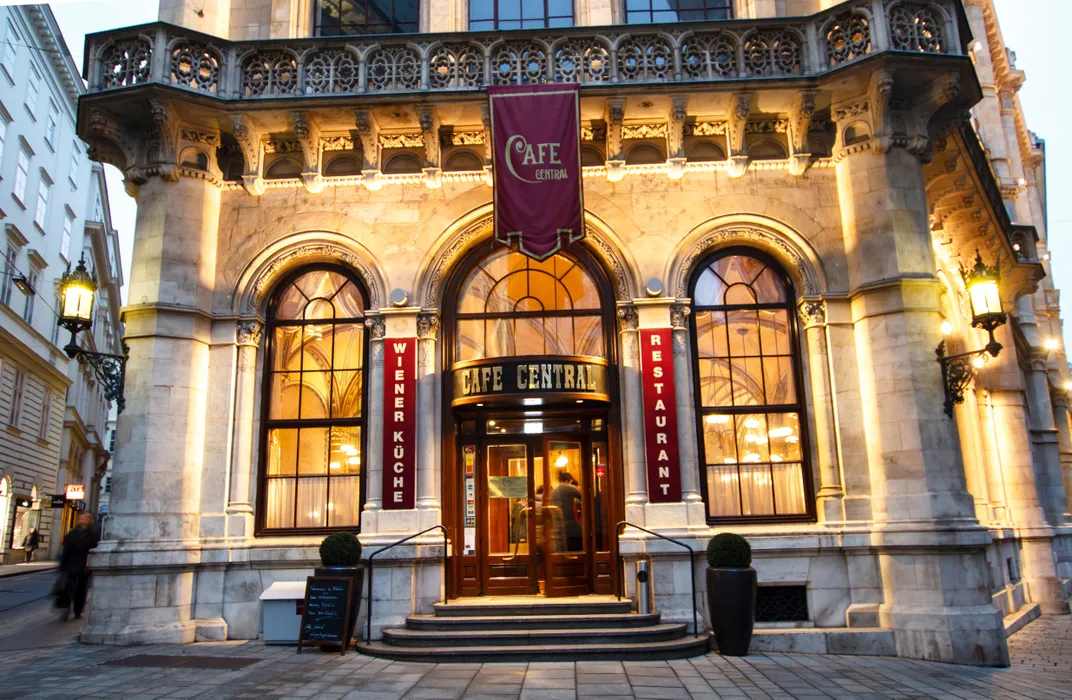
If you like cafes, coffee and travelling, then this link is for you: 12 Cafés Every History Buff Needs to Visit | Travel | Smithsonian. Of the places in the article, I’ve only been to Cafe Central in Vienna and it is great. (In truth, Vienna has many great cafes. I went there years ago and enjoyed many of them. Cafe Central was one of the highlights.)
As far as bucket lists go, you could do worse than making it your aim to visit all the places listed here. 🙂
(Hat tip to @candicewalsh on twitter for sharing this link originally, and who also has a great travel blog.)
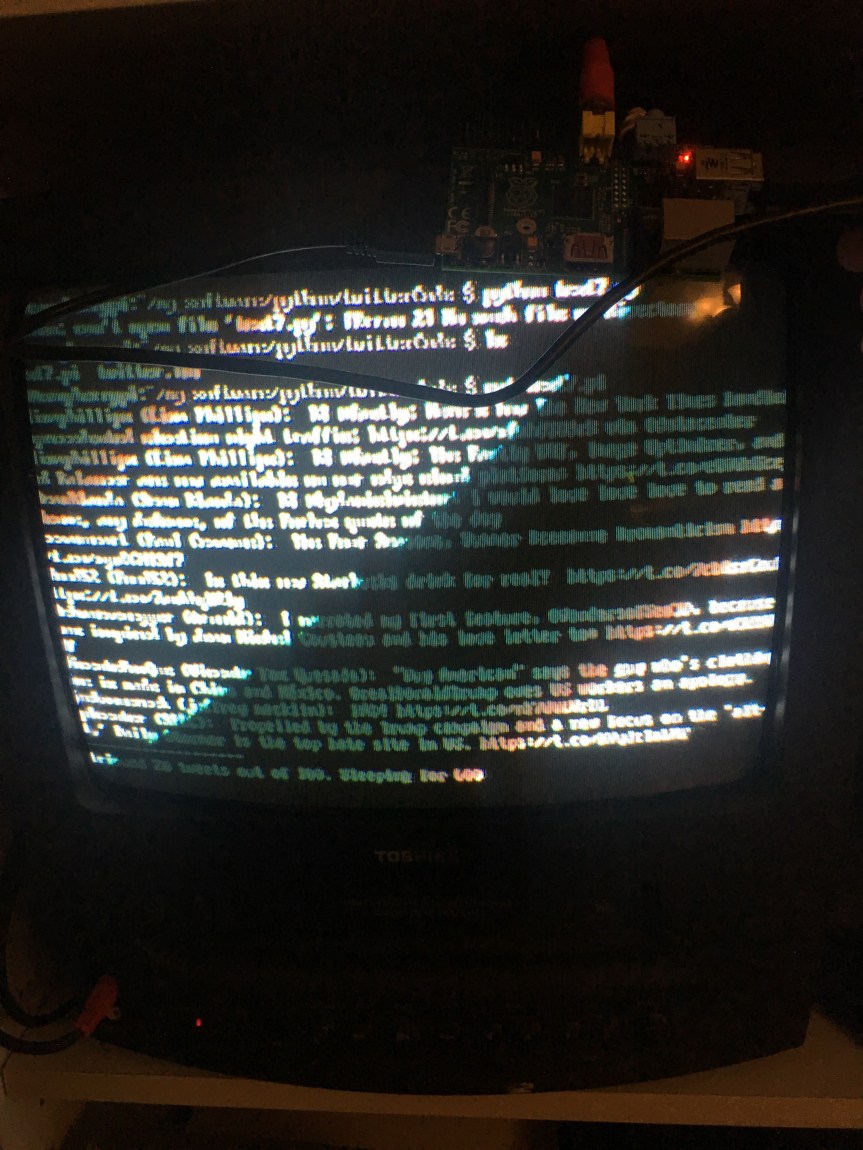
I had an old Raspberry Pi 1 Model A, with an HDMI port and a standard RCA composite video port for older displays and I also had an old Toshiba TV (pictured above) and I wanted to get them working together. Here’s what I did and here’s some things I learned.
First things first, I had to get a the Raspberry Pi functional. To do that, I mostly followed the steps here: http://www.pcworld.com/article/2598363/how-to-set-up-raspberry-pi-the-little-computer-you-can-cook-into-diy-tech-projects.html. I say mostly because I was using a Mac, so I used SDFormatter to format the SD card. If you have a Mac, you can get SDFormatter here.
Basic steps to set up the Pi were:
All that is pretty straightforward in terms of setting up the Pi. If you don’t care for the instructions from PCWorld, Google “Raspberry Pi setup Mac” (or Windows or whatever your operating system) and you will likely find a site that is helpful.
Now, once the files are copied on to the SD Card, modify the config.txt file on the SD card. This is a key thing I had to do. Before I did it, I could plug my Pi into the TV but nothing appeared on the screen. After modifying the config.txt file (and it took some hacking around), I was able to get it to work.
Why do you have to do this? It seems that Raspbian assume you will be using HDMI and will not recognize a non-HDMI output device unless you modify the file. So modify it you must.
Note! Before I edited the file and replaced the text in it, I selected all of the text in that file and copied and pasted it into a file on my Mac as a backup. I recommend you do the same. Then I made the changes to the file, saved it, then ejected the SD card and put it in my Raspberry Pi. If you want to see my version of the file, you can see it here.
It was a process of trial and error to figure out which lines in the the config.txt to change. I was fortunate that I could start with this page which had details on how he got it working. Unfortunately his config.txt and the one I needed were slightly different, so I kept at it until I figured out how it should work. (With his file, the text was unstable: it kept rolling up the screen. With my file, the text did not roll.)
In my config.txt, I have colour burst disabled, rendering everything in black and white. Enable it if you want colour. I disabled it because I thought it would improve resolution but it did not.
Other things to note:
I hope you found this useful.
P.S. The other thing I like about doing this is: my TV now looks like the TV between Leon and Holden in Blade Runner. 🙂


Since the start of the great recession in 2009, two things have happened in the stock market:
This leads me to two conclusions
The second conclusion is something that this piece tries to tackle: Gradual Improvements Go Unnoticed. It is easy to see what drives the stock market down in the short term: it is difficult to ascertain what drives the stock market up in the long term. Gradual improvements could be a contributor. Other things, like the activity of the central bank, affects this. Even how other markets in the world in the world can affect the stock market.
The New Yorker has the answer: Sorry for the Delayed Response – The New Yorker. (I think it is meant to be humourous, but it’s a little too close to reality to make me wonder. :))

If you looking to reboot your fitness routine, these four links could help.
(PHOTO CREDIT: Markus Spiske / raumrot.com via Flickr.com Creative Commons Search)

An interesting article: Ben Schreckinger from Politico Did Ruth Bader Ginsburg’s Workout. It Nearly Broke Him. If you want to see what the 80+ year old judge does to keep in shape, or be inspired to keep in shape yourself, I’d recommend reading it.
It can get too easy to forgo exercising when you get older. One reason people stop is because they think they are too old and cannot do it. Or if they do exercise, they will harm themselves. Her trainer cautions against that, and says:
“Do something. If you’re not doing anything then I advise you do something. It doesn’t matter what you do. You find out what is your niche and do something. Your body is made to move.”
Good advice. Maybe your fitness routine is long walks. Or cycling. Or yoga. Or benchpressing hundreds of pounds. Whatever you do, do something. And read the article. I hope it will inspire you to get fit. Whatever your age.
(Image linked to on Wikipedia)


