It’s Monday. Why are you working more than five hours a day?


It’s Monday. You are only working five hours today, right? I bring this up because I recently read this piece in Wired on how that is the right amount of hours to work each day, and how people who worked that way were more productive.

Of course there are a few caveats. For one thing, many jobs are not mainly focused on being productive. Anyone who has a job that requires many meetings can tell you that. But if you have a job that is largely focused on producing things, then try and limit yourself to five hours.

(Photo by ANIRUDH on Unsplash )

If you ever have that feeling of not wanting to be here

If you ever have that feeling of not wanting to be her, these article might be of some help:

If they don’t help or they don’t help enough, consult with a professional right away.

(Photo by John Baker on Unsplash )

On the difficulty with being stuck on a local maximum

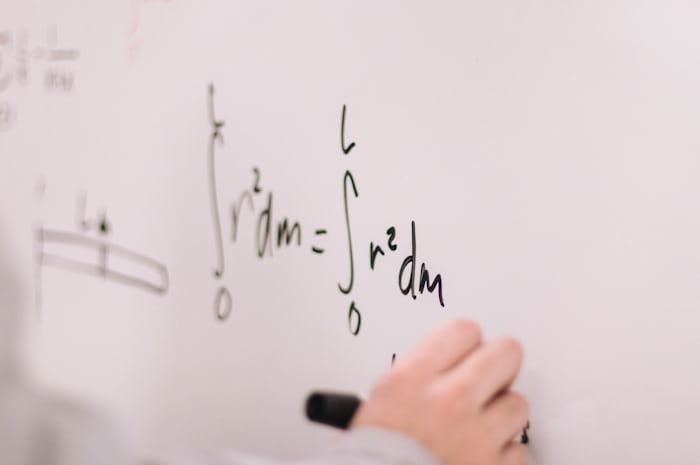
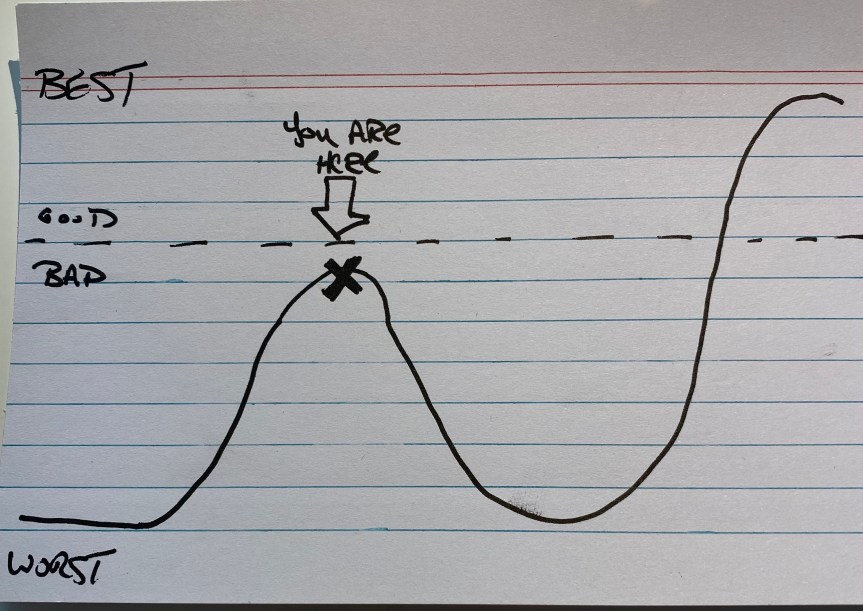
In math there is the concept of a local maximum. It is a point on a curve that is higher than the area around it, but not the highest point on the entire curve.

This happens in life too. You can be at a point in your life where you know life could be better, but to make a move from that point leads to life getting worse. Now if this high point is good, you can feel pretty good about it. Sure you could try and go for the higher point, but you may decide the tradeoff isn’t worth it.

The problem is when the high point isn’t good. Here you are stuck between choosing bad or worse. You could decide to move from bad to worse on the hope of getting to a much better life, but what if you don’t have the resources to do so? What if you move off the local maximum and fall into the valley of the a local minimum and never move off of there?

When you ask yourself those questions and you don’t have good answers, you will get stuck. You will be unhappy with the thought of staying, and unhappy with the thought of leaving. It’s hard. Here’s some things to consider.

First off, this is just a model. A diagram. It’s not the real world. It’s just a way of analyzing your situation. Your life is not just one point on a curve, not one score (like an IQ) that says your life is good or bad. Mathematically speaking, your life is more like a set of numbers, all different values on different curves, and these values are changing all the time. Indeed, if you only focus on one number, you may find you life painful and shallow. Some people devote their life to one measure: an award, a championship, a job title, and find themselves disappointed and even bitter when they achieve it and realize they gave up everything just for that.

Second, it is hard to measure things even at the best of times. That job title you wished so hard for suddenly means nothing when the company suddenly goes bankrupt. Or the limited domestic life you have suddenly looks good when a pandemic lands on everyone.  Measurements change all the time as the ground shifts all the time, and all measurements are relative.

That said, it is no reason to be complacent. Have more faith in yourself. Look back at all the difficulty you have had in the past that you survived and prospered in. If you do move off your local maximum, you may get stuck in a rut for awhile. But only for awhile. Keep moving. Keep remembering that you life is more than one measure, and if you are in a rut workwise, for example, your life may be at a high point in other aspects. You are not measured by one number: you are measured by a set of numbers. Better still, you can decide on some of those numbers yourself. Don’t let others dictate the numbers.

What curves you use to measure yourself, and how you measure them, are up to you. Choose wisely, and you may find your life is closer to the maximum point than you thought.

Have a good life.

It’s Monday. You want to stop procrastinating. You need to use your brain (better)


It’s Monday. If you are struggling with procrastinating, here is a good article on how to finally stop procrastinating for real this time. Basically in order to understand why you are procrastinating, you need to understand there are two parts of your brain that are influencing your behaviour. Knowing this can help you change. Here’s a key quote:

…there’s a part of the brain that accurately weighs the benefits of a behavior against its costs. This is your neocortex, and it’s one of the newest and shiniest parts of our brains. Very often, the neocortex comes to quite reasonable conclusions—that, for instance, the benefits of exercising outweigh the costs. But there’s another part of your brain that’s been around for millions of years—the limbic system—and it only seems to care about what’s happening right now. So if a behavior incurs more upfront hassles than upfront benefits, the limbic system isn’t interested in participating.

For more on this, read the article. It will help you get your neocortex and your limbic system working together. If you do that, you will definitely procrastinate less.

(Photo by Jason Strull on Unsplash )

Two hacks for cleaning your oven

Sure, you can go out and buy oven cleaner and deal with all that. Or you can try one of these two hacks to clean your oven:

  1. Clean Oven with a Dishwasher Tablet | Kitchn
  2. Use Shaving Cream to Clean an Oven | Kitchn

I haven’t tried them, so I can verify they are good. But if they work as well as the articles say, it could be a nice alternative way to have a sparkling oven.

Let me know if you try them and if it works.

What do you do if you want to keep working from home

While many of us have been forced to work from home during the pandemic, that time may be ending some time this year. Many people will be delighted to go back. If this is not the case for you, then read this article.

That article contains good advice for either finding a new job that is full time remote, or finding a job that can be a hybrid. Either way, if you want to continue to work from home, I recommend you start thinking of how to achieve that now.

(Photo by Collov Home Design on Unsplash )


It’s Monday. Here’s how to link your days together to make for a more productive week


Often times we start the week productive, but then things unravel midweek, until we are saying thank god it’s Friday and we are left wondering how things went so off track.

To avoid this, build bridges from one day to the next. To do this, at the end of your work day, leave aside a task or an activity that you can start on immediately the next day. This task bridges the days. Hemingway did it and Tharp did it and you can too.

By bridging like this, you already know what your work looks like tomorrow. This helps give you focus when you start your day and it will make you productive for the rest of the day. If you do this daily, it will propel you effectively through the work week too.

Bridging can be hard to do that on some teams. Some team leaders will not let go of a problem on any given day because they are worried that it won’t get done tomorrow. But here too, a bridge can be good. At the end of the day, summarize what was done today and what the next step is and how you plan to tackle it first thing on the next work day. This will give them confidence it will be done, and it will give you assurance you know what your priority on the next day.

For more on this, read this article: The Super Simple End-of-the-Day Hack That Makes Every Morning More Productive | Apartment Therapy

(Photo by kyler trautner on Unsplash)

You need a better way to change. Here you go….


Setting goals, making plans, those are all good things. But if you find that you are not changing despite all that, read this and put it into practice: How to motivate yourself to change | Psyche Guides.

Lots of good tools and techniques in there to help you get to where you need to get where you want to be.

(Photo by Brett Jordan on Unsplash )


On what not to do when you are moving apartments


I thought this was great: The Decorating Lessons I’ve Learned From Moving 12 Times in 12 Years

I’ve made many of these mistakes the last time I moved (e.g. waiting too long to decorate). I’ll review this list the next time I am getting ready to move.

If you are planning to move, you owe it to yourself to read that piece.

Good luck with your move!

(Photo by Michal Balog on Unsplash)

It’s Monday. You have a stressful week ahead. Here’s how to better deal with it

Stress in life is unavoidable (despite how much you are trying to avoid it). The question is: what is the best way of dealing with it when it occurs? If you do not have any strategies to deal with it (other than run away), then read this: How to Turn Off Harmful Stress Like a Switch.

Sometimes just knowing you have one or more tools available to you can automatically reduce your stress. Read that and load up your stress toolbox.

P.S. If you need more tools, see this piece in the New York Times.

Getting out of your comfort zone gives you a new and better comfort zone

During the pandemic I have found myself retreating into my comfort zone. It makes sense to some degree: life is hard enough with the lockdowns and worse that this stupid disease has brought us: why make things harder?

What I have realized now though is my comfort zone has shrunk as I retreated to it more and more. This has led to a bad downward spiral. Take exercise, for example. A 30 minute run used to be in my comfort zone while a 60 minute run was not. But as I exercised less during the pandemic, now even a 5 minute run is barely in my comfort zone anymore.

This made me realize that to have a larger comfort zone, you need to regularly go outside your old comfort zone and get uncomfortable. Staying in your comfort zone only shrinks it. But by going outside it more, you expand it. Having a larger comfort zone means you feel more comfortable and in control more often.

I’m going to start pushing on the boundaries of my comfort zone not because it is fun, but because I want a bigger one. I believe life is better when you do that.

One provision I would add is to make sure that when you go outside your boundaries it is in the direction of growth, not harm. Some people avoid going outside their comfort zone because they are afraid of getting hurt. Other people go too hard (eg runners) and end up returning to their old comfort zone and get stuck. Don’t do those things. Be gradual and be consistent as you stretch yourself: that’s the best way to expand your comfort zone.

The best book to learn calculus from

This may be the best book to learn calculus from: Calculus Made Easy.

I like it for two reasons. One, it’s free. Two, it does not take itself seriously nor does it take calculus seriously. To see what I mean, here’s a clip from the beginning of the e-book:

Considering how many fools can calculate, it is surprising that it should be thought either a difficult or a tedious task for any other fool to learn how to master the same tricks. Some calculus-tricks are quite easy. Some are enormously difficult.

The fools who write the textbooks of advanced mathematics—and they are mostly clever fools—seldom take the trouble to show you how easy
the easy calculations are. On the contrary, they seem to desire to impress you with their tremendous cleverness by going about it in the most difficult way.

Being myself a remarkably stupid fellow, I have had to unteach myself the difficulties, and now beg to present to my fellow fools the parts that are not hard. Master these thoroughly, and the rest will follow. What one fool can do, another can.

So if you want to learn calculus but are struggling, give that book a look. Sure it’s an old book, but calculus is an old subject. It may suit you just fine.

(Photo by Jeswin Thomas on Unsplash)

DBT is one way to deal with strong emotions

As this piece argues, if you need help or struggle with your emotions, approaches from dialectical behaviour therapy (DBT) may be helpful. Consider the article as a bit of emotional first aid.

First aid may not be sufficient for everyone and you may need to see a therapist. But try the piece first and see if it is for you.

P.S. Another good piece on managing your moods is here.

It’s Monday. You have some difficult tasks in front of you this week. Here’s some help with that.

It’s always hard to deal with difficult tasks. If you are struggling, read this: Getting Good at Just Starting a Difficult Task – zen habits zen habits.

I especially liked the idea of making it meaningful and joyful. Sometimes just thinking about how you will feel when it is done brings joy. Focus on that.

Also shrink it down. I sometimes make a difficult task more difficult by imagining all the follow on activities. That’s wrong. Stay focused, break down the task, make it easier to do the next thing.

Good luck!

(Photo by Sigmund on Unsplash )

What I find interesting: dealing with getting old

Here’s some links I found around the topic of getting older and retiring. Maybe you aren’t thinking too much about that yet, but you should. For example, here’s a piece about how to have a long, fulfilling career and perhaps never retire. But if you going to retire, here’s how to retire on a fixed chuck of money. To get a fixed amount of cash, you need a plan. This piece can help you get to a million bucks regardless if you are in your 30’s, 40’s, or 50’s.

Money is just one challenge to deal with as you get older. Another is a potentially deteriorating brain. Here’s a sobering essay on how this person is preparing for the dementia she believes she will get. One wait to fight such things is to keep your mind active. One way to do that is to engage in activities such as games. Chess, for example. You might think you are too old to learn chess but this person learned when they were 40 and so can you.

(Photo by Jon Tyson on Unsplash)

In praise of katas and other forms of motion


Reading this great piece by John DeMont on how he finds calm while doing katas made me think that I often forget that motion is a good way to deal with a too active mind. Sure, mindfulness and meditation are great, but there are days when my brain resists that. Moving, whether it is katas or tai chi or simply  walking, all help the mind in finding a place to center and calm down. I believe involved movement such as katas help with that even more.

If you have a discipline such as martial arts, then you can tap into that. You can also do workouts, even workouts that approach tai chi, such as this. Or just go for an engaging walk where you push yourself not only to walk a bit faster but to really observe and take in the world as you go.

You’ll be glad you did.

(Photo by Jason Briscoe on Unsplash)

On taking time off on your birthday

Since I started work, decades ago, I have always taken the day off from work for my birthday. There are two good reasons for this:

  1. You get to celebrate and do things special things. I would often go to the Senator in downtown Toronto and have the fantastic breakfast they serve. Then I would roam around downtown and shop for things I love. I’d meet friends for lunch. Perhaps go to an afternoon movie or just go home and have a nap before the evening festivities. Whatever makes a great day, having the day off means you get to indulge in it.
  2. You get to avoid difficult things. Work is often difficult, and difficult things can spoil your birthday. If you have a great job then this isn’t such a problem. But if you have a demanding job, it’s hard to enjoy your birthday with all that. Best to take the day off!

The next time your birthday rolls around, I recommend you do the same. Tell people in advance, book off the time, and plan your own idea of a great day. You’ll be glad you did. It’s like a gift you give yourself.

This year I am celebrating a milestone birthday and am taking off the entire week! How old am I? The dog photo contains a hint. 🙂

Happy birthday for whenever your day is!

(Top photo by Toa Heftiba on Unsplash. Dog Photo by Glenn Han also on Unsplash)

It’s Monday. Here’s some links on moving from being resilient to being successful


Here’s two pieces on being resilient. The first one argues that to be more resilient, it pays to journal. That’s certainly a good thing to do. To move from being resilient to being successful, consider taking an active role in shaping your story, as this piece argues. If you are unsure of how to do that, consider examining role models who have struggled with similar difficulty and succeeded. Look at what they did and how they thought and felt during their struggle. Take all of that which applies to you and use to change your story.

(Photo by Brett Jordan on Unsplash)

John Stuart Mill on why you should not argue with people on the Internet (and especially twitter)

I have long tried to not get into arguments with people on the Internet*. This has served me well. If you are struggling with that, I recommend this piece:
150 Years Ago, a Philosopher Showed Why It’s Pointless to Start Arguments on the Internet

Mill makes the case for why trying to argue with people won’t get anywhere.

Read it. Practice it. Enjoy a better Internet.

(*Especially Twitter. Even debating with reasonable people is awful on Twitter due to the format of the medium.)


It’s Monday. A good time to remember there is something better than willpower to succeed


It’s Monday. You might be thinking: I could be more successful if only I had more willpower. I am here to challenge that with this article: Willpower Isn’t the Key to Success.

In a nutshell, set yourself up so that the thing you need least of all is willpower. It’s easier said than done, I know. But it is true: the easier it is to start something, the less effort is required, the easier it is to succeed. Easier, but not necessarily easy.

Focus on setting yourself up for success. Once you start making progress, you may find your willpower is increasing along with everything else.

It’s the weekend. Time to clean house. And you hate cleaning house. So read this.

Some people love cleaning their house. I envy them. I hate it, and only the thought of a dirty and mess place gets me through it.

If you are like me, I highly recommend this: The Lazy Person’s Guide to a Happy Home: Tips for People Who (Really) Hate Cleaning | Apartment Therapy

You will find some tips to make the process less painful. Will you enjoy it? Please. Let’s not get carried away. But you will not mind it so much.

(Photo by Daiga Ellaby on Unsplash )


On using your comfort zone effectively


When people use the term “comfort zone”, they are talking  about  getting out of it. They say you need to get out of your comfort zone to grow. The problem with that is it implies the comfort zone is a bad place. And it isn’t.

It is true you need to leave it to grow. But you don’t always need to be growing. Sometimes you need to care for yourself. You need to recharge, repair, recover. During those times finding your comfort zone and staying in it is the right thing to do.

I recommend you be aware of your comfort zone and leave it when you want to grow and improve yourself. And stay in it when you need to get yourself back to where you need to be. This is the best way to use your comfort zone.

(Photo by Luca Dugaro on Unsplash)

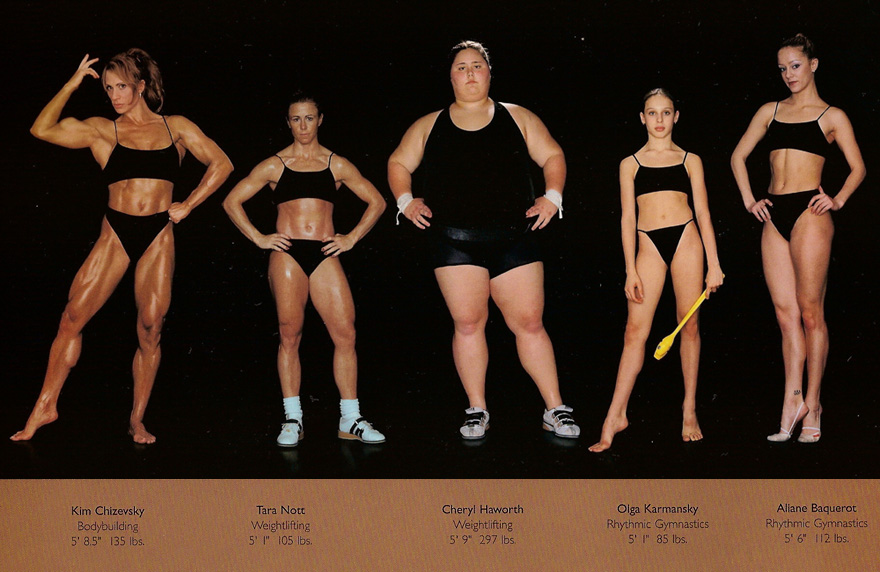
There is no perfect body for an athlete, and anyone can be fit

It can be a problem: people who are fat or whose bodies don’t fit a stereotype of an athlete don’t think they can be fit without changing their body. So they give up or focus on losing weight rather than trying to get fit. That’s too bad. Fitness leads to a better life, regardless of your age or sex or body size.

What I love about this piece is that it clearly shows there is no perfect body shape for an athlete and you can be fit and athletic regardless: The Body Shapes Of The World’s Best Athletes Compared Side By Side | Bored Panda

For more on this, I recommend you read this: In Obesity Research, Fatphobia Is Always the X Factor – Scientific American.

(Image from the Bored Panda site. I recommend you go through it. It is amazing to see just how different are the bodies of athletes in different sports.)

On How to Do What you Love


This piece, How to Do What You Love by Paul Graham, should be something we all read from time to time. It’s especially good to read if you aren’t happy with your job and you are about to make a career change. It will give you the necessary perspective you need to make the right and difficult choice. For example, it is tempting at times to take on a new role because of the prestige that comes with it. Graham outlines the dangers of that. He’s also realistic about the fact that work is still work, and there are times when you won’t love it. But if you are rarely loving what you are doing, I highly recommend you read Graham.

(Photo by Johnson Wang on Unsplash )

It’s Monday. You need a positive and uplifting goal to achieve this week. Here’s one

Do you want a weekly challenge that is easy to do but also satisfying? Then you want to read this and then start giving out one compliment a day: I Challenged Myself to Give One Compliment a Day – PureWow

You may think: that’s easy, why do I need to read an article on it. Well there are good and not so good ways to go about it. After you read it, you’ll see what I mean.

Good luck with that this week. I hope you feel much better about yourself after the week is done.

(Photo by Trung Thanh on Unsplash )


When you don’t know what to create, record what you know

When you don’t know what to create, record what you know. I was reminded of that rule when admiring the paintings of Rachel Campbell, here:  Colorful Oil Paintings Depict Give a Glimpse into the Life of the Artist.

If you are trying to write or draw or paint, you may be stuck with two problems: being able to make things look “nice” and not knowing what to make. Recording what you know solves those two problems. You know what you are going to make: a recording of what is in front of you. And even if you don’t make a good recording (i.e. it isn’t “nice”), I can assure you years from now you will look at it and say “oh that! I forgot all about that, but I am glad I have a recording of it now!”

Here’s another tip: ask yourself what is something you know that you Love or think is Beautiful. Whether it’s a place or a person or a thing or even a time of day, record that. When you see it, you won’t think the lines aren’t great or the colour is wonky: you will see the Thing you Love or think is Beautiful. Others will think it too.

Here’s a final tip: record something of your era. Include something fashionable, or technology, or anything that is not long lasting. Years from now it will be fascinating to your or others. “Look at that old phone”,  they’ll say. Or “look how cheap everything is”, or “look at that dress”.  You get the idea.

Sure you can take a photo, and it may be a good photo. But put some creative thought and effort into it. Your art will get better, and the work you produce will be better.

(Image is a link to the article in My Modern Met.)

It’s Friday. You need a to-don’t list

Ok, that’s a cute name, but what do I mean by “to don’t” list? Chances are, you have a long list of todos. Worse, you don’t even have a list: you just have a foggy anxious stew in your head of many things you feel you need to do.

Here’s what to do. Write out everything. You can use paper, you can use post-it notes. You can use workflowy like I do. But get down those todos. If you already have a long list, then great. I mean…”great”. 🙂

Once you have your list, go through the four questions here: Multiply your time by asking 4 questions about the stuff on your to-do list

Take all those items you are going to eliminate and put them in one list. The items you are going to automate in another, the items you plan to delegate in a third, and the items you can put off in a fourth. Then remove them from your list. Tada!  You’ve decluttered your todo list and separated it into a To-do List and a To-don’t List.

If you find this difficult — and decluttering is difficult — ask a friend to come in and help you. They can be much more objective about things that you can. Don’t dither: if you can’t decide, put an item into the Put Off list.

As for automation, don’t just think of the one time you do something, think of the many times a year you have to do something. It adds up. A little bit of time automating might add up to hours of effort in the next year or two.

The point of a todo list is not to accumulate a list: it’s to get things done. Get the unnecessary things off of it so you can focus on the necessary ones.

(Photo by Kelly Sikkema on Unsplash )

It’s Monday. Your web site needs a tune up. You need this checklist


Most organizations and many people have web sites. Some of us have several. No matter how many you own, I highly recommend you study this checklist and review your own with it: Website Content Checklist: 200+ Checkpoints to Make Your Prospects Love You.

I would be willing to bet there’s at least one idea in here that you can adopt to make your web site better. In fact, I bet there are several.

If you have no web site, go through this before you start building your own. It’s a great resource if you are a small business  needing to design your web site. In today’s world, we are all small businesses.

(Photo by Andrew Neel on Unsplash)

There are four ways to fail. Here’s how to fix three of them.


In this good piece by James Clear, he talks about three ways we fail and how we can fix it.  The three types of failure are:

.. a Failure of Tactics. These are HOW mistakes. They occur when you fail to build robust systems, forget to measure carefully, and get lazy with the details. A Failure of Tactics is a failure to execute on a good plan and a clear vision.
… Failure of Strategy. These are WHAT mistakes. They occur when you follow a strategy that fails to deliver the results you want. You can know why you do the things you do and you can know how to do the work, but still choose the wrong what to make it happen.
…Failure of Vision. These are WHY mistakes. They occur when you don’t set a clear direction for yourself, follow a vision that doesn’t fulfill you, or otherwise fail to understand why you do the things you do.

Really good piece. I recommend it as something you schedule yourself to read at least once a year to help you do better both at work and elsewhere.

In the piece he doesn’t focus on failure of opportunity, but it is huge. For people living in the right place and born into the right segment of society, success is much easier because opportunities abound.  Sometimes you can change that (e.g. emigrate) and sometimes you cannot.

Despite that, read the piece and reflect on how you can address the things that cause you to fail.


On Anger

It is natural to feel angry at times. As the Mayo Clinic explains, anger is a natural response to perceived threats. What you do with your anger is what is important.

For some, stopping your anger is what is important. Some but not all. This piece argues that anger can be a public good. On the other hand, this article compares it to a form of madness that needs to be curbed. Certainly if you have kids, especially kids with severe difficulties of their own, knowing how to regain your sense of calm (as this pieces shows) is important.

My personal view is that anger is like a fire, and while fire has its uses, it is generally someone you want to contain if you don’t want to cause major damage to yourself and others. It is worthwhile to examine what you perceive to be a threat and try and break it down and determine if it really is a threat. Often the things we fear are not as threatening as we imagine. Plus sometimes we feel that way because we are tired or feeling isolated.

The last piece I want to recommend on anger is this piece in Zenhabits.

(Photo by Yaoqi LAI on Unsplash)

It’s Monday. You have some emails you want to send but don’t know what to say. This can help


Have you’ve been putting off sending an email to someone because you don’t know what to say? Well with canned emails, you have a good start. Simply go to this site: Canned Emails – a minimal site with prewritten emails. and search for what you want to say. Want to catch up with someone? There’s an email for that. Does someone owe you money? There’s another one for that. Want to cancel a service? That site has you covered.

Some people have a knack of knowing what to write in any situation. For the rest of us, canned emails can help us get over the hump and get that communication going.

Give it a try.

(Photo by Melinda Gimpel on Unsplash )

On Bernie Michalik’s Rule of Performance Testing

Two things. First my rule of performance testing is that you cannot avoid performance testing: you either do it with test data and test users in a test environment or you do it with live data with real users in a production environment.

So often I see clients try to slim down or avoid performance testing. I came up with my rule to show them that it is impossible. Now sometimes you can get away with it but it’s risky. I never advise it. You can always do some form of performance testing before you go live. Always. Still some try not to.

Second, above is an example of a site that clearly was performance tested. Even better, it is designed to respond to peak loads. Impressive.

The feeling wheel: a great tool to help you assess how you feel

If you are in therapy or using some sort of mood log to assess how you feel, I highly recommend this tool: the emotional word wheel. It’s more than a fancy thesaurus. As the creator explains:

I work with people who have limited emotional vocabulary and as a result the intensity of their negative emotions and experiences is heightened because they can’t describe their feelings (especially their negative feelings). That’s why this list is heavily focused on negative emotions/ experiences. Being able to clearly identify how we are feeling has been shown to reduce this intensity of experience because it re-engages our rational mind.

I think it’s great, especially for men of a certain generation who have difficulty assessing how they feel and therefore have difficulty in dealing with it.

Speaking of mood logs, if you are interested in why you want to keep one, see this. Mood logs don’t have to be fancy: you can write your daily moods on post it notes for all it matters. And you don’t have to only write down bad moods: if you note the good moods, you can better understand what makes you feel good and look for ways to replicate that. That’s the goal for people like me.

You can find more on the emotional word wheel all over the Internet. The version I am referencing is here.

It’s Monday. Here’s a guide for teens to cope with anxiety that you too should read

Sign with the word Emotions on it.
Wait a second, you say. I am not a teen with anxiety, and I don’t know any. Fine, read this anyway: How to cope with teen anxiety | Psyche Guides

We all have a mix of bad feelings at all stages of our lives. You are likely reading this on a Monday: don’t tell me you don’t have some bad feelings right now. 🙂 The good news is that techniques used in CBT can help you deal with those feelings, whether you are somewhat anxious or depressed.

Not only that, but I think CBT can help people with feelings like being bored, disappointed or frustrated. Feelings you may feel weighing on you that don’t make you feel good. You can use it to shake yourself our of your current mindset which may not be helpful to you and move you into a better mindset.

Take those emotions that don’t make you feel your good self and move towards some better ones. Hey, it’s Monday: a good day to take a crack at it.

All the best.

(Photo by Alexas_Fotos on Unsplash)

New office chair and phone ideas (or, be good to your back and head :))

chair

Two things that can make our lives easier as we work from home are a good chair and a good phone. If you are in the market for a new office chair, see this:

Best office chairs of 2021 for your home office or student workstation – TechRepublic.

If you are in the market for a new phone, consider something out of the ordinary, like these minimal phones.

If your outputs aren’t great, look at your inputs


Are your outputs bad lately? Do you find your work is not up to the same grade they used to come up to? Are you finding yourself struggling to maintain good relationships with others? Maybe you find you aren’t taking care of yourself the way you used to? If your outputs are not great lately, I recommend you look at your inputs.

Simply put, if you have bad inputs, you will have bad outputs. Anyone who runs a well run machine will tell you that. It’s also true for you.

First of all, you are living in a pandemic in the middle of winter as I write that. Some of us are in a lockdown.  Just that alone is one big bad input into every day. Part of your pandemic life may be that you don’t get to see and meet people who at one time would give you a lot of positive input. A deficit of good inputs can be as  bad as a surfeit of bad inputs.  If you find you aren’t sleeping properly, or eating properly, or doing other things to take care of yourself, then those too are bad inputs.

Some of us can do well with even meagre inputs. But few can thrive that way. If you want to do better, you need to improve your good inputs and reduce your bad inputs. To do that,  I want to point you to this piece I wrote about it some time ago: Motivational Jiu-Jitsu: Staying Positive in the Face of Negativity & Indifference – Adobe 99U

There’s some inputs you can’t change. But you can tune some of them out, just like you can amplify some of your good inputs. If you do, I can assure you that you’ll get better outputs.

P.S. For more on the importantance of inputs on outputs, see: Austin Kleon – Posts tagged \’input and output\’

(Photo by Pete Nuij on Unsplash)

Two pieces to help with (getting back into) mindfulness

mindfulness sign
For some time, I was doing well practicing mindfulness. I found it helpful. I don’t know why I stopped. But then I have stopped doing so many things during the pandemic, and mindfulness was one of those.

If that sounds like you too, here’s two good pieces that could help:

  1. How to Practice Mindfulness | A Cup of Jo
  2. How to Meditate: It’s Not Complicated, but It’s Not Easy | GQ

They’re also good if you haven’t done mindfulness before and want to start.

(Photo by Lesly Juarez on Unsplash)